 1. Framework Conditions
 The emergence of the Order of St. John in the 11th century was not an isolated event, but the result of profound historical developments. Since the rediscovery of the Holy Sepulchre by Helena6 , the mother of Emperor Constantine, and the subsequent construction of the Church of the Holy Sepulchre7 Jerusalem exerted an unbroken attraction on the Christian West.
With the Constantinian shift, Christianity transformed from a persecuted minority to the official religion of the Roman Empire.
Helena's archaeological endeavours in the Holy Land aimed to make the sites of Jesus Christ's ministry, suffering, and resurrection physically tangible. The construction of the Church of the Holy Sepulchre enabled generations of believers not only to visit these places but also to celebrate the memory of salvation there in the liturgy and the Eucharist.
   8 |
These thousands of crosses9 carved into the stone walls of the stairway leading to the Chapel of St. Helena in the Church of the Holy Sepulchre in Jerusalem, are medieval testimonies of pilgrims. For a long time, they were considered mere "graffiti" left by the Crusaders themselves. However, more recent studies using 3D scanning technology point to a more organized origin:
The place is particularly |
|---|
Pilgrimage10and penitential practice
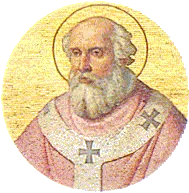 Pilgrimage gained new momentum under Pope Leo IX (1049–1054), who in 1053 granted pilgrims to the Holy Sepulchre the so-called "Indulgence of the Cross." In the Church's discipline at that time, sacramental penance was often associated with years of arduous practice. The pilgrimage to Jerusalem was considered such an extraordinary act of penance, which could lead to the reduction or remission of temporal punishment for sins. For serious offenses, the pilgrimage was often imposed as a direct act of atonement.
Image11
Given the enormous hardships and dangers of a journey lasting weeks on horseback or on foot through unfamiliar territory, most pilgrims reached Jerusalem in a state of physical exhaustion or illness. This created an urgent need for lodging and care facilities modelled on the ancient xenodochia. In the immediate vicinity of the Church of the Holy Sepulchre stood the Benedictine monastery of St. Maria Latina, which—in accordance with the Rule of St. Benedict—maintained a guesthouse. Due to the pilgrims' precarious situation, this hospice increasingly developed into a hospital. The management of this institution was entrusted to a man named Gerhard . It is historically plausible to consider him a monk of the abbey who had been entrusted by his abbot with the care of the guests.
Given the founding of Cava de' Tirreni Abbey 12in 1011 and its proximity to Scala, it is reasonable to assume that Blessed Gérard entered the Benedictine Order there. This would explain how he arrived in Jerusalem after 1032 during the Amalfi Expedition, when the Abbey of Santa Maria Latina was repopulated.
Founding of the Abbey: Cava de' Tirreni Abbey was founded in 1011 by Alferius (a nobleman from Salerno) and received its official charter from the Princes of Salerno in 1025. By 131032, it was already a flourishing Benedictine centre in close proximity to the Duchy of Amalfi.
Amalfi influence: It is historically documented that merchants from Amalfi (including the Mauro family) financed the Monastery of Santa Maria Latina in Jerusalem. Since Cava de' Tirreni was the most important Benedictine monastery in the Amalfi/Salerno region, it is likely that the Jerusalem branch was staffed by monks from Cava.
Gerhard's origins: Although his exact origin (Scala or Martigues) is debated, the close trade and religious ties between Amalfi and Jerusalem support the Italian theory . Entering Cava de' Tirreni as a novice would have been the logical career step for a young man from Scala.
0B Excursus: Scala & Amalfi14There are two conflicting accounts of Blessed Gérard's origins. One suggests he came from the island of Martigues near Marseille in southern France and gives him the surname "Tenque" or "Tonque." The other theory names Scala, along with Amalfi, as his place of residence and gives him the surname "del Sasso." I wanted to investigate this further and visited Scala with an Italian friend in 1997. The current inhabitants of the small village of Scala knew little at the time about their most famous son.
However, they named a local church youth group after him: Circolo "Gerardo Sasso". It took a long time, after following three contradictory instructions, before we arrived at the place where Blessed Gerhard is said to have grown up.
Very little remains of what could have withstood the destructive forces of history for more than 900 years.
Historical image of the “Villa Saxo”15
Where does that come from? 16 Picture17
From emblem to insignia: Picture18
The symbolism seems somewhat far-fetched to me: the eight-pointed shape of the Amalfi Cross is said to visually resemble a compass rose . In Amalfi's maritime tradition, the eight points of the cross were often associated with the eight cardinal directions, which were crucial for compass navigation in the Mediterranean. Picture19 |
|---|

 The house, named “Villa Saxo”, was presumably the ancestral home of the “del Sasso” family.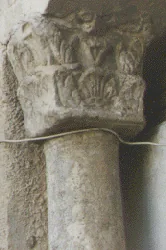
 In fact, the family who lived in the "Villa Saxo" pointed out to us that the columns in the basement of the building were the only remnant of its former splendour.
 In the village's St. Peter's Church there is a stone sculpture donated in 1358 by Paolo de Saxo, which probably depicts Blessed Gérard in the style of Saint Michael.
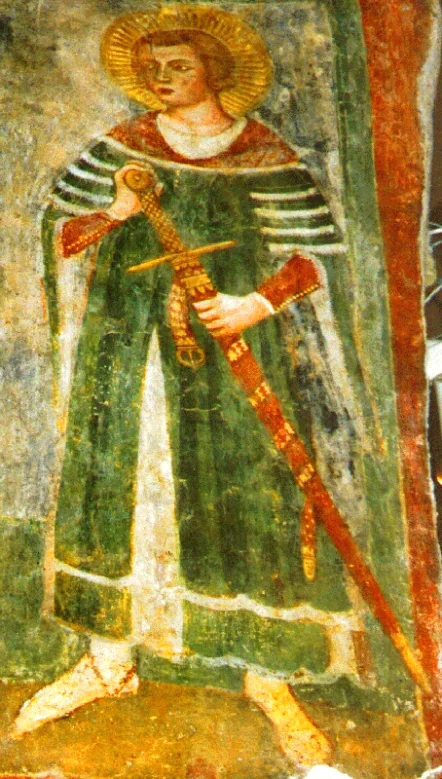 Another clue is the fact that a fresco was found in the former cathedral of Amalfi (Basilica del Crocifisso), now a museum (Museo del Duomo) , which is also believed to depict Blessed Gérard as a young knight. We know for certain that during Blessed Gérard's lifetime, the order was exclusively a hospitaller order without military duties. However, the fresco shows Blessed Gérard with a sword. This attribute may have been bestowed upon him posthumously, since his order later evolved into a chivalric order.
 Regarding the history of the Amalfi or Maltese cross, it is interesting to know that it is part of the coat of arms of Amalfi.
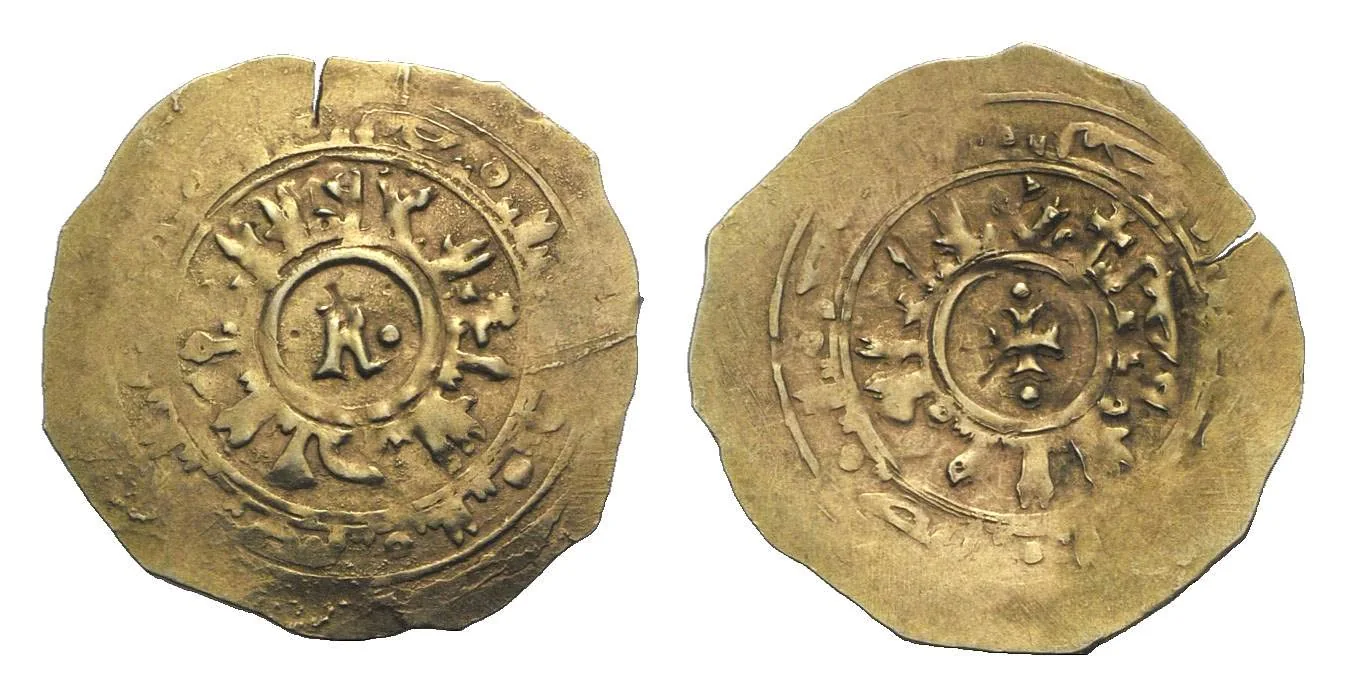 Transfer to Amalfi:
 The Influence
of the Crusades20
Although the Order of St. John has its roots in this Benedictine hospitality, its further development was significantly transformed by the Crusades. However, the Crusades were not the reason for its founding, but rather the catalyst for the structural evolution of the Order.
The political situation in the Holy Land had steadily deteriorated since the Saracen conquest of Jerusalem (637/638). While oppression and fiscal burdens increased under the Fatimids from 969 onwards, the Seljuk advance from 1071 onwards led to massive destruction of Christian infrastructure in Jerusalem 21.
 Image22
In response to these circumstances, Pope Urban II convened the Council of Clermont on November 27, 1095, where he called for a crusade23 to reclaim the holy sites from non-Christian rule. Fulcher of Chartres, who attended the council, provides the following account of Pope Urban’s address24:
Most beloved brethren: Urged by necessity, I, Urban, by the permission of God chief bishop and prelate over the whole world, have come into these parts as an ambassador with a divine admonition to you, the servants of God. I hoped to find you as faithful and as zealous in the service of God as I had supposed you to be. But if there is in you any deformity or crookedness contrary to God's law, with divine help I will do my best to remove it. For God has put you as stewards over his family to minister to it. Happy indeed will you be if he finds you faithful in your stewardship. You are called shepherds; see that you do not act as hirelings. But be true shepherds, with your crooks always in your hands. Do not go to sleep, but guard on all sides the flock committed to you. For if through your carelessness or negligence a wolf carries away one of your sheep, you will surely lose the reward laid up for you with God. And after you have been bitterly scourged with remorse for your faults-, you will be fiercely overwhelmed in hell, the abode of death. For according to the gospel you are the salt of the earth [Matt. 5:13]. But if you fall short in your duty, how, it may be asked, can it be salted? O how great the need of salting! It is indeed necessary for you to correct with the salt of wisdom this foolish people which is so devoted to the pleasures of this -world, lest the Lord, when He may wish to speak to them, find them putrefied by their sins unsalted and stinking. For if He, shall find worms, that is, sins, In them, because you have been negligent in your duty, He will command them as worthless to be thrown into the abyss of unclean things. And because you cannot restore to Him His great loss, He will surely condemn you and drive you from His loving presence. But the man who applies this salt should be prudent, provident, modest, learned, peaceable, watchful, pious, just, equitable, and pure. For how can the ignorant teach others? How can the licentious make others modest>? And how can the impure make others pure? If anyone hates peace, how can he make others peaceable ? Or if anyone has soiled his hands with baseness, how can he cleanse the impurities of another? We read also that if the blind lead the blind, both will fall into the ditch [Matt. 15:14]. But first correct yourselves, in order that, free from blame , you may be able to correct those who are subject to you. If you wish to be the friends of God, gladly do the things which you know will please Him. You must especially let all matters that pertain to the church be controlled by the law of the church. And be careful that simony does not take root among you, lest both those who buy and those who sell [church offices] be beaten with the scourges of the Lord through narrow streets and driven into the place of destruction and confusion. Keep the church and the clergy in all its grades entirely free from the secular power. See that the tithes that belong to God are faithfully paid from all the produce of the land; let them not be sold or withheld. If anyone seizes a bishop let him be treated as an outlaw. If anyone seizes or robs monks, or clergymen, or nuns, or their servants, or pilgrims, or merchants, let him be anathema [that is, cursed]. Let robbers and incendiaries and all their accomplices be expelled from the church and anthematized. If a man who does not give a part of his goods as alms is punished with the damnation of hell, how should he be punished who robs another of his goods? For thus it happened to the rich man in the gospel [Luke 16:19]; he was not punished because he had stolen the goods of another, but because he had not used well the things which were his. "You have seen for a long time the great disorder in the world caused by these crimes. It is so bad in some of your provinces, I am told, and you are so weak in the administration of justice, that one can hardly go along the road by day or night without being attacked by robbers; and whether at home or abroad one is in danger of being despoiled either by force or fraud. Therefore it is necessary to reenact the truce, as it is commonly called, which was proclaimed a long time ago by our holy fathers. I exhort and demand that you, each, try hard to have the truce kept in your diocese. And if anyone shall be led by his cupidity or arrogance to break this truce, by the authority of God and with the sanction of this council he shall be anathematized." After these and various other matters had been attended to, all who were present, clergy and people, gave thanks to God and agreed to the pope's proposition. They all faithfully promised to keep the decrees. Then the pope said that in another part of the world Christianity was suffering from a state of affairs that was worse than the one just mentioned. He continued: "Although, O sons of God, you have promised more firmly than ever to keep the peace among yourselves and to preserve the rights of the church, there remains still an important work for you to do. Freshly quickened by the divine correction, you must apply the strength of your righteousness to another matter which concerns you as well as God. For your brethren who live in the east are in urgent need of your help, and you must hasten to give them the aid which has often been promised them. For, as the most of you have heard, the Turks and Arabs have attacked them and have conquered the territory of Romania [the Greek empire] as far west as the shore of the Mediterranean and the Hellespont, which is called the Arm of St. George. They have occupied more and more of the lands of those Christians and have overcome them in seven battles. They have killed and captured many and have destroyed the churches and devastated the empire. If you permit them to continue thus for a while with impurity, the faithful of God will be much more widely attacked by them. Image26
"All who die by the way, whether by land or by sea, or in battle against the pagans, shall have immediate remission of sins. This I grant them through the power of God with which I am invested. O what a disgrace if such a despised and base race, which worships demons, should conquer a people which has the faith of omnipotent God and is made glorious with the name of Christ! With what reproaches will the Lord overwhelm us if you do not aid those who, with us, profess the Christian religion! Let those who have been accustomed unjustly to wage private warfare against the faithful now go against the infidels and end with victory this war which should have been begun long ago. Let those who for a long time, have been robbers, now become knights. Let those who have been fighting against their brothers and relatives now fight in a proper way against the barbarians. Let those who have been serving as mercenaries for small pay now obtain the eternal reward. Let those who have been wearing themselves out in both body and soul now work for a double honour. Behold! on this side will be the sorrowful and poor, on that, the rich; on this side, the enemies of the Lord, on that, his friends. Let those who go not put off the journey but rent their lands and collect money for their expenses; and as soon as winter is over and spring comes, let them eagerly set out on the way with God as their guide."27 |
|---|
 Image
Image On this account I, or rather the Lord, beseech you as Christ's heralds to publish this everywhere and to persuade all people of whatever rank, foot-soldiers and knights, poor and rich, to carry aid promptly to those Christians and to destroy that vile race from the lands of our friends. I say this to those who are present, it meant also for those who are absent. Moreover, Christ commands it.
Later, Bernard of Clairvaux became a key advocate for the concept of the Crusades. In Chapter 3 of his work, “In Praise of the New Knighthood
(Liber ad milites Templi: De laude novae militae),” he writes:
ON THE NEW KNIGHTHOOD
The knight of Christ, I say, may strike with confidence and die yet more confidently, for he serves Christ when he strikes, and serves himself when he falls. Neither does he bear the sword in vain, for he is God's minister, for the punishment of evildoers and for the praise of the good. If he kills an evildoer, he is not a mankiller, but, if I may so put it, a killer of evil. He is evidently the avenger of Christ towards evildoers, and he is rightly considered a defender of Christians. Should he be killed himself, we know that he has not perished but has come safely into port. When he inflicts death it is to Christ's profit, and when he suffers death, it is for his own gain. The Christian glories in the death of the pagan, because Christ is glorified, while the death of the Christian gives occasion for the King to show his liberality in the rewarding of his knight. In the one case the just shall rejoice when he sees justice done, and in the other man shall say, truly there is a reward for the just; truly it is God who judges the earth. I do not mean to say that the pagans are to be slaughtered when there is any other way to prevent them from harassing and persecuting the faithful, but only that it now seems better to destroy them than that the rod of sinners be lifted over the lot of the just, and the righteous perhaps put forth their hands unto iniquity. 5. What then? If it is never permissible for a Christian to strike with the sword, why did the Savior's precursor bid the soldiers to be content with their pay, and not rather forbid them to follow this calling? But if it is permitted to all those so destined by God, as is indeed the case provided they have not embraced a higher calling, to whom, I ask, may it be allowed more rightly than to those whose hands and hearts hold for us Sion, the city of our strength? Thus when the transgressors of divine law have been expelled, the righteous nation that keeps the truth may enter in security. Certainly it is proper that the nations who love war should be scattered, that those who trouble us should be cut off, and that all the workers of iniquity should be dispersed from the city of the Lord. They busy themselves to carry away the incalculable riches placed in Jerusalem by the Christian peoples, to profane the holy things and to possess the sanctuary of God as their heritage. Let both swords of the faithful fall upon the necks of the foe, in order to destroy every high thing exalting itself against the knowledge of God, which is the Christian faith, lest the Gentiles should then say, "Where is their God?" 6. Once they have been cast out, he shall return to his heritage and to his house, which aroused his anger in the Gospel, "Behold," he said, "your house is left to you desolate." He had complained through the Prophet: "I have left my house, I have forsaken my heritage," and he will fulfil that other prophecy: "The Lord has ransomed his people and delivered them. They shall come and exult on Mount Sion and rejoice in the good things of the Lord." Rejoice Jerusalem and recognize now the time in which you are visited! Be glad and give praise together, wastes of Jerusalem, for the Lord has comforted his people. He has ransomed Jerusalem. The Lord has bared his holy arm in the sight of all peoples. O virgin of Israel, you were fallen and there was none to raise you up. Arise now and shake off the dust, O virgin, captive daughter of Sion. Arise, I say, and stand on high. See the happiness which comes to you from your God. You will no longer be referred to as the forsaken one, nor your land any more termed a wilderness; for the Lord takes his delight in you, and your land shall be peopled. Raise your eyes, look about you and see; all these are gathered together and come to you. Here is the help sent to you from the Holy One! Through them is already fulfilled the ancient promise, "I will make you the pride of the ages, a joy from generation to generation. You will suck the milk of the nations and be nourished at the breasts of their sovereignty." And again, "As a mother consoles her children, so will I console you, and in Jerusalem you will be comforted." Do you not see how frequently these ancient witnesses foreshadowed the new knighthood? Truly, as we have heard, so we have now seen in the city of the Lord of armies. Of course we must not let these literal fulfilments blind us to the spiritual meaning of the texts, for we must live in eternal hope in spite of such temporal realizations of prophetic utterances. Otherwise the tangible would supplant the intangible, material poverty would threaten spiritual wealth, and present possessions would forestall future fulfilment. Furthermore, the temporal glory of the earthly city does not eclipse the glory of its heavenly counterpart, but rather prepares for it, at least so long as we remember that the one is the figure of the other, and that it is the heavenly one which is our mother.29 |
|---|

The spiritual justification: The idea of a just war
Although modern legal and moral understanding fundamentally evaluates armed conflicts differently today, in the High Middle Ages the prevailing conviction was that a “holy war” against those who threatened the holy sites or suppressed the Christian faith was morally justified.
 This view was rooted in ancient and early medieval theology. Even the holy Augustine of Hippo developed the concept of 30bellum iustum (just war) in his debate with the Donatists .
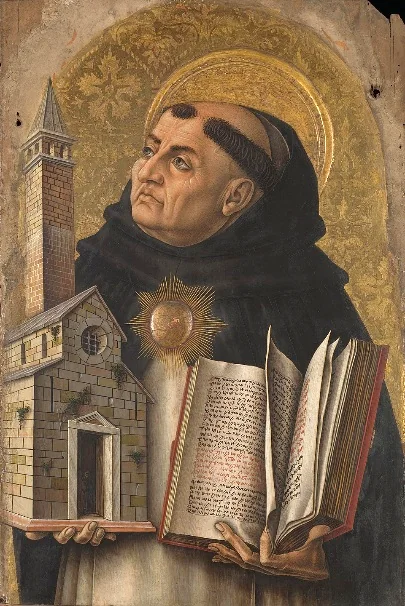
Saint Thomas Aquinas31
He later systematized this doctrine and
defined the strict criteria for ethical justification:
iusta causa (just cause),
recta intentio (right intention),
legitima potestas or auctoritas principis
(legitimate state or church authority),debitus modus (appropriate manner of warfare)
and the principle of weighing goods and services.
Western knighthood viewed the liberation of the Holy Sepulchre and the restoration of God's honour as a sacred duty. Eleventh-century chivalry offered ideal conditions for this:
The philosophy of chivalry 32 fused service to the Church with personal loyalty to one's liege lord and the protection of the weak (embodied in the ideal of women's honour). Within this self-understanding, armed service in the Holy Land was interpreted as an act of faith and a form of following Christ in service to the Church.