1. Sources : The Order's Rule and Statutes

Citation of the order's rule in Verdala, Hugues Loubenx de (ed.):
Statuta Hospitalis Hierusalem. Rome: [Tipografia Apostolica Vaticana] 1588.
The spiritual element in the early days of the Order will be described here based on the Order's Rule and the statutes that were added to it at the time () 278when the Order's centre was in Jerusalem. Unfortunately, the originals of these sources were lost (279).
The oldest surviving versions of the rule are
a handwritten copy (referred to in the archive as "Die Johanniterregel in lateinischer Sprache") dated October 7, 1253 2 280and
A codex from the late 13th century (1278-1283)281, which, among other things, contains not only the Rule of Raymond but also the statutes of Jobert and Roger de Moulins in medieval French. This is Codex membr. in the Vatican Library No. 4852, which is listed in the Index of Codices Vat. lat. of the Library as “Regulae Hospitalis S. Joannis Hierosolymitani in Lingua Gallica”282.
He begins with the French translation of the bull “Quanto per gratiam Dei” by Pope Lucius III of August 22, 1185 (folios 1 to 3R, 15R to 18R),
which quotes the Rule of the Order by Raymond du Puy (folios 3V to 15R). These folios have handwritten additions
noting the passages of the Rule modified by the General Chapter of Margat 1204-1206 under Grandmaster Alphonsus of Portugal .The following are the two statutes of Jobert.
Bread Ordinance “White Bread Privilege of the Sick”
of 1176 (pages 18V to 20R),Church ordinance “The Church Customs”
before 1177 (pages 20R to 24R),
the statutes of Roger de Moulins
Hospital regulations “That the churches should be subject to the prior” dated 14.2.1181 (pages 24R to 29R),
Hospital regulations “Concerning the duties of the house” before March 1181? (pages 29R to 32V)283
The customary law established by the General Chapter of Margat 1204-1206 under Alfonso of Portugal (folios 32V to 49V),
the four statutes of Hugo de Revel 1162-1178
(folios 50R to 79V),the statutes of Nicholas Lorgne (pages 79V to 82V),
the Statute of Jean de Villiers 28.10.1287 (folios 83R to 88V)284,
Legal provisions Roger de Moulins ? 1177(81?)-1183
(pages 89R to 104R)285,Parts of the “Usances” (=customary law) 1198- end of the 12th century (folio 105R to 111V),
“Esgars” (=penal laws) end of the 12th century (folio 111V to 140V).
Historical scholarship used286and uses287this codex as the most important source for its research.
The older versions of the rule in German (late Middle High German) are
a manuscript in the Cologne City Archives (HAStH, Geistl. Abt. 129 a) from around 1380 and
another manuscript from the 14th century in the Bavarian State Library (Clm 4620 – see Part III of this work).
The text of the Rule from the Aargau State Archives and the one from the Vatican Library is edited in Delaville's Cartulaire (No. 70), the Middle High German manuscript from the Bavarian State Library in my book "Die Ordensregel der Johanniter/Malteser”. St. Ottilien 1983".
Waldstein-Wartenberg () 288concludes that Raymond adopted the Rule of St. Augustine and supplemented and explained it with a statute that reflected the decisions of the general chapters. Although this seems plausible, since the Rule of the Order of St. John appears incomplete compared to the content and structure of the Rules of St. Augustine and St. Benedict, it is uncertain, and there is no documentary evidence to support this hypothesis. As I will explain later, the Rule of the Order of St. John contains numerous quotations from the Rule of St. Augustine, which would not have been necessary if it had merely been a statement on how to implement the Rule of St. Augustine. At the beginning of the 13th century, according to Waldstein-Wartenberg, the dependence on the Rule of St. Augustine had been forgotten, and this statute was therefore considered the order's rule.
The bull “Quanto per gratiam Dei”289
by Pope Lucius III. from August 22, 1185

The bull refers to Raymonds statutes already as a “rule”.
Pope Lucius III reaffirmed the rule of the Order of St. John and contrasted it with the Augustinian rule:
“Through God and Christ we also have the firm confidence that you too, just as the Rule of Saint Augustine brought salvation to the Canons Regular, will attain the prize of eternal beatitude if you observe your Rule.”290
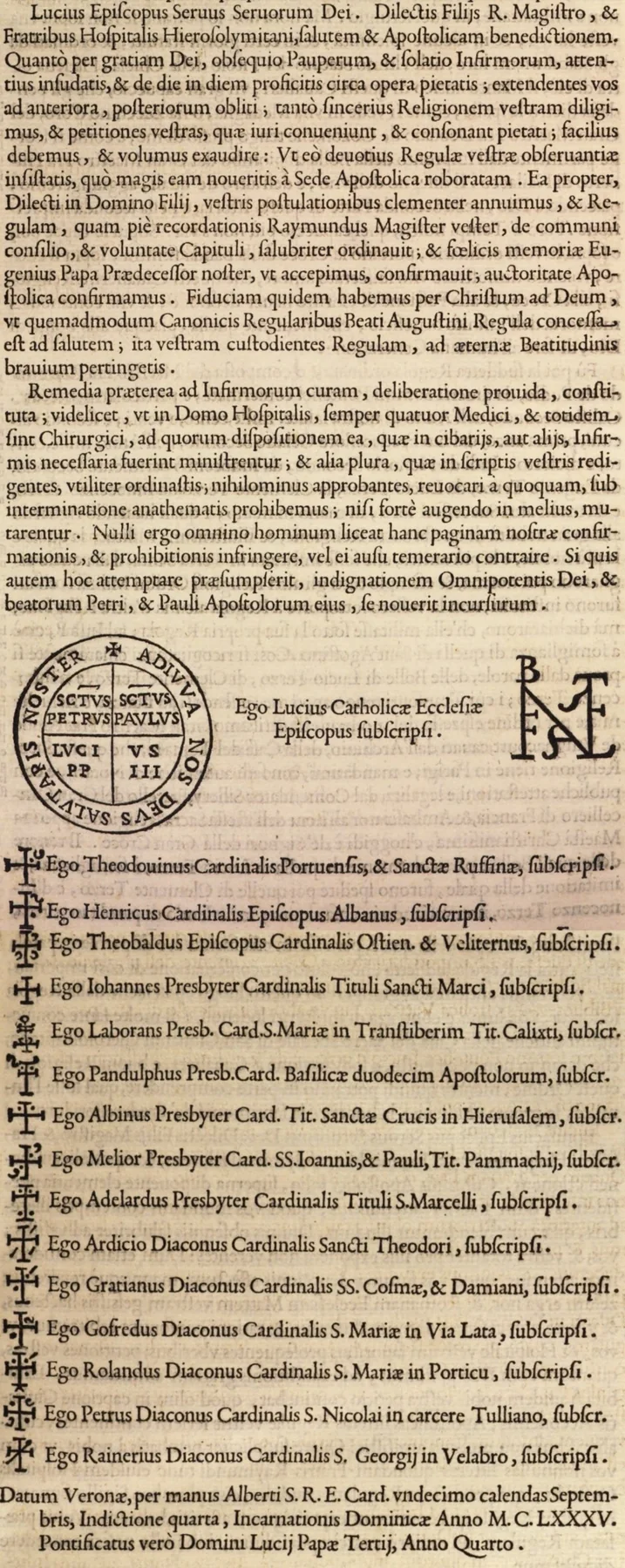 Lucius, Bishop, Servant of the Servants of God. To our beloved sons R. [Roger de Moulins], Master, and the Brothers of the Hospital of Jerusalem, greetings and Apostolic blessing.
Inasmuch as through the grace of God, you devote yourselves most attentively to the service of the poor and the comfort of the sick, and from day to day you make progress in works of piety; stretching yourselves toward those things which are before, forgetting those which are behind; so much more sincerely do we love your Religion [Order], and we ought and wish to more easily grant your petitions, which are consistent with the law and consonant with piety: so that you may insist upon the observance of your Rule the more devotedly, the more you know it to have been strengthened by the Apostolic See. Therefore, beloved sons in the Lord, we graciously assent to your requests, and by Apostolic authority, we confirm the Rule which your Master Raymond [du Puy], of pious memory, wholesomely ordained with the common counsel and will of the Chapter; and which our predecessor of happy memory, Pope Eugenius [III], as we have received, confirmed. We indeed have confidence through Christ toward God, that just as the Rule of the Blessed Augustine was granted to the Canons Regular for salvation; so you, keeping your Rule, will reach the prize of eternal Beatitude. Furthermore, we approve the remedies established with provident deliberation for the care of the sick; namely, that in the House of the Hospital, there shall always be four physicians and as many surgeons, to whose disposal those things which are necessary for the sick—whether in food or other things—shall be administered; and many other things which you have profitably ordained, reducing them to your writings. We forbid anyone to revoke these things under threat of anathema, unless perhaps they should be changed by improving them for the better. Let it be permitted to no man at all to infringe upon this page of our confirmation and prohibition, or to go against it with rash daring. If anyone, however, should presume to attempt this, let him know that he will incur the indignation of Almighty God and of His blessed Apostles Peter and Paul.
I, Lucius, Bishop of the Catholic Church, have signed.
I, Theodovinus, Cardinal Bishop of Porto and Santa Rufina, have signed.
I, Henricus, Cardinal Bishop of Albano, have signed.
I, Theobaldus, Cardinal Bishop of Ostia and Velletri, have signed.
I, Johannes, Cardinal Priest of the Title of San Marco, have signed.
I, Laborans, Cardinal Priest of Santa Maria in Trastevere, Title of Calixtus, have signed.
I, Pandulphus, Cardinal Priest of the Basilica of the Twelve Apostles, have signed.
I, Albinus, Cardinal Priest of the Title of Santa Croce in Gerusalemme, have signed.
I, Melior, Cardinal Priest of Santi Giovanni e Paolo, Title of Pammachius, have signed.
I, Adelardus, Cardinal Priest of the Title of San Marcello, have signed.
I, Ardicio, Cardinal Deacon of San Teodoro, have signed.
Given at Verona, by the hand of Albertus, Cardinal of the Holy Roman Church, on the eleventh day before the Kalends of September [August 22nd], in the fourth Indiction, in the year of the Incarnation of the Lord 1185, and in the fourth year of the Pontificate of the Lord Pope Lucius III.
There is also disagreement about the dating of the rule. The bull “Quanto per gratiam Dei”291 of Pope Lucius III, dated November 4, 1184 or 1185292, deals with the confirmation of the rule by Pope Eugene III. 293 However, Eugene died on July 8, 1153, which means that the rule must have been issued before 1153294. Waldstein-Wartenberg295 adds that the origin of the rule can be assumed to be significantly earlier, since such papal approval, a kind of legalisation of existing facts, was only common from the mid-12th century onward. On the other hand296, it is dated to the years 1155 to 1160, since the rule repeatedly297 deals with clerics and priests of the order, and Pope Anastasius IV only granted the order permission to admit priests on October 21, 1154, through the bull "Christianae fidei religio"298, and since Raymond died no later than 1160, its promulgation is placed after 1154 (between 1155 and 1160), because Raymond du Puy died no later than 1160. |
Pope
|
|---|


However, because the bull is to be seen more as a papal confirmation of what was probably previously common practice, and not as a conditio sine qua non, and because in both the older orders of the Augustinians and the Benedictines there had always been a natural coexistence of priests and lay brothers, for which no special papal permission was required, I agree with the dating of the order's rule to the period between 1125 and 1153 .
![[Order of Saint John of Jerusalem; Malta], Stabilimenta Militum Sacri Ordinis Divi Joannis Hierosolymitani: Una Cum Bulla Ipsis Concessa, a Summo Pontifice Claemente VII, 1534. Salamanca. J. De Junta.](../assets/media/f0d442a8a53b7c7272b9.webp) Raymond's rule was and remains to this day a major authority for the development of the Order.
Raymond's rule was and remains to this day a major authority for the development of the Order.
Later versions of the rule (e.g. the Stabilimenta Rhodiorum militum of 1489) were always preceded by the first chapter of Raymond's rule302, as it establishes the principles of his spirituality and his activities in Christian charity.
The title page by Villiers de l'Isle-Adam, Philippe de (ed.):
Stabilimenta militum sacri ordinis divi Joannis
Hierosolymitani.
Una cum bulla ipsis concessa a summo pontifice Clemente VII. Salamanca:
Juan de Junta 1534.303

[from: Villiers L'Isle Adam, Sacri ordinis et hospitalis sancti Joannis
hierosolymitani magnus magister, Fr. Philippus de:
Stabilimenta militum sacri ordinis divi Joannis hierosolymitani. una cum bulla ipsis concessa A summo pontifice Claemente VII. (Salamanca 1534)]
|
The oldest known manuscript |
|---|
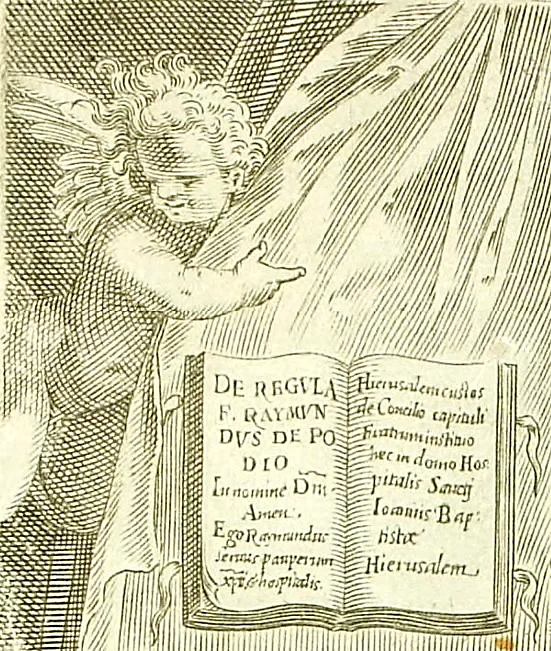

Delaville divides the text of the Rule into 19 chapters, according to the structure of Codex Vaticanus Lat. 4852. .306 The following follows the initial protocol, which shows the authorization of the rule by the entire (General) Chapter:
| Chapter | German version | French version |
|---|---|---|
| 1 | The Profession | How the brothers should take their vows |
| 2 | The brothers' claims | What the brothers are entitled to |
| 3 | The honour of the brothers, church service, and the care of the sick | On the conduct of the brothers and the service of the churches and the reception of the sick |
| 4 | The brothers' travels and their behaviour towards women |
How the brothers should behave abroad |
| 5 | Alms collecting | From whom and how alms should be asked |
| 6 | The use of alms | About the alms received and about the income from the houses |
| 7 | The preaching and fundraising tours |
Who should go abroad to preach, and in what way? |
| 8 | Clothing and fasting |
About the clothing and diet of the brothers |
| 9 | The punishment for the brothers' fornication |
Concerning the brothers who are guilty of fornication |
| 10 | The penalty for disputes and unauthorized leaving of the house | Regarding the brothers who are arguing and hitting each other |
| 11 | The silence | On the silence of the brothers |
| 12 | What to do if a brother behaves disorderly | Regarding the brothers' misconduct |
| 13 | The procedure to follow when discovering (unauthorized) possession by a brother | Regarding the brothers who were found with private property. |
| 14 | The funeral rites | Which funeral liturgy should be celebrated for the deceased brothers |
| 15 | A reminder to be zealous | How the regulations listed here must be strictly adhered to |
| 16 | The admission and care of the “sick gentlemen” |
How our sick gentlemen should be received and cared for |
| 17 | The brotherly rebuke |
How brothers may correct brothers |
| 18 | The accusation of another brother |
should accuse another brother |
| 19 | Wearing the cross on one's clothing |
That the brothers bear the sign of the cross on their chests |
Jobert's two statutes , "The Privilege of the Sick to Receive White Bread" (the so-called "Bread Ordinance") of 1176307and "The Customs of the Church of the Hospital of Jerusalem" (the so-called "Church Ordinance") from the period between 1177 and 1181308, can be described as the first implementing provisions of the Rule.
"The privilege of the sick to receive white bread" states that the income from the farms of St. Mary and Caphaer should be used to bake white bread for the sick. Should this income be insufficient, good wheat should be taken from the hospital's granary. Even the weight of a loaf was specified as 16 ounces (≙ 453.59 grams), and such a loaf should be given to two poor people.
The “Customs of the Church of the Hospital of Jerusalem” state in
Chapter 1 prescribes the beginning of the morning mass, prohibits celebrating mass more than once a day, and regulates church ceremonies in the event of death.
Chapter 2 regulates the stipends and stole fees for priests, with special regulations for the memorial service of a deceased person.
Chapter 3 stipulates that the light must always be on in the church and specifies which liturgical instruments must be kept ready.
Chapter 4 regulates what to do if a stranger dies, and
Chapter 5, if the deceased was a member of the Brethren community.
Chapter 6 and
Chapter 7 contains regulations on the use of the stole fees and
Chapter 8 finally deals with the procedure for depositing a will with the hospital.
The statutes issued by the General Chapter on March 3, 1181, by Master Roger de Moulins, “That the churches shall be regulated with the prior’s knowledge” (the so-called “Hospital Regulations”)309, can be considered further regulations for the implementation of the Rule of Raymond, particularly Chapter 16. These regulations are divided into two parts. The second part represents the customary law for implementing the first part. Part one begins with the regulation that priests and clergy, as well as the furnishings of the church, are subject to the prior’s supervision. From the second regulation onward, the focus is exclusively on nursing regulations: four physicians were to be employed for the hospital. Furthermore, the size and furnishings of the beds, the clothing of the sick when going to the latrine, the making of cradles for newborns, and the nature of the bier are addressed. Subsequently, the conduct of the nursing staff and the procedure to be followed in cases of misconduct by a nurse are discussed. Finally, the responsions, i.e., the contributions, that the mother hospital required from the overseas branches of its community are listed. The first part concludes with the code of conduct for the brothers: to care for the sick as if they were their masters, to provide them with servants as assistants, and to outline the duties of these servants. The second part describes in more detail the reception, care, and feeding of the sick, as well as their clothing when going to the latrine. We also learn that the hospital formerly sheltered abandoned children and provided food for poor couples at their wedding celebrations. The house repaired and distributed used clothing and shoes and provided financial support to released prisoners. Five clerics prayed the Psalter every evening for the benefactors of the house. The convent invited 30 poor people to a meal daily. Three days a week, all the poor who came received alms and food. During Lent, thirteen poor people were invited to a meal every Saturday, their feet were washed, and they received new clothing and alms.