2. Spiritual Foundations
and Spirituality in the Rule of the Order

Picture311
a. The Image of God
Consecration to the Lord:
A life lived according to the evangelical counsels for the glory of God
Entering the order meant consecration in the sense of complete self-surrender to God312Since the rule is issued in the name of Almighty God313, he demands of the brothers at the Last Judgment their faithfulness to their promise to live according to the evangelical counsels.314. But God helps them to fulfil this obligation.315. He dwells in his saints and protects them316. Their service, including the work of the General Chapter, is done for the glory of God.
Therefore, and for the glory of the cross itself, they wear the cross on their garments, so that God may protect and defend them through this banner because of their faith. The second and third divine persons are only rarely explicitly mentioned in the documents—except in the formulas “In the name of the Father, and of the Son, and of the Holy Spirit” and “(year) after Christ’s birth.” But even though the rule in these instances refers only to God the Lord, the theological content of these statements proves that God is meant either as the Trinity () 317, or specifically Jesus Christ () 318, or the Holy Spirit () 319.
Jesus Christ as such is explicitly referred to only in a few cases, e.g., in the Rule, where it says: “The priestly brothers who sing Mass (for a deceased brother) should pray to our Lord Jesus Christ for his soul”320, or in the Latin version of the “privilege of the sick to receive white bread,” the brother who acts contrary to the regulations is equated with the betrayer of Jesus Christ.321
b. The Liturgy
A dignified liturgy constituted an essential part of service in the Order of St. John, since the entire practice served the glorification of God. Under Master Jobert, the General Chapter even issued its own "church order," which established precise rules for these services322
Within the church, decent behaviour was required, 323 moreover, the eternal light had to be burning there324 The church was responsible for providing the necessary liturgical equipment 325The order of service stipulated that morning mass could not begin before sunrise303F , 326 and no priest could celebrate mass more than once a day (prohibition of bination)327 The priest was to be served at the altar by clerics 328 wearing albs329
Readings from Holy Scripture and the sprinkling with holy water (Asperges) took place on Sundays in the hospital itself330 The commemoration of the deceased played a significant role in the liturgical celebrations. Extensive regulations in Chapter 14 of the Rule, as well as Chapters 1, 4, and 5 of the "Church Order," governed these ceremonies in detail.
c. The Sacraments
The order's understanding of the sacraments – insofar as it can be derived from the underlying rule and statutes – provides deep insights into its spiritual foundations.
The sacrament of penance (confession) is the instrument of reconciliation, to refocus attention entirely on following Christ when a brother has strayed from the right path .331If sins are publicly confessed, the order prescribes the most severe punishments,332, intended to move the offender to sincere repentance.333Also characteristic of the Order of St. John's self-understanding is the spiritual care for those in need: upon admission to the hospital, the sick were to first go to confession and receive Holy Communion before being put to bed .334
Holy Communion played a central role in the daily life of the hospital , being regularly administered to the sick after their admission.335
The deep reverence for the sacrament of marriage is, however, indirectly revealed in the "Hospital Regulations": According to these, the hospital generously supported needy couples in organizing their weddings.336
d. The Image of Humanity
The order's view of humanity is reflected in the tasks and positions of the various classes of God's people.
The religious priest was an equal member of the community and subordinate to the prior (337). Since diocesan priests at that time were often far from wealthy, the religious rule repeatedly mentions voluntary stipends () 338for diocesan priests who served the order (339).
The canon law of the time included not only priests and deacons in the clergy , but all those who had received minor orders, such as subdeacons and acolytes. They were to assist the priest at the altar () 340and accompany him in distributing Holy Communion to the sick () 341. Furthermore, the Psalter was read every evening by five clerics for the benefactors of the house.342.
The general view of man in the rule and the first statutes reveals the essence of the spiritual basis of the service of the Order of St. John: the faithful themselves become saints343because God dwells in them344. The brothers had to bear witness to this holiness, for example, when they went out345.
The perspective of the poor and sick is a particularly insightful source for our topic: they are called “the poor of Christ” or “the poor of our Lord.” The “poor 346of Christ” 347are therefore “holy poor” 348in whose name the Rule is issued and who are 349treated 350like lords because they are lords 351.
 Image352
Chapter 5 of the Rule of the Order of St. John is also part of its propers.
The term "holy arms" is a novelty introduced by the Rule of the Order of St. John.
In the spirituality of the Order of St. John, the sick person is a full member of the "community of saints" of the hospital.
William de Ferrariis and Raoul le Funs (1165 – 1172) later used the term “holy arms”.
The term “quasi dominus” can be interpreted in two different ways:
On the one hand, as "like a lord"
– note that "lord" was a kind of title of sovereignty at that time – andOn the other hand, it is "like the Lord", meaning like God or like Christ.
The oldest Latin and French texts allow for both interpretations, while the oldest German text opts for the interpretation "like a gentleman." The many discussions about which of these interpretations might be correct will not be elaborated upon here. Instead, I will summarize both into one:
By serving the sick as if they were masters, the brother serves the Lord.
This is the stated aim of the Order. Nowhere else in the relevant documents is it clearer that Christ's words, " Whatever you did for one of the least of these brothers and sisters of mine, you did for me " 353are to be put into practice. The hospital is to be a community of saints , in which all contribute to the sanctification of all. The sick are called to be instruments for the sanctification of the brothers , 354and when they follow this calling, they themselves become holy. The brothers glorify the Lord through their service to the sick, which has always been understood as a holistic service of body, mind, and soul. In this way, the brothers sanctify the sick, the service itself, and themselves. Even the house in which this mutual sanctification takes place becomes holy . 355Now we understand why the word "holy" is used so frequently in the Rule of the Order.
e. Asceticism
A look at the ascetic goals and practices of the brothers offers us a deep insight into the spirituality of the Order of St. John356:
At the heart of it all are the monastic vows : All the brothers vow chastity, obedience, and the renunciation of personal property (357). The requirements of the individual evangelical counsels are subsequently specified:
Chastity : To maintain the vow of chastity, the brothers must avoid contact with women (358). Where this is unavoidable, they are obliged to maintain their sense of modesty (359). Contrary to the customs of the time, they are also forbidden to sleep naked (360). If a brother, despite all precautions, falls into fornication, he must, if he has sinned secretly, confess in secret and do appropriate penance (361). However, if the sin becomes public knowledge, a severe punishment follows (362).
Obedience : Whatever the Master requires of a brother () 363, he must obediently carry it out. This devotion is called "holy obedience" because it serves as an essential instrument for sanctification (364).
Poverty: Fulfilling the vow of poverty requires simple, by no means luxurious clothing365. This requirement is enforced by the threat of severe punishments – even beyond death, should a fellow brother die in possession of forbidden goods366. If such possessions were discovered during his lifetime, the money was tied around his neck; he was paraded naked through the hospital and severely beaten367.
Another ascetic obligation is fasting . The brothers are only allowed to eat twice a day; on Wednesdays and Saturdays, as well as during the period from Septuagesima to Easter, the consumption of meat is forbidden .368
Furthermore, the brothers are called to utmost humility369and obliged to observe silence370– especially at table and after Compline.
f. The Veneration of Saints
Another essential element of the order's own spirituality is the veneration of saints, although this topic is only explicitly mentioned sporadically in the sources of the early period examined here.
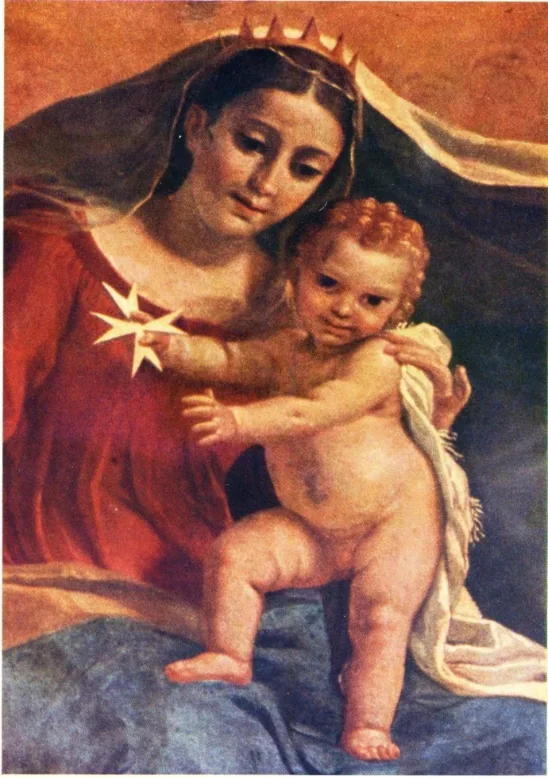 Mary371, the holy Mother of God, and Saint John are mentioned only once in the Order's Rule. Chapter 15 states: "All this [...] we command and ordain in the name of Almighty God and the Blessed Mary and Saint John and the (holy) poor." Interestingly, only the German source adds the attribute "holy" to the poor. This formula effectively introduces Mary, John, and the poor as the central patron saints of the Order.
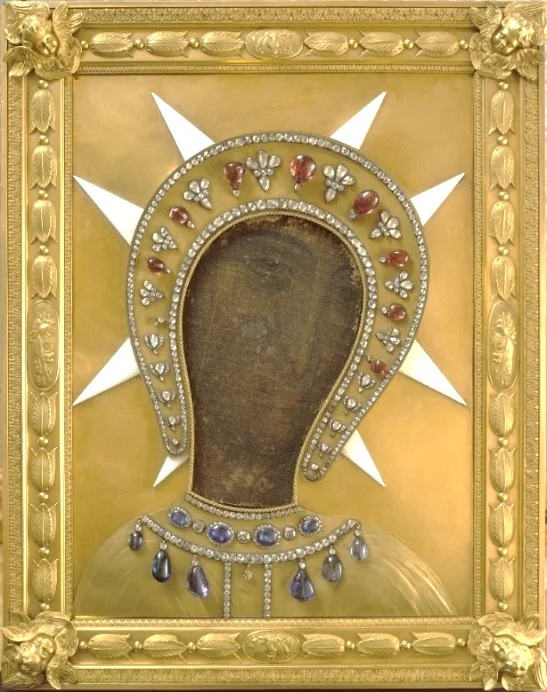
The roots of this devotion can be traced historically: The hospital church was built in the immediate vicinity of the Church of Saint Maria Latina and originated from this monastic environment. Marian devotion 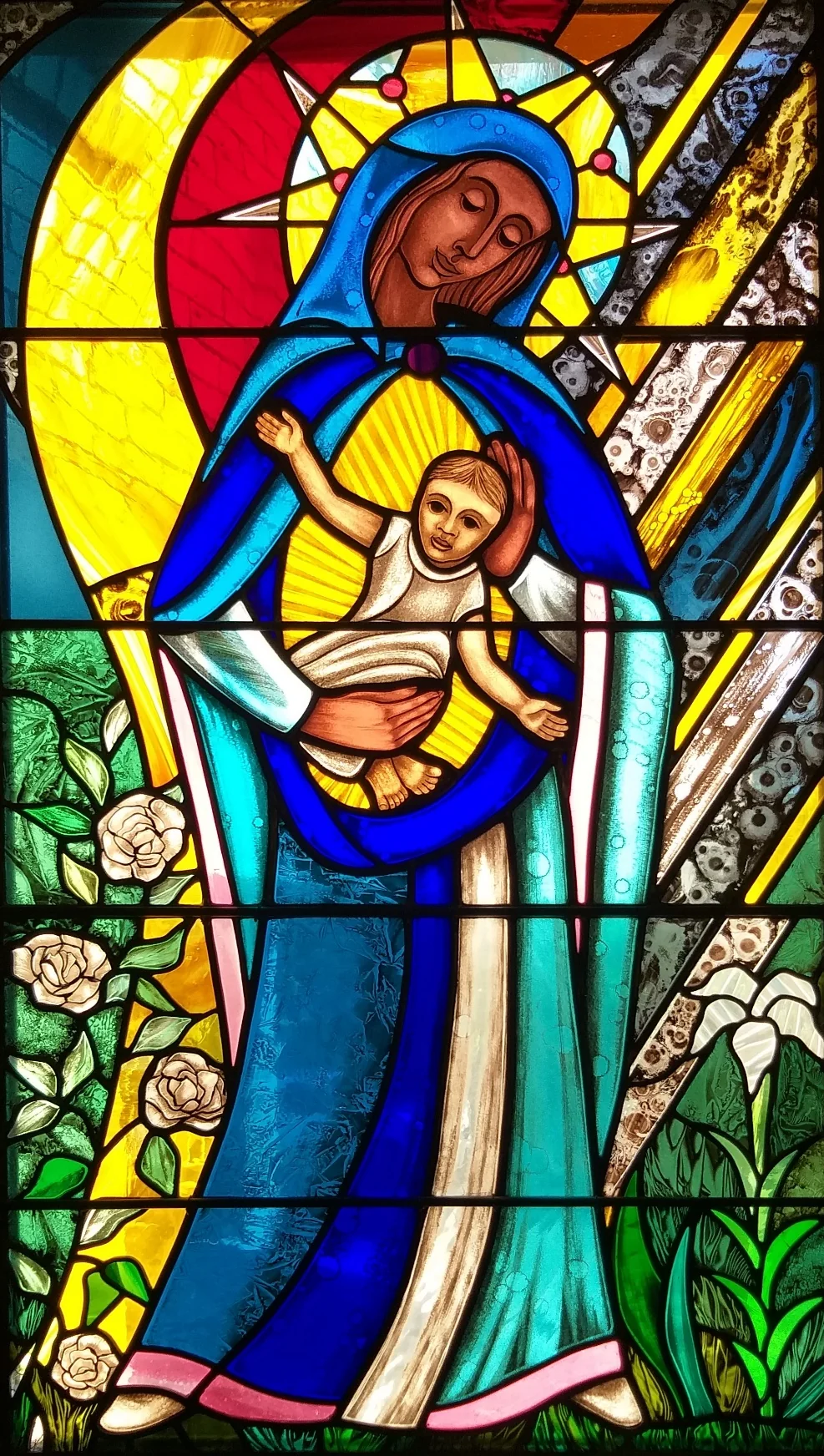 was evidently continued seamlessly from there. Later sources attest to the growing importance of this spiritual orientation over time: Around 1239, it is documented with certainty that novices had to vow upon their admission: “I vow and promise to God, Almighty God, to the Blessed Virgin Mary , and to Saint John the Baptist , that I will always obey the superior whom God and our Order have given me, that I will live without possessions, and that I will preserve chastity, so help me God.”372. This profound devotion is also reflected in the accounts of Bosio, to which Moroso refers. These accounts emphasize the knights' particular devotion to the Blessed Virgin and the erection of numerous shrines in her honour.
Image: Our Lady of Philermos373
|
Among these is the Shrine |
The veneration of the image |
|---|---|
 377 377The Devotion to Our Lady of Damascus |
and |

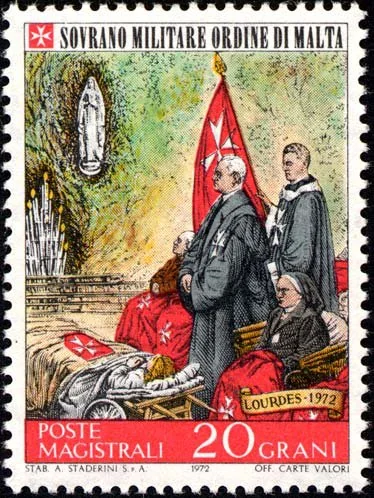
The veneration of St. John plays a special role in the order, especially since the order is named after him. First, however, a distinction must be made:
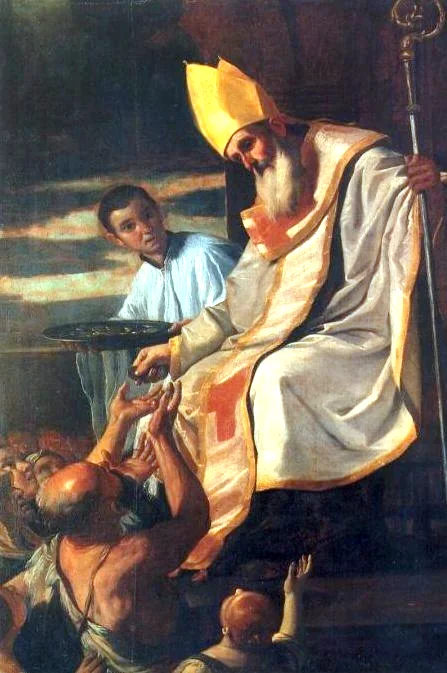
 The men's hospice and its chapel, built as an extension of the monastery of St. Maria Latina, were originally dedicated to the late 11th century.
St. John
the Merciful379 consecrated.
Historians who consider the Hospital of St. John of Jerusalem to be a continuation of the hospice also call him the first patron saint of the Order of St. John380.
He was a nobleman from Cyprus, born in 550.
He became Patriarch of Alexandria in Egypt.
He was soon revered in the East as one of the greatest benefactors, as he devoted himself especially to the poor and sick. He founded hospitals and homes for the poor and was the first to call the poor and sick his " lords and masters ".
He died between 616 and 620381.
Picture382
 Most historians who deny the hospital's dependence on the Amalfi Hospice consider John the Baptist from the beginning as patron saint of the Order383.
Picture384
The first document that mentions John the Baptist is the deed of gift from Foupier Favard concerning the land of Diosolvol.
This document385dates from the period between 1106 and 1110.
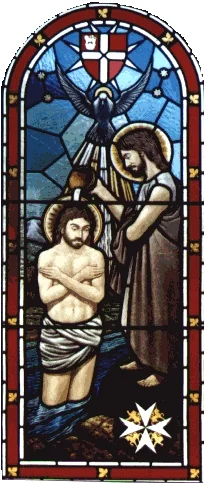 From this point onwards, i.e., during the lifetime of the founder Gérard, John the Baptist is considered the patron saint of the order.
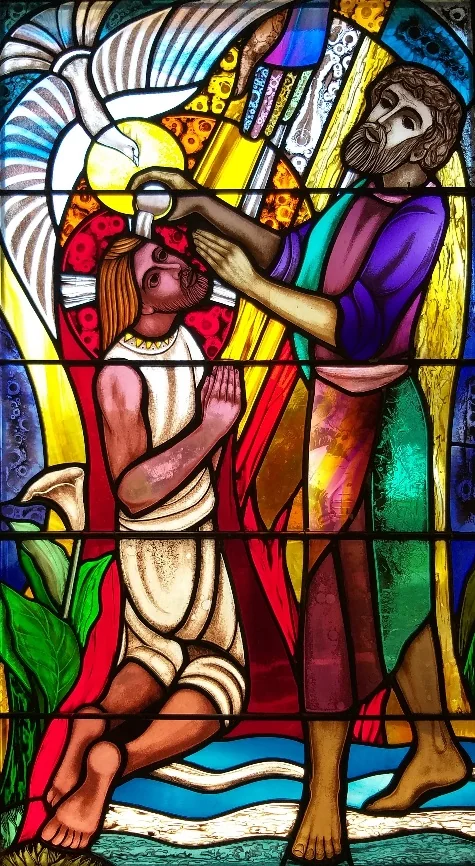 This is also what the bull “Pie postulatio voluntatis” by Pope Paschal II of 15. February 1113386John the Baptist as patron saint.
He was venerated as a forerunner of Christ.
He lived and preached in the desert, like the brothers of the Order of St. John, who went to a strange, desert-like region to serve Christ.
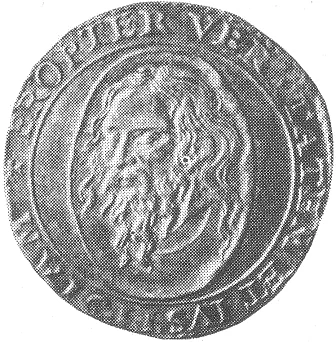 Saint John (probably as the Vicar of Christ) is symbolically depicted on the
  coins of the Order389from the beginning of the 16th century as a liege lord390, who invests the Grandmaster with banners, or his (John's) head on the platter after his beheading,
images391
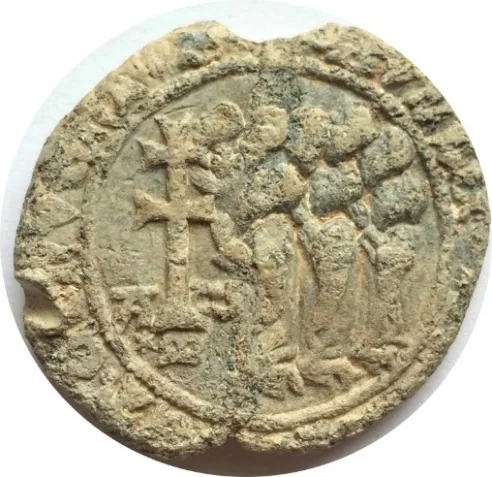
 Image392
while the Grandmaster and the Council of the Order kneel and pray before the tomb of Christ on the oldest seals of the Order393.
Waldstein-Wartenberg mentions the veneration of St. John the Baptist as patron saint of the lonely and of baptisteries in France, and Bedford reports that St. John was also venerated as patron saint of the sick – he means epileptics394.
Excursus: The saints and blessed of the Order in the period up to 1187The official canonization process, as we know it today, developed in the Catholic Church from the 10th century onwards . The most important stages at a glance:
|
|---|
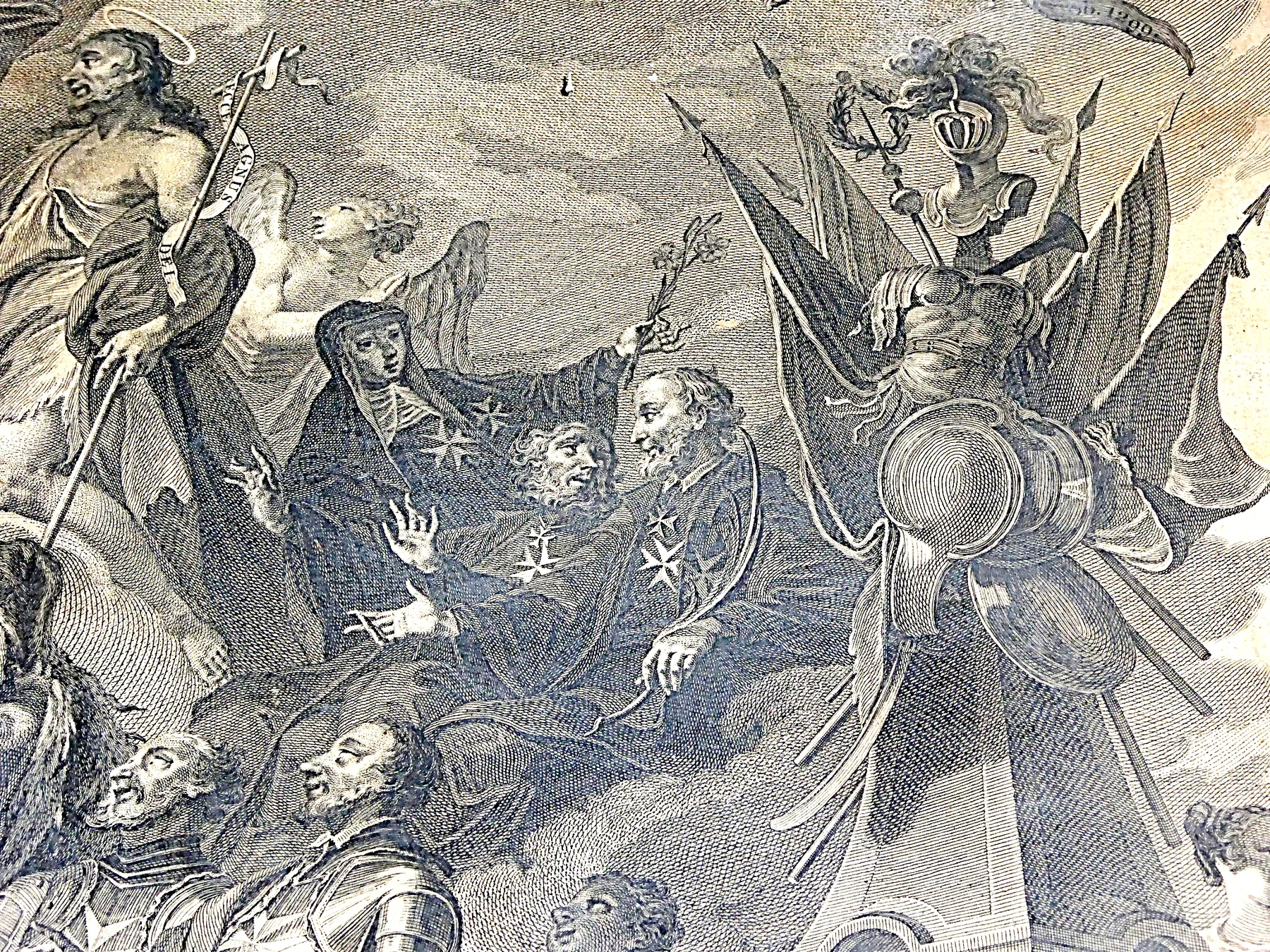
By 1187, the Order of St. John had been
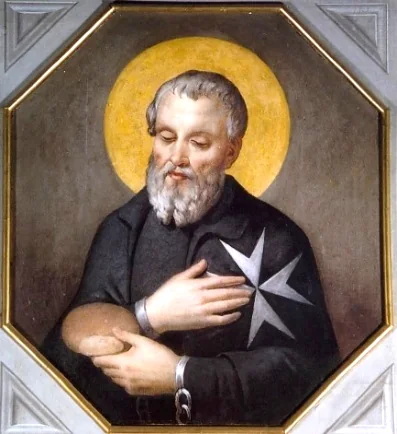
The life and work of Blessed Gérard has already been described in detail in this work. The same applies to Blessed Raymond. He is venerated as a Blessed primarily within the tradition and liturgy of the Order. Here, he is specifically referred to as follows:
|
|---|


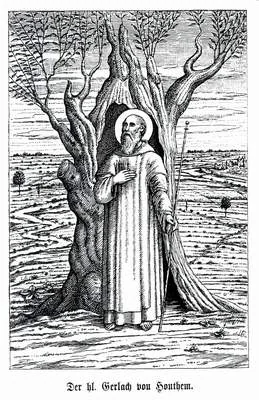
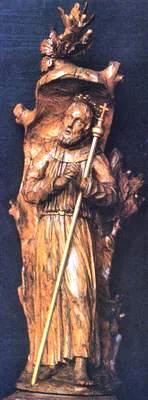
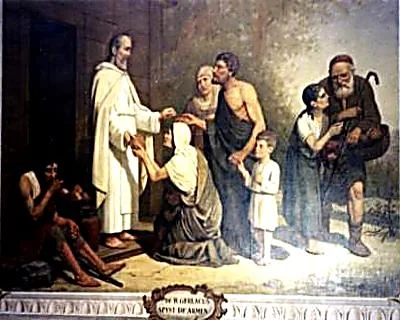
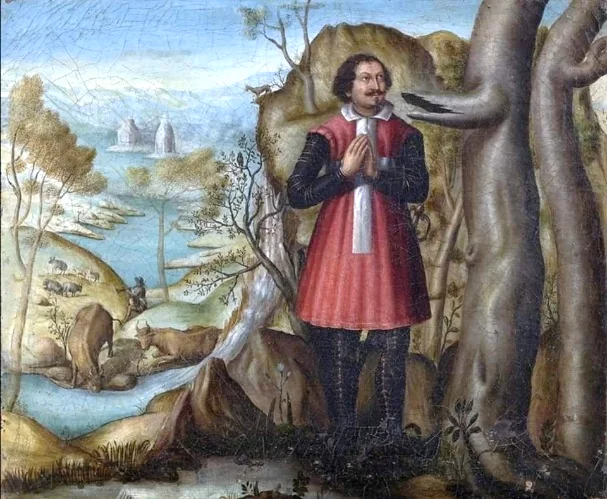
6B Saint Gerlach of Valkenburg / HouthemWikipedia (https://de.wikipedia.org/wiki/Gerlach_von_Houthem ) writes: Gerlach of Houthem (variant names: Gerlachus, Gerlac, Gerlach of Valkenburg, and others ; * around 1100 in Valkenburg aan de Geul ; † between 1164 and 1177 in Houthem near Valkenburg aan de Geul) was a knight and later a hermit from the Duchy of Limburg . He was later canonized and is venerated in various ways, particularly in the Maastricht and Aachen area . His Catholic feast day is January 5. Life and work Gerlach was of noble birth and participated as a knight in various battles and tournaments . During one of these away tournaments, he was informed that his wife had died at home. Gerlach was deeply saddened that he had not been present during her final days and repented of his careless life. He then made a pilgrimage to Rome and asked the Pope for appropriate penance. The Pope advised him to first make a seven-year pilgrimage to Jerusalem and to lead a permanently ascetic Christian life. Gerlach then gave away all his possessions and luxury goods and embarked on the imposed pilgrimage to Jerusalem. There he worked in a hospital run by the Knights Hospitaller and as a simple shepherd in the fields. It must have been around the year 1151 when Pope Eugene III It was the hospital of the Order of St. John, and possibly Blessed Raymond, who welcomed him. Wikipedia continues: "Gerlach subsequently settled
Gerlach died on January 5th His feast day is celebrated on January 5th. |
|---|
|


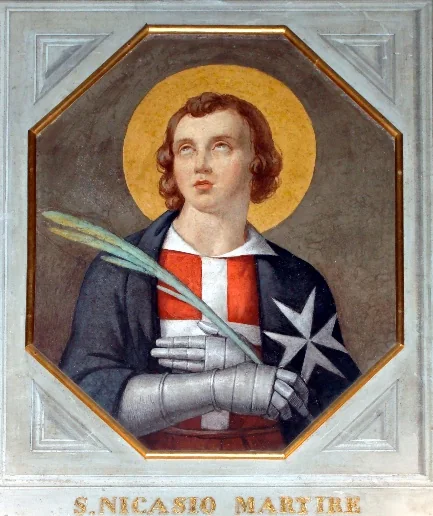 7B Saint Nicasius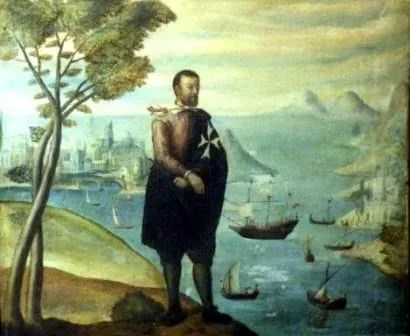
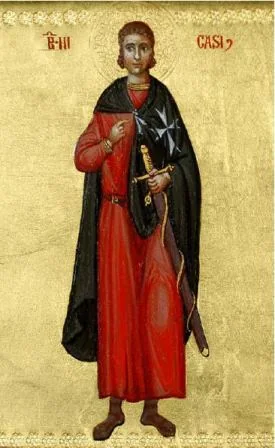
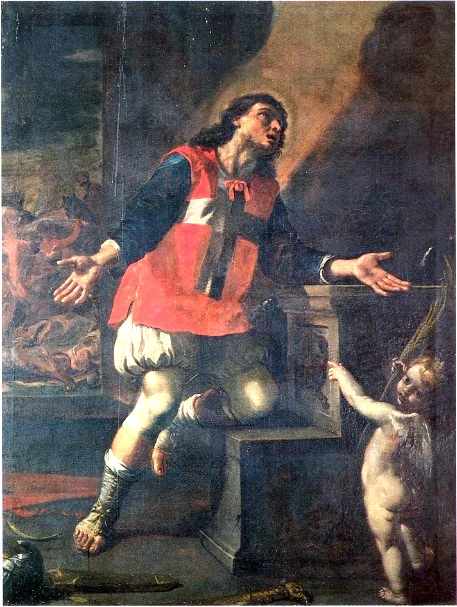 Of Saint Nicasius, a knight martyr, it is only known that he lived shortly after Blessed Gerland. His image, painted in several churches (in the Church of Saint Dominic in Palermo, in the Church of Saint Catherine dell'Olivella – near the altar of Our Lady of Itria – Saint Mary of Miracles in Palermo, and in the Church of Saint John the Beheaded in Valletta, Malta), shows that he is not a myth, but a martyr of our Order. Beneath the image of Saint Nicasius, painted on a column of Saint Dominic in Palermo, this inscription can be read, which testifies to a popular belief:
 Our knight suffered from scrofula as a result of his torture. From his heavenly place, he will protect us from scrofula, under one simple condition: if our glands cause us or our children concern, let us confidently write down the name of Saint Nicasius and wear it on ourselves or in the patient's clothing. The holy martyr will indeed be able to heal the disease he knew.
 Life and Martyrdom
 Miracles and veneration
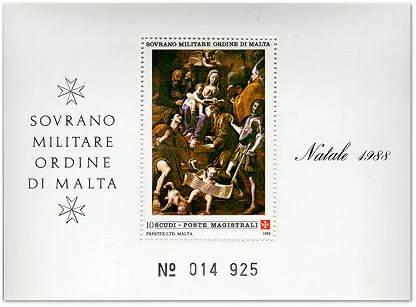

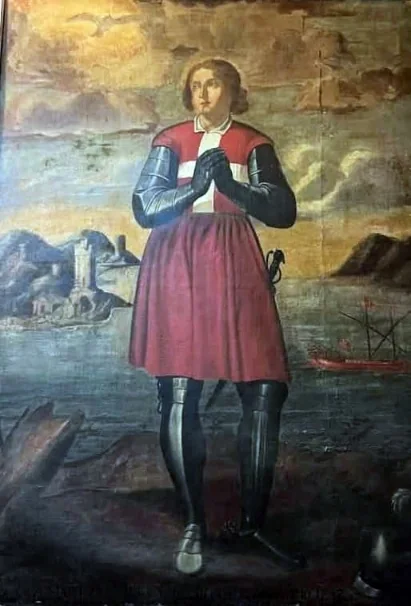 Image
Image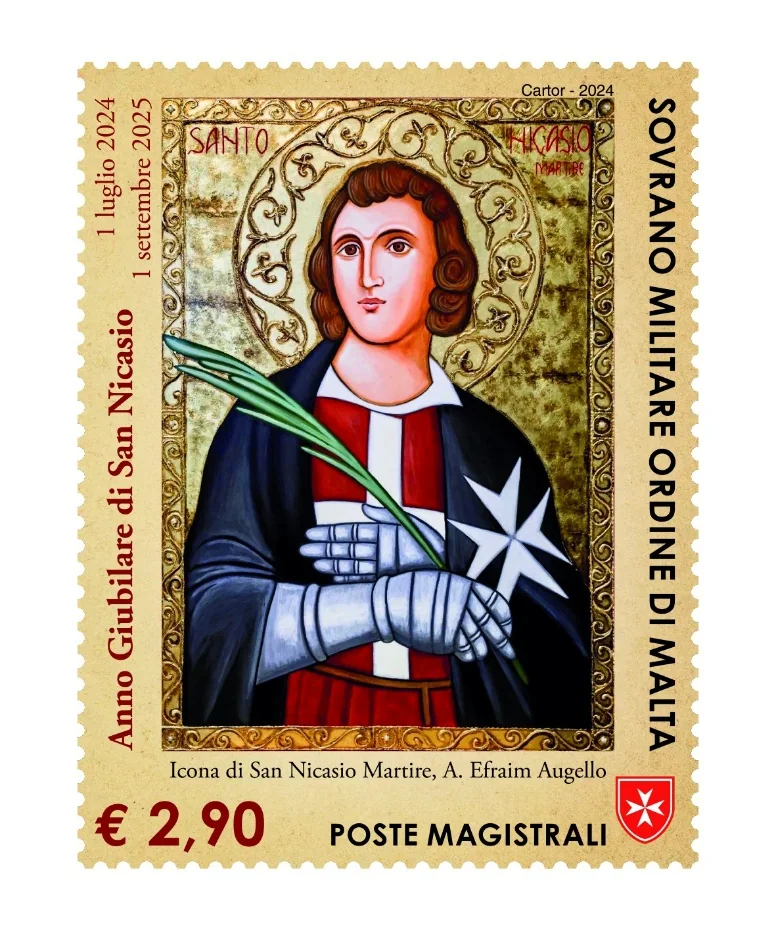

g. The works of charity.
Hospitality as the core task of the order
 Image415
“Hospitality occupies the first rank among all works of piety and humanity. All Christian peoples agree on this because it encompasses all other virtues. It must be practiced and respected by all people of good will—especially by those who bear the honourable name of a Hospitaller Knight. Therefore, we must devote ourselves more devotedly to no other task than that from which the Order derives its name.416”
Image417
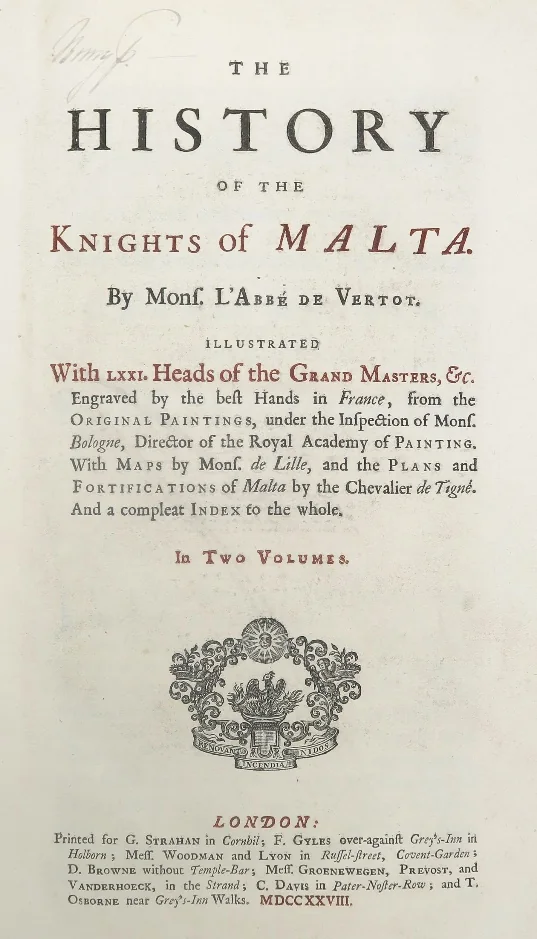 History proves that these words of René Aubert de Vertôt were not merely a formula but were put into practice in real-world service.
The hospitality of the Order of St. John is rooted in the profound spirituality discussed earlier; it is its practical expression. Hospitality is consistently understood here as service to the poor of the Lord. This is reflected in the titles: the Grandmasters are known as “Servants of the Poor of Our Lord Jesus Christ”418or “Servants of the Poor and Sick”419, while the friars are simply called “Servants of the Poor”420.
This attitude may seem paradoxical at first glance, since chivalric self-image is rarely associated with humility. However, the chivalric ideal of loyalty found its sacred expression here: the Crusaders regarded Christ as their supreme overlord. Since Christ, following Matthew 25:37-40 , identifies with the least among us, service to the hungry, the sick, or the imprisoned becomes direct service to Christ himself.
Caring for the poor as "masters" is therefore the logical consequence of chivalric loyalty and Christian faith.
The reading of the Latin manuscript of the monastic rule (JR II,2) speaks even more clearly of:


“Domini nostri pauperes quorum servos nos esse fatemur “
Our Lords, the poor , whose servants we profess to be…
The rule of the Order of St. John calls the members of the order
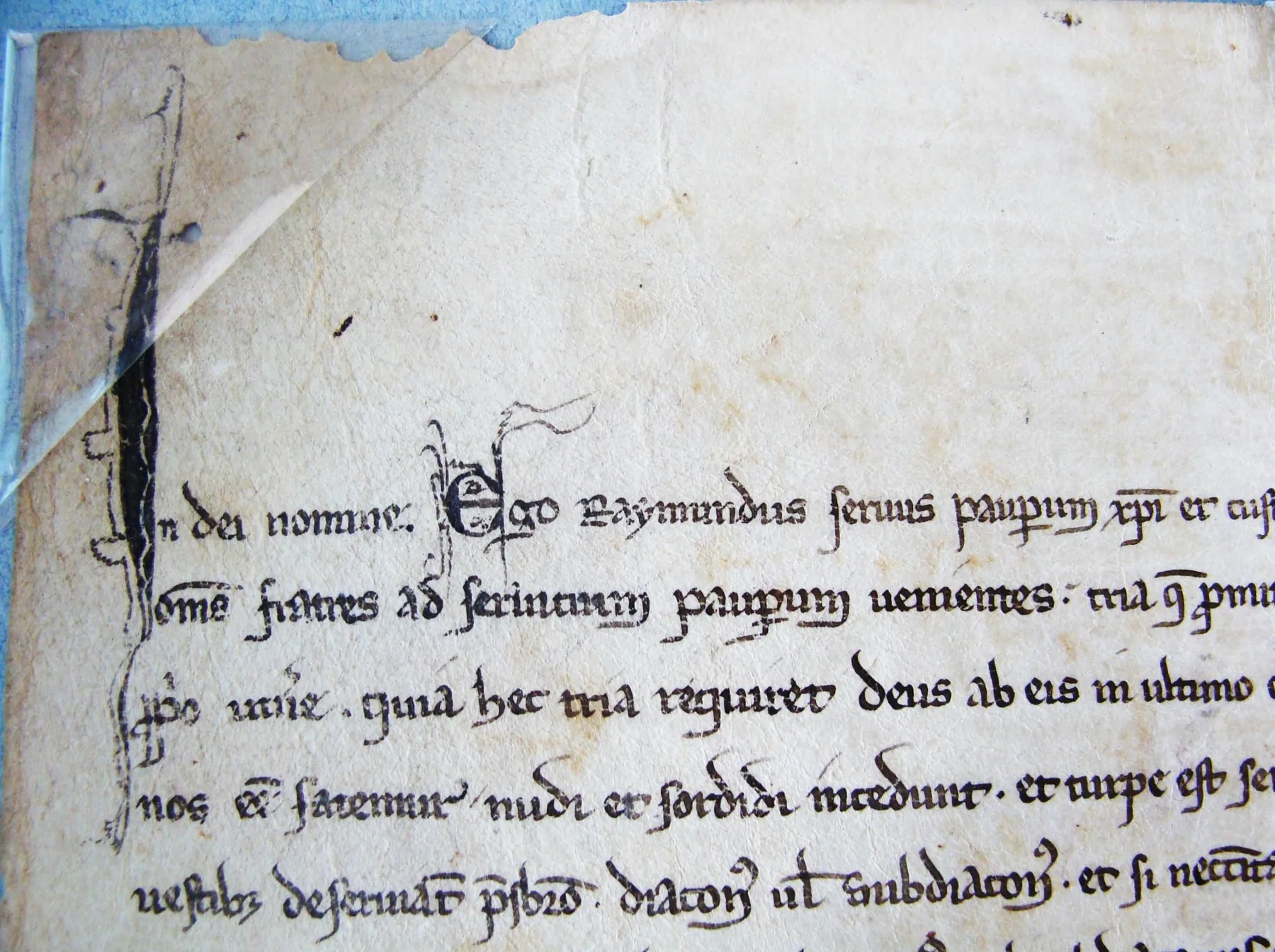
“fratres at servitium pauperum venientes”
= brothers who come to serve the poor.

In later versions of the rule, this is expanded to a dual mandate
" fratres accedentes ad obsequium pauperum et tuitionem fidei catholicae "
(Brothers who approach the service of the poor and the protection of the Catholic faith).
“tuitio fidei et obsequium pauperum” comes
from.
A distinctive feature of the Order of St. John (cf. Chapter 3 of the Rule) is the holistic nature of care: Service is not limited to physical care but includes concern for the spiritual well-being of both those receiving care and those providing it. The pastoral and sacramental dimensions – priestly visits to the sick and Holy Communion – are not optional additions but integral components of care .
In the Order of St. John, charity thus becomes a fully realized act of worship : the hospes (guest) is Christ himself, who encounters us in the sick.
Hospitality as a salvific event and the " communio " sanctorum “:
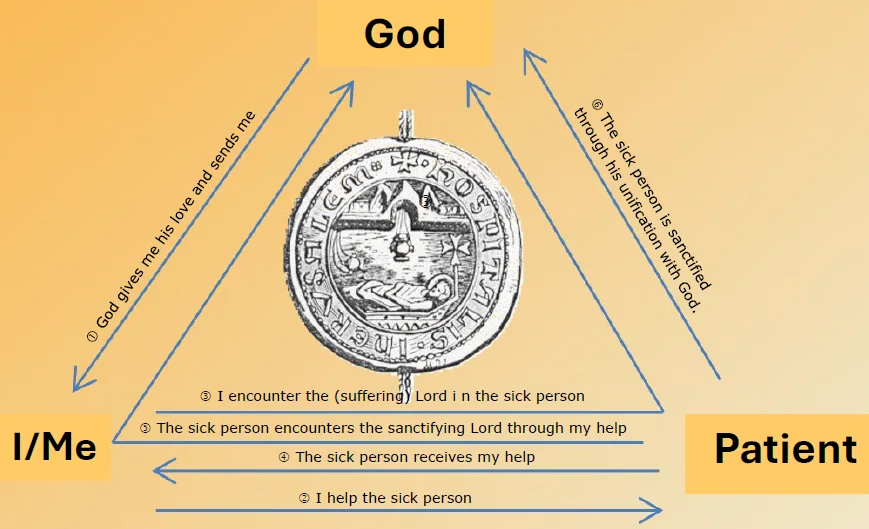
God gives me his love and sends me
I help the sick person
and encounter the (suffering) Lord in the sick person
The sick person receives my help
and thus encounters the [holy ] Lord
And becomes holy in oneness with God.
This transforms…
the hospital as a place of healing experience,
the hospital community became the “community of saints” and
Hospitality becomes a sacramental event of salvation.
Historical uniqueness and the “Fourth Vow”
The Order of St. John was the first community in the West to make hospitality its primary mission. While Roman valetudinaria primarily served to maintain the labour power of slaves, and episcopal xenodochia (from the 5th century onward,421) were more general welfare institutions, the Order of St. John distinguished itself through a primary focus on the care of the poor and sick on a large scale. Although the original rule does not yet contain an explicit vow of hospitality, the customary law of the Order of St. John, around 1239 (Chapter 121), codifies a unique admission ceremony. In addition to the evangelical counsels (obedience, chastity, poverty), a fourth, distinctive promise is added: "...for you promise
to be servants and slaves to our lords who are ill ."
The Architecture of Salvation: Sacred Space and Hospital Ward
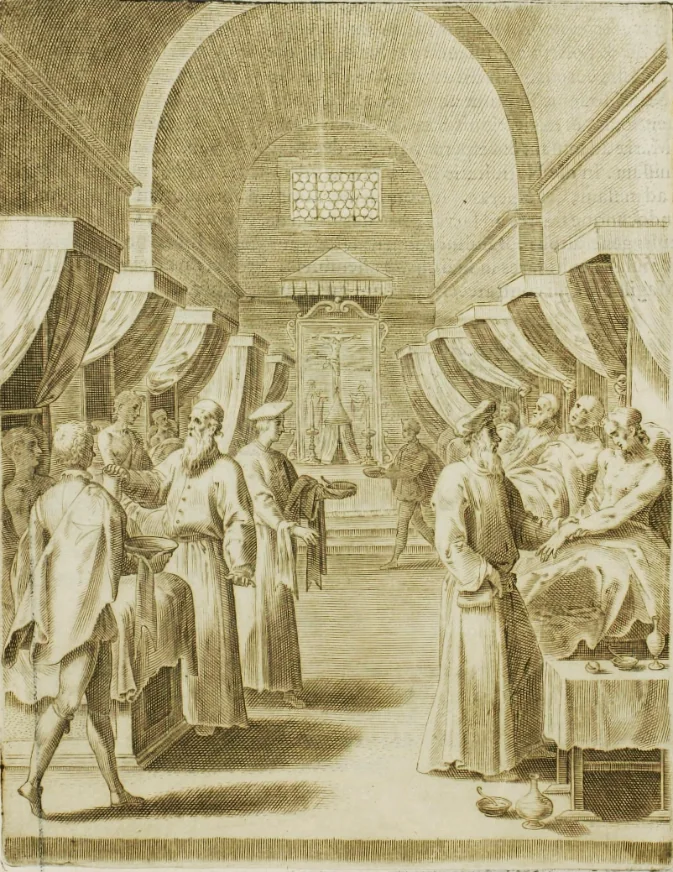

This theological orientation shaped the architecture: many hospital wards of the Order of St. John had built-in altars or were designed as two-story churches. This arrangement allowed patients on the upper floor to see and hear the liturgy at the altar below, thus enabling 424them to participate even from their beds.
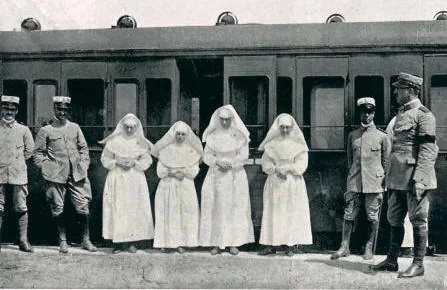

A principle that extended even to the hospital trains of the First World War425
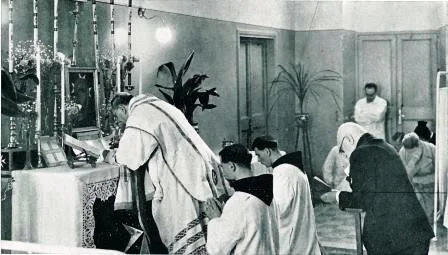
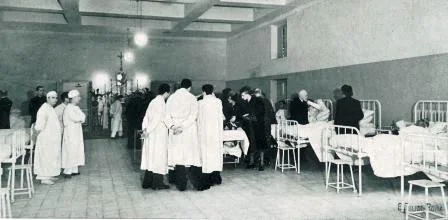
and other institutions such as San Giacomo in Augusta in Rome, traditional426.
 427
427
Holy Mass in the Blessed Gérard's Church in Mandeni/South Africa
 The Rule of the Order of St. John consistently prioritizes pastoral and sacramental care. Before hospitalization, the salvation of the soul is ensured through the sacraments of Reconciliation and Eucharist. Only then is the sick person received as "quasi dominus " (like a lord) and strengthened daily (reficiantur).
The oldest seal of the Order
dates from the era of Blessed Raymond du Puy.Image428
and a lead bulla, used by Grandmasters in Jerusalem in the 12th century, symbolize this connection:
Image429
The bull depicts the Order's hospital in Jerusalem, recognizable by the inscription "HOSPITALIS HIERUSALEM" and the octagonal cross. In the centre is a dome from which hangs the lamp of the Eternal Light. The "Eternal Light" testifies to the uninterrupted presence of Christ in the Blessed Sacrament. To the left is a censer, symbolizing the prayers and care of the Knights for the sick. The sick man lying in bed represents Christ, with a halo and the crown of thorns, symbolizing his divinity and suffering.
Image430
The Hospital of Jerusalem as a comprehensive social system
The statutes demonstrate that the Order of St. John operated a highly sophisticated system of charity from its very early stages. The Hospital of Jerusalem was far more than a hospitium (guesthouse); it functioned as a comprehensive centre of charitable care, encompassing infant care, welfare for the needy, and prisoner support. In both quality and quantity, it represented the first regular and professional aid institution in Western Christendom.
 431The Dimensions
of the Hospital of Jerusalem
The efficiency and scope of the social services provided by the Order of St. John can be impressively demonstrated by the logistics of the hospital in Jerusalem.
Johannes von Würzburg , who visited Jerusalem in 1135, left behind a detailed description in 1170 () 432documenting the exceptional character of this institution:
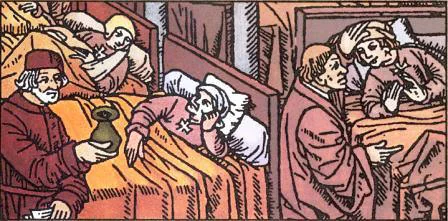 "Opposite the Church of the Holy Sepulchre, on the opposite side of the road heading south, stands a beautiful church built in honour of John the Baptist. Attached to it is a hospital where, in various rooms, an enormous number of sick people, both men and women, are gathered. They are cared for and healed daily with great effort. When I was there, I learned from the account of the ministering brothers themselves that the total number of these sick was two thousand, of whom sometimes more than fifty are carried out dead in the course of a day and a night, while many new ones are constantly arriving. What more can I say? This same house provides food for as many people outside as inside, in addition to the boundless charity it bestows daily on the poor who beg for bread from door to door and do not live in the house, so that the total sum of its expenditures certainly cannot even be calculated by the administrators and stewards. In addition to all this money spent on the sick and other poor, this house also maintains, in its various chambers, many people who participate in all kinds of military exercises for the defense of the Christian lands against the invasion of..." Saracens are trained.”
Infrastructure and holistic care
This account illustrates that the hospital of the Order of St. John was far more than a medical station. It was a large, multifunctional institution that both treated the sick as inpatients and accommodated the healthy and pilgrims as " hospitaliters ." The scale of 2,000 beds underscores its quantitative uniqueness in the 12th century.
A key characteristic of the Order of St. John was the combination of charitable service and military protection. The mention of armed forces to secure the lands and castles demonstrates the order's early on-developing dual structure: the protection of the faithful (tuitio fidei) formed the necessary framework to enable service to the poor (obsequium pauperum) in the first place.
Thus, the Hospital of Jerusalem, in the context of the Order of St. John, represents a holistic model of Christian existence, combining physical healing, social security, and military protection into a theologically grounded unity.
Excursus created by Google AI: Functional differentiation: Fratres armorum and Fratres infirmarii The professionalism of the Order of St. John manifested itself early on in a clear internal division of tasks. This differentiation was not an expression of hierarchical value judgment, but rather the necessary structural response to the dual mission of tuitio fidei and obsequium pauperum . 1. The Fratres infirmarii (nursing brothers) The brothers The infirmarians formed the spiritual and operational core of the hospital. Their service was directly focused on the "proper" of the Order of St. John : the direct care of the " domini". nostri pauperes “.
2. The Fratres Armorum (Brothers in Arms) The brothers The armorum (later often referred to as knightly brothers) represented the military capacity of the Order of St. John . However, their role should not be considered in isolation from the hospital system.
The organisational unit Despite these specialized areas of expertise, the Order of St. John remained an indivisible unit. Sources demonstrate that military resources (castles, lands, armed forces) were consistently directed towards the goal of hospitality . The fratres armorum created external security so that the fratres The infirmarii were able to carry out the saving event of hospitality. Only through this professionalization could the Order of St. John exist for centuries as the most stable aid institution in the West. |
|---|
Capacity and universality of the service
Further contemporary accounts support the reports of the hospital's exceptional capacity in Jerusalem. The pilgrim Theodoric () 433, who visited the institution around 1172, documented 1,000 beds. Roger de Moulins provides a concrete example of its logistical capabilities for the year 1177: After the Battle of Tell Diezer (Montgisard /Ramla), 750 wounded soldiers were admitted to the hospital, which at that time was already caring for 900 patients.
A key distinguishing feature of the Order of St. John was the unconditional universality of its admission: no distinction was made in treatment based on the origin or religious affiliation of those seeking help. This practiced impartiality led, as early as the 11th century, to a form of gentlemen's agreement between the hospital and its non-Christian opponents.
Zwehl acknowledges this pioneering achievement of the Order of St. John with the words:
 "The Knights Hospitaller deserve the honour of having been the first to undertake the accommodation and care of the sick of all kinds and origins on a larger scale.434"
In addition to its social openness, the Order of St. John also set new qualitative standards in infrastructure. Unusual for the medieval period was the fact that each patient was assigned their own bed (435). Overall, the hospitality of the Order of St. John thus marked a substantial advance in the history of Western nursing.
Picture436
Universal recognition by secular and religious powers
The preeminent position of the Order of St. John is underscored by the recognition of the highest contemporary authorities.

Frederick Barbarossa and Richard the Lionheart
Emperor Frederick I Barbarossa praised the achievements as “invaluable works of mercy”438.
Similarly, Richard the Lionheart praised the “holy hospital of Jerusalem” as “great in works of piety”439.
This secular appreciation corresponded with the papal recognition of the order's special structure.
In his bull “Quanto maior” of March 9, 1160
, Pope Alexander III explicitly referred to the brothers in the Order of St. John as “steadfast fighters of Christ”440. This title legitimized the unity of charitable service and chivalric protection characteristic of the Order of St. John.
Glimmers of hope in the history of the order: New sources discovered
Two significant discoveries have decisively advanced research into the practical activities of the Order of St. John in medieval Jerusalem.
In 1988, Berthold Waldstein-Wartenberg uncovered a fascinating eyewitness account
from the Munich "Johanniterregel" (CLM 4820, folios 132v – 139v) in his book
" Die Vasallen Christi " .This was supplemented in 2010 by Katja Klement, who discovered a previously unknown hospital ordinance in the Codex Vaticanus Lat. (No. 4652, folios 89r–104r) . This source, attributed to Roger de Moulins, impressively illustrates the knights' self-conception as " God's hosts ."
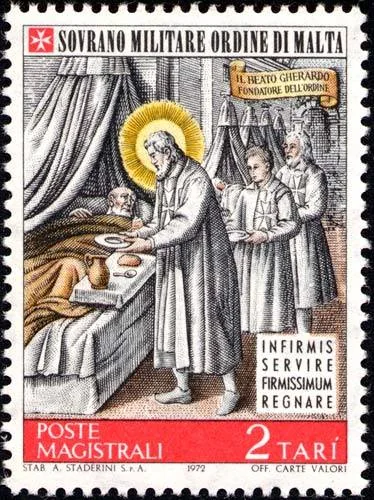 "The Vassals of Christ"441
(CML 4620):
Insights into the nursing care of the early Order of St. John
The discovery
of the “eyewitness account”
A significant contribution to the study of the early history of the Order of St. John was made by Count Berthold von Waldstein-Wartenberg in 1988 with his work "The Vassals of Christ." His research was based on a discovery in the Bavarian State Library in Munich (CML 4620 f. 132v–139v): the account of an unknown German monk. Waldstein-Wartenberg suggests that the author was either John of Würzburg or the pilgrim Theoderich.
The author states that he had been within the city walls of Jerusalem even before its conquest by the Crusaders and was himself admitted to the hospital as a patient. The charitable devotion he experienced there contrasted so sharply with the secular life of the city that he felt inspired to write a treatise on charity. This treatise contains a detailed description of the nursing care provided by the Order of St. John. Since the author did not want to distract the doctors and nurses from their work by questioning them, he limited himself to pure observation. This fact makes the document particularly valuable today, as it reflects the unvarnished everyday life – even if the author clearly had difficulty distinguishing between knights and serving brothers or representing the correct hierarchies of the order.
The hospital as a "palace of the sick"
The hospital followed the radical principle of universality: it admitted patients of all nations, social classes, and denominations. Every patient—regardless of gender or faith—was considered "Lord" and representative of Christ. Consequently, the hospital was known as the "Palace of the Sick"; it symbolically belonged to the patients, not the order.
To ensure the best possible care, the order likely employed not only European specialists but also doctors from the Orient. This significantly increased the local population's trust in the institution.
415 Mobility and field medicine
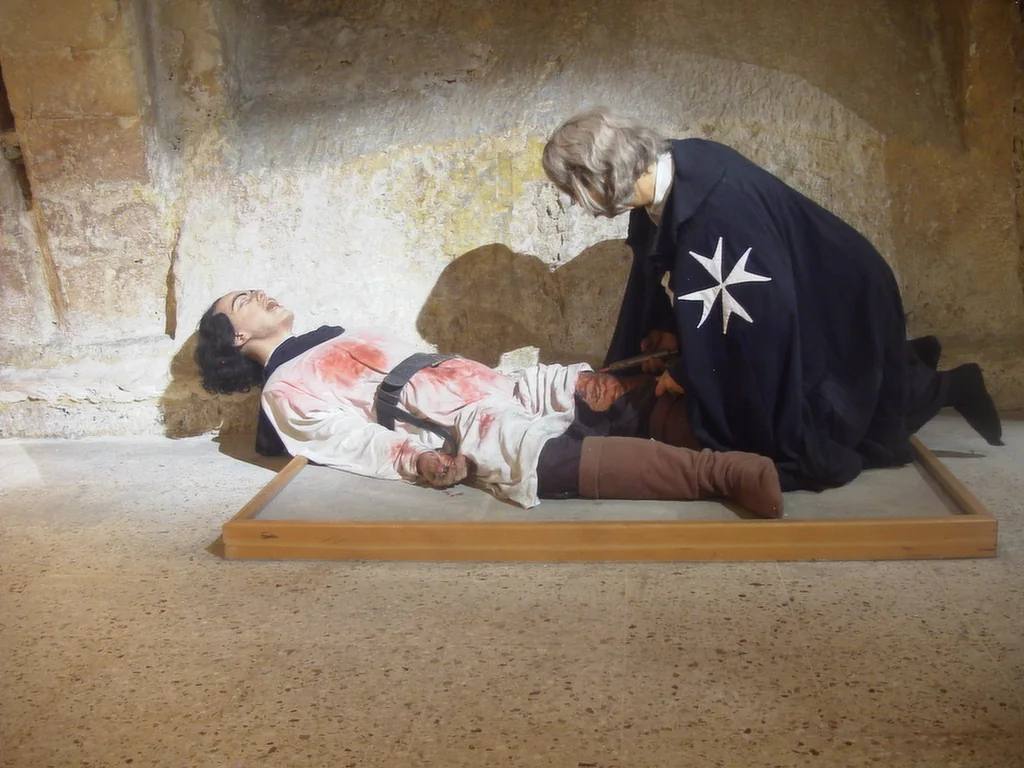 Image F442
The Order's care began even outside the hospital walls. The sick, unable to make the journey on their own, were fetched by the friars. Historically noteworthy is the existence of a mobile medical service that accompanied the crusaders on their campaigns. The staff included full-time surgeons who erected tents and pavilions on battlefields to provide initial medical care. The friars even provided their own mounts and pack animals for transporting the wounded – a symbol that their possessions were ultimately only a loan from their "masters," the sick.
Admission and nursing structure
Upon arrival at the hospital, each patient was received by the porter with a respect usually reserved for royalty. The admission process began spiritually: before medical treatment came confession and the reception of Holy Communion, which was referred to as "heavenly medicine"—a practice the order had adopted from the medical school in Salerno.
 Image F443
The hospital was divided into eleven wards, each specializing in a particular medical condition. A ward comprised between 90 and 180 beds and was staffed by a team of twelve nurses under the direction of a head nurse. The women's ward, primarily a maternity ward, was located in a separate building, presumably in the west wing near the Maria Latina Maior monastery.
Comfort and nutrition as remedies
The hospital wards were luxuriously furnished for medieval standards. The beds were large, with linen sheets, feather pillows, and bedspreads to spare the patients any discomfort. When getting out of bed, patients were given coats, furs, and shoes so they would neither freeze nor soil themselves on the cool marble floors.
 Picture444
Nutrition was a central component of the therapy. While the basic meals (meat on Tuesdays and Thursdays, flatbread on the other days) were prepared in the monastery kitchen, there was a sophisticated system for supplementary food. In cases of poor appetite or to provide sustenance, delicacies such as partridges, pigeons, lamb, fish, or fresh fruit (pomegranates, pears, figs) were purchased. The order's treasury provided each ward with a weekly budget for this purpose. Interestingly, the members of the order ate only after the patients and received exactly the same food to ensure the quality of the meals.
Medical practice and hygiene
 Picture445
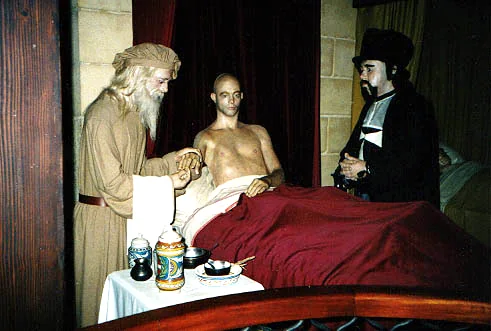
Hygiene was of paramount importance. In addition to regular personal care (haircutting, beard trimming, foot washing with pumice stone), the wards were ritually sprinkled with water and fumigated with the wood of the oriental tree of life during mealtimes. This served not only as a ceremony but also disinfected and repelled insects.
Medical care was provided by learned specialists. Since European medical knowledge was limited, the order specifically recruited Jewish, Arab, Armenian, and Syrian physicians. Rounds took place in the morning and evening, with the doctors accompanied by orderlies who recorded prescriptions and prepared samples for the then-standard urinalysis.
Humoral pathology and surgical interventions
In addition to physicians, the hospital employed barbers for surgical procedures such as bloodletting. These treatments were based on the ancient humoral pathology (theory of the four humours). It was believed that illnesses arose from an imbalance of blood, phlegm, yellow bile, and black bile. An excess of these humours affected not only health but also temperament (sanguine, phlegmatic, choleric, melancholic). Bloodletting was considered a necessary means of artificially restoring this balance.
The Night Watch: Devotion and Control
A distinctive feature of the care provided by the Order of St. John was the continuous provision of services after nightfall. Two brothers took turns on the night shift at each ward. To protect the patients from nighttime anxieties, illusions, and doubts, the ward remained brightly lit by several lamps.
The night shift was characterized by a ritualistic cycle of care: The brothers walked along the rows, offering drinks with the cries of "Wine from God!" and "Water from God!" Later, the patients were cleansed with warm water, which, according to eyewitness accounts, was always done with gentle persuasion and without coercion. During the night's rest, the brothers kept a constant vigil to ensure that the sick remained warmly covered and comfortably bedded. In emergencies, it was their responsibility to summon the priest for the Anointing of the Sick and Viaticum, or to escort the deceased with dignity from the ward.
Prayer as a spiritual remedy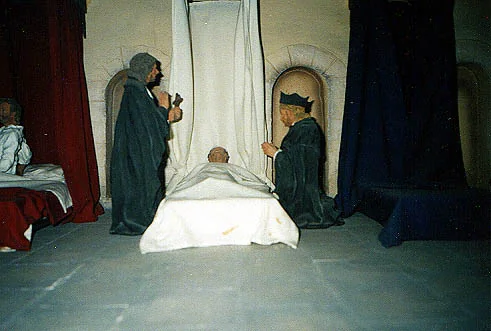
Picture446
Although the reporter does not explicitly mention it, communal prayer was an integral part of daily life. The sick were actively involved in intercessory prayers. They were asked to pray for peace, the fruits of the earth, the Church hierarchy, the Holy Land, as well as for benefactors and prisoners of war. This practice stemmed from the medieval belief that the sick, through their suffering, were especially close to Christ and that their prayers therefore possessed a greater power.
To ensure the quality of care at night, a solemn candlelight procession of all those on duty took place. During this procession, it was checked whether the staff were properly fulfilling their duties. An elected overseer also patrolled throughout the night to immediately correct any negligence. Violations of the monastic discipline or the mistreatment of patients were punished severely—ranging from public flogging to 40 days of confinement on bread and water, as well as immediate dismissal from service.
The Women's Hospital: Obstetrics and Care
The women's hospital was located in a separate building, to which the male reporter presumably had only limited access. The nurses working there are referred to as "Mothers of St. John"—likely nuns from the tradition of the Magdalene Convent.
447The focus of this department was obstetrics. Women in labour received warm baths and comprehensive hygiene care. Each newborn was given its own cradle next to its mother's bed. However, should a mother be too ill or unable to care for her child due to extreme poverty, the order's social safety net intervened: the newborn was entrusted to a wet nurse.
Social responsibility for foundlings
The care did not end with discharge. If mothers were unable to raise their children due to their precarious living conditions, the hospital director arranged for their placement with foster families. The report speaks of a considerable scale: up to a thousand children received financial support from the order, with annual costs per child amounting to approximately twelve talents (419 pfennigs) 448. This underscores that the hospital in Jerusalem was not only a medical institution but also a significant centre of medieval social welfare.
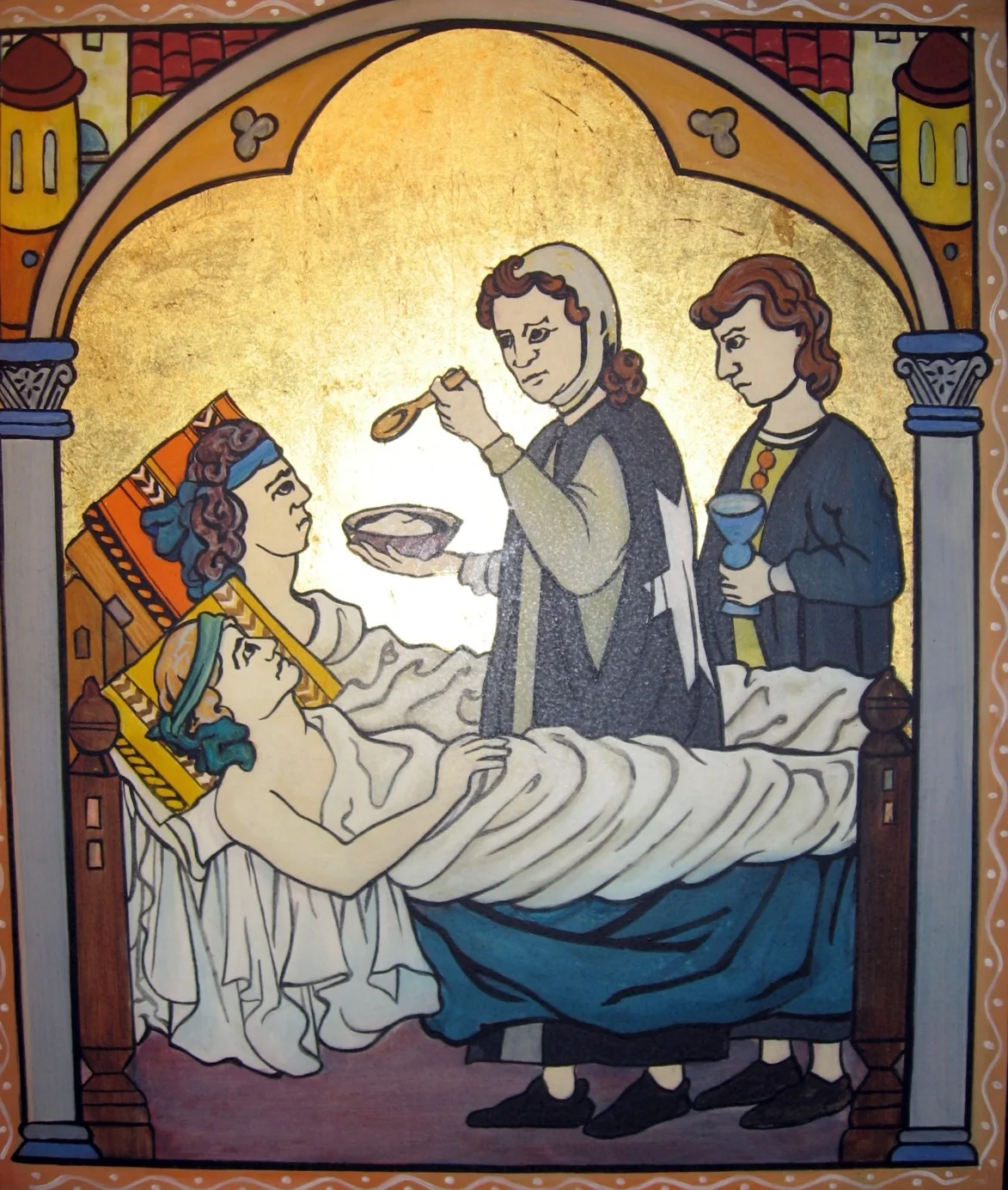
Image449
“God’s Host” (Vat. Lat. 4852)
The text discovered by Katja Klement in the Vatican manuscript Vat. Lat. 4852, probably between 1181 and 1183 from
Roger de Moulins wrote hospital regulations
On the food for the sick and on the doctors and the order
that was customary in the Palace of the Sick in Jerusalem.
The Master of the Hospital and the General Chapter decreed that every day each sick person should have half a soft loaf of bread and enough of the house's bread, and the same wine as the convent.
 Picture450
The physicians should examine the characteristics of the sick and what diseases they have. And they should examine the urine and give them syrup and electuaries451and the other things the sick need, and they should forbid harmful things and administer beneficial ones. And the sicker and weaker they find them, the more they should strive to heal them.
The diet of the sick shall be as follows. From Easter until the Feast of St. Michael, they shall receive meat from chickens and other poultry, and meat from goats and lambs under one year old, and meat from mutton one year and older. They shall be cared for as prescribed by the physician . 452From the Feast of St. Michael until Lent, they shall receive chicken and the same as before, and meat from one-year-old male pigs, as determined by the physician. The sick shall not eat meat from female four-legged animals at any time of year, and the brothers caring for the sick shall not give it to them. During Lent, the sick shall be given fresh fish three times a week, if they can tolerate it given their illness, but this shall be done on the advice of the physician. Vegetable soup and other cooked dishes made from vegetables and barley flour (pearl), and other foods suitable for the sick, shall be given to them on the physician's instructions. And, properly prepared, they shall be served to them on the appointed days. We forbid the sick to be given eels, cheese, lentils, beans, cabbage, and other foods that are not good for them.
About the fruits intended for the sick
One third of the tree fruits, such as pomegranates and other apples, pears, plums, figs and grapes, shall be given to them, as the masters who came before us established and designated in the chapter of the hospital in Jerusalem for the support and benefit of the poor.
The provisions concerning the brothers and the sergeants453
in the corridors
In each row of the sick, there shall now and in the future be twelve sergeants who make the beds of the sick, keep them clean, and take the sick to the latrines, guiding and supporting them. For the Easter crossing and the Feast of the Exaltation of the Holy Cross, additional sergeants shall be posted at the direction of the Hospitaller. Between the rows shall be those brothers who keep the night watch, specifically two brothers who must stand watch every night so that nothing adverse befalls our sick lords.
Of the 7,500 Byzantine gold coins for the sick
 At the General Chapter, it was decided and determined that 1,500 Besanten (425 florins) 454should be given annually to the Hospitaller Brother, who is responsible for the care of the sick, for the employment of physicians and for almonds for the sick, from the first alms collection brought back during the two voyages, in the following manner: Half of the aforementioned Besanten should be given to the Hospitaller Brother for the Easter voyage and the other half for the voyage to the Exaltation of the Holy Cross. These Besanten must be paid first, as stated, and the remaining alms should be used for the upkeep of the house.
Gold bezant with Christian symbol
(1250s) (British Museum ).455
The Casalia456of the Sick
These are the estates whose fruit harvest and production of goats, rams, goats, pigs, and chickens belong to the common good of the hospital and are for the benefit of the sick. Specifically, the estate of Mont Gabriel, the estate of Sareth, the estate of Cuisinat, the estate of Saint Marie, the estate of Caphaer, and the estate of Cole457. No one may violate this provision or take away, diminish, or in any way disturb these possessions, but all the belongings of the sick shall remain fully preserved for the benefit of the Hospital of Jerusalem.
On the reception, care,
and concern for the poor of Jesus Christ
When the sick person arrives at the Hospital of St. John, he must go to the church and wait until one of the chaplains arrives, according to the custom and regulations of the House of Charity. The chaplains appointed for this service shall come to the sick person, hear his confession, administer Holy Communion, and escort him to the ward. The sergeants shall be prepared to receive him. And when it is time for lunch or dinner, they shall take him to the tables set by the altar in the ward of the sick, and there he shall eat and drink if he wishes. Afterwards, the sick are taken to the caravan room458and undressed, and their clothes are tied tightly and shown to the sick so that each one can recognize his own when they wish to depart. And the caravanier () 459shall give each person a pair of sheets, a blanket, a pillow, a tankard, a spoon, and a small barrel for their wine, and he shall assign a sergeant to attend them to bed. Then they shall ask them if they have any money to give to the hospitalier for safekeeping. The will shall be drawn up before the hospitalier or one of his companions, and the will shall be observed according to the means of the house. One brother and the notary are sufficient for the will. And if the sick person wishes, they may call a chaplain or another person, and they shall draw up their (last) will as God inspires them, and the notary must put on parchment how much they will tell them. The brother who is present must show them the benefits of the house and exhort them to bequeath to the house first.
Every day after morning mass, the sergeants are to be ready to give the sick some of the wine that the convent drinks, diluted in the same way, and each is to take half a litre of it into his cask. And if the sick person does not want wine, he is to have sugar, a quarter of the weight of a cask. After this, the sergeants are to eat their breakfast: a loaf of bread and a (glass?) full of the convent's wine and a bowlful of cooked food. While they are eating, the hospitaller and his companions, and those in his room, are to serve the weakest among the rooms the best and finest food that the house has. When the sergeants have eaten, a bell is to be rung that hangs above the entrance to the bottle shop460, and water is to be made available to the sick throughout the palace for washing their hands. Long and wide tablecloths are to be laid before them, and the brothers and the sergeants are to carry the food to them. Every day, the whitest bread that can be found locally should be bought, and each sick person should have as much of it and of the convent's bread as they need. On three days of the week—Sunday, Tuesday, and Thursday—they should have pork or mutton. Five portions of roast pork should be prepared, and only four portions of roast mutton. On these three days, chicken or hens should be prepared in good broth, very well-seasoned and infused with saffron. The chicken should be divided into four parts, the hen into two. And whoever does not want pork, or mutton should have chicken or hen if they wish. And if they want neither, they should pay two denarii (≙ (approximately 6 euros) and a bowl of cooked food, provided by the hospitaller or someone else in his place. When the sick have eaten, the leftover meat should be given to the sergeants. The larger and best pieces should go to those who are charitable to the sick. Every evening, semolina should be given in the palace to all who wish to have some, and the weak should be given ground almonds with barley grits or almond milk or a light porridge, and fruit and other things they need. When the sick eat supper, they should be given wine, diluted in the same way as in the morning, three half-litres. On Wednesdays and Saturdays, the sick should generally have salad for supper. And twice a month, the sheets and tablecloths should be changed. On Mondays, Wednesdays, Fridays, and Saturdays, chickpeas and almonds or delicious... should be served, and everyone should have a bowl of it, and whoever doesn't want one should have the other. After that, they should receive eggs boiled in water, and whoever wants them should have four, and whoever doesn't want any should receive a denarius or something else from the hospitaller instead of eggs. And the weak should be given what they ask for. On the days of great fasts, such as Ember Day and other major fasting periods, the sick should receive double the ration of cooked food. Almonds, noodles, or rice with chickpeas and plenty of fruit should be given as fasting food if available. On Good Fridays, when the fruit is fresh, they should frequently have fruit as fasting food.
Regulations concerning winter clothing and night watch
At the beginning of winter, each sick person should be given a pair of shoes, and blankets and rugs for the entire winter, as needed. Sixteen sergeants should keep watch in the palace every night to care for the sick. Eight should watch from Compline until midnight, and the other eight from midnight until daybreak. Four should be at one end of the palace and four at the other, and four in one room with the weak and four in another room. All the sergeants should check on the sick throughout the night, covering those who have been uncovered, bringing fresh water, and saying in a low voice, "Sick gentlemen, look, here is water from God." The sergeants should take the sick to the privy, support them, and carry them there and back to their beds. If necessary, they must carry them back and forth. They should also give them their commodes when needed, carry them to the privies to be emptied, bring them back, and place them under the sick people's beds. The other sick, whose needs arise from weakness and who defecate in their beds, are to be dried and gently cleaned by the sergeants, who are to place white, soft, and clean cloths beneath them. This is to be done day and night, whenever necessary, and not only by the sergeants but also by the brothers themselves. They are to have a physician for the weak, who will attentively care for each individual according to their needs. When the brothers appoint this physician to treat the sick, he must swear by the saints or promise that he will care for the sick to the best of his ability, without asking anything of them. On Candlemas, the hospitaller gives each of the sergeants a candle. On the day before the start of Lent (Shrove Tuesday), the sick receive leeks and fresh pork in the morning and chicken in broth in the evening, one chicken divided into four parts.
Lent and processions
On Ash Wednesday, the prior, the clergy, the brothers, and the people from the world who come that day process around the sick, singing the psalms and the litany. The procession is to end before the altar, where a sermon is to be given to the healthy and to the sick for their salvation. Afterward, the prior and the chaplains are to go among the sick and give them ashes. During Lent, the sick receive fresh fish three times a week, if it is available, just as they receive meat on meat days, only exceptionally salted if no fresh fish can be obtained. On the other four days, they receive double the usual ration of cooked food with almonds, pasta, rice with chickpeas and raisins, or other fruit. On Sunday, when the altar wine is distributed, the sick are covered with long, wide, and valuable cloths of purple and silk, and even those embroidered with gold. And there the procession goes, circling the sick, and then it stops before the altar where the Epistle and the Gospel of the Holy Spirit are read, and then the procession returns to the church. Every night throughout the year, the procession circles the sick, and the Caravanier goes ahead with a burning candle in his hand, covering those who are covered and kindly admonishing the sick to behave quietly and respectfully until the procession has passed. Behind him walks a brother, the Bottlelier of the Sick, who carries a censer and incenses them. Behind him walks a brother who says the prayer for all Christendom and for all the benefactors of the hospital, especially for the particular benefactors. Behind him walks the Hospitaller, carrying a large burning candle. Behind the Hospitaller walk the Prior, the Chaplains, and the Clerics. Behind them walk the Commander and the other brothers. Behind them walk the Sergents of all offices. Twice a year, or more often as needed, the caravan is set up wherever the sick people's belongings are located, in the following manner: All the sick people's belongings are brought to a large and spacious place. There, the sick people line up in an orderly fashion. First, those who are in one section (actually: row), and then those who are in another section, and each person is to mark their bundle and separate it from the others. Anyone who wishes to leave should take their belongings and may leave if they so desire. Anyone who wishes to stay should return their belongings to the safekeeping, and the belongings are placed back into the caravan. If someone cannot find their belongings, the hospitaller is to compensate them as best he can. And if they are not those whom one would readily believe at their word, they are asked to explain, on their journey, how much the lost item was worth and whether they lost it at home. And when this service is completed, the belongings of those who have died are taken to a room, and the following day the Hospitaller, accompanied by his sergeants or whomever he trusts most, enters this room and opens the bundles, carefully checking for any money sewn inside. The woollen items are placed together on one side, and the linen items on another. Belts are removed from trousers, and the same is done with coats, shoes, and all other belongings. Once this is done, the Hospitaller takes the best woollen and linen garments, as he sees fit, and keeps them to give to those who cannot find their belongings in the caravan. The less valuable garments are given by the Hospitaller at the beginning of winter to the sergeants who care for the sick, one to each. The poorer and less valuable garments are sold. On Good Friday, the sick receive water and bread, and those who wish to have wine are to take some in their tankards. On Holy Saturday, the sick throughout the palace receive fish. And if the feast of the Holy Evangelist Mark falls on a meat day, the sick should receive a casserole of eggs and cheese on that day, or fish if it is available, or eggs.
Festivals and holidays
On the Monday of Rogationes () 461, processions from all over the city circle the palace of the sick, and silk cloths are spread over them. On this day, they receive eggs and their usual provisions. The next day, they receive fish if it is available, and if it is not, they receive floons (462). On Christmas Day, Easter, and Pentecost, the sick receive meatloaf and other customary items, and fresh meat in sauce. On the Feast of St. John the Baptist, they are to be served the same if the feast falls on a Sunday, Tuesday, or Thursday. If it falls on another day, they receive cooked food and some fruit. The sick must fast on the Vigil of St. Lawrence and on the Vigil of Our Lady of Mid-August () 463. And on the feast day itself, the solemn procession circles them, and they must fast for the Vigil of St. Bartholomew, the Vigil before Pentecost, and the Vigil before All Saints' Day. The sick are also to fast during the Ember Days in May. Throughout the year, the sick generally receive eggs on Wednesdays and Saturdays when no Vigil is being observed. And on Fridays, they receive chickpeas, almonds, and fresh fruit if available.