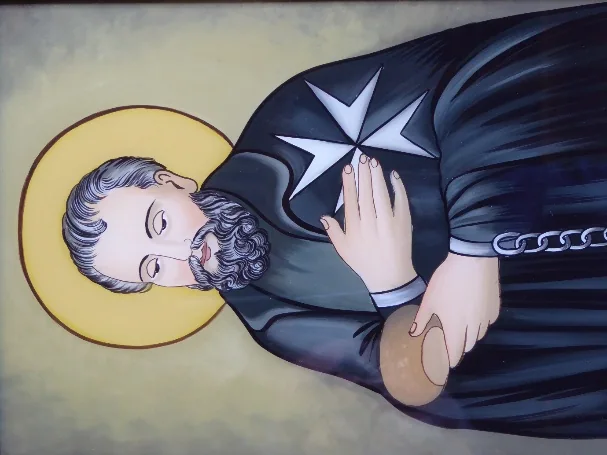
I. The Profession
First, I command that all brothers who come to serve the poor keep, with God's help, the things they have promised to God, into the hand of the priest and on the book (= Holy Scripture): These are chastity and obedience ; this is all that is commanded of them by their leadership (= superiors), and that they live without possessions , because these three things (obligations) are what God demands of them on the Last Day. |
II. The brothers' claims
And they shall grant you no more
(lat./fr.: they shall not ask for more) of your claim than the water and bread and clothes that are promised to you. And their clothing should be modest,
since we call ourselves servants of our Lord's poor , who walk naked and dirty. And it is shameful for a servant to be proud while his master is humble. |
III. The Honour of the Brothers, Church Service
, and the Hospitalisation of the Sick
It is also stipulated that their conduct and lifestyle in the church must be honourable. This means that clerics serve the priest at the altar in white robes (= albs), be it a deacon or a subdeacon, or if necessary, another brother who is trained. There should be a light (burning) in the church day and night. And when visiting the sick , the priest should wear white robes and piously carry the body of our Lord . And a deacon or a subdeacon or an acolyte shall go ahead carrying a lantern with a burning candle and a holy water font. |
IV. The brothers' travels and their behaviour towards women
But when the brothers go through the cities or the castles, they do not go alone, but in pairs or in groups of three. And they should not go with whomever they want, but with those whom the superior commands them to go. And as soon as they arrive where they want to go, they stop. Nothing should happen in her appearance, her way of life, or in any of her possessions that could cause offense, as befits her holiness (= holy state). Even when they are in the house or in church, or wherever women are, they should maintain their modesty (decency). Women, however, should neither wash their heads nor their feet nor make their beds. May our Lord, who dwells in his saints, protect them in this way. Amen. |
V. Alms Collecting
collect alms for the holy poor , religious persons, clerics and lay brothers, should set out on their way. When they are looking for lodging, they go to a church or to another respectable person and ask for something for their sustenance for God's sake and buy nothing else. If they can't find anyone to give them something, they should buy a single, moderate amount of food that they can live on. |
VI. The Use of Alms
to the poor of the hospital with an accompanying letter . And the superior shall receive from all the houses a third part of bread, wine and all food. And whatever is left over, he shall give to the poor in Jerusalem , along with his written confirmation . |
VII. The preaching and fundraising tours
No brothers should leave any house
to preach or collect alms, except those whom the superior and the chapter designate to do so. The brothers who go out to collect alms shall be received
in whatever house they enter and share in the sustenance of the brothers among themselves and shall ask for nothing further. They should carry a light with them,
and wherever they find lodging, they should leave it burning before them at night. |
VIII. Clothing and Fasting
Furthermore, we forbid (prohibit) the brothers from wearing iron (= rust) brown and yellowish-brown cotton cloth (= fustian) and furs of wild animals. They should also not eat more than twice a day, and every Wednesday and Saturday from then until Easter, when the Alleluia is said (= Septuagesima, i.e., the pre-Lenten season), they should not eat meat, except for the brothers who are weak and sick. They should also not lie (= sleep) naked, but in linen clothing or flax skirts. |
IX. The punishment for the brothers' fornication
And if a brother, which God forbid, has fallen into unchastity, let him do penance in secret, if he has sinned in secret, and a suitable penance should be prescribed for him.
But if he is caught and the truth is made public, he shall be stripped naked in the same village where he sinned, on the Sunday after the first Mass, when the people are leaving the church, so that everyone can see him, and he shall be beaten by a cleric on the instructions of his superior, if the one who sinned is a cleric. But if it is a layman, he shall be beaten most severely with whips or straps by a cleric or by one whom the cleric recommends, and he shall be expelled from the entire community of the order and the brothers. If, after that, God enlightens his heart and he returns to the house of the poor and confesses that he is guilty and a sinner and has transgressed God's laws and promises to amend his ways, then he shall be received back, and a worthy penance shall be imposed upon him. He is to be kept in the position of a stranger throughout the year, and during this time the brothers are to observe his improvement and later do what seems best for him. |
X. The penalty for disputes and unauthorized leaving of the house
If one brother gets into a quarrel with another and the matter comes before the Commander, he shall do penance for seven days and fast on Wednesday and Friday on bread and water, eating on the floor without a table or tablecloth. However, if one brother stabs another, he should be made to do penance for fourteen days, every Wednesday and Friday, on bread and water. If he (= one) leaves the house or the superior to whom he is entrusted, wilfully against the will of his superior, and then returns, he shall eat on the floor for fourteen days and fast on bread and water every Wednesday and Friday. and he shall remain in the position of a stranger for as long as he has been outside, unless the board of directors’ orders (the length of time) to reduce it. |
XI. The Silence
At the table, as the Holy Apostle says,
everyone should eat their bread in silence. and after Compline he drinks nothing but pure water, And the brothers are to keep silent in their beds. |
XII. Procedure in case of disorderly behaviour of a brother
If a brother behaves disorderly and is punished by his superior or reprimanded two or three times by other brothers, and he does not improve after being warned by the whispers of the devil, he should be sent to us with a letter listing his guilt. He should be given modest provisions for his journey so that he can come to us and we can judge him (decide his fate). No one shall strike servants entrusted to him, except the head of the house and brothers administering punishment to him in full view of everyone. In any case, one should fully respect the rights of the house. |
XIII. The procedure when discovering (unauthorized) possession
by a brother
If it happens that any brother who should be without property has property at his death which he did not show to his superior during his lifetime, no religious services should be held for him, but he should be buried like a convict. If, during his lifetime and in good health, he has property which he hid from his superior and which is then found in his possession, then his property shall be tied around his neck, and he shall be led naked through the hospital in Jerusalem or through the other houses where he lives and shall be beaten by a cleric if he is a cleric. But if he is a layman, let another who is commanded to do so strike him, and let him sit on the bare ground for forty days, fasting every Wednesday and Friday on bread and water. |
XIV. The Exequies (The Office of the Dead)
And what is also very necessary, we command you all to observe the regulations for all those who are departing (= dying) in all houses. In whatever house they die, thirty masses should be sung for the soul of the dead brother. At the first Mass, each brother present should offer a candle with a penny. No matter how many pennies it is, they should be given to poor people. And the priest who sings all the masses shall receive his food throughout the day if he does not belong to the household. Once the office is completed, the superior should show him favour. All the clothes of the dead brother should be given to poor people. And the brothers who are priests, when they sing Mass, should offer their prayer to our Lord Jesus Christ for his soul. Every member of the clergy should pray a psalter for him, and every layman fifty Our Fathers. One should also decide and judge fairly on other transgressions and on all matters within the chapter. |
XV. Exhortation to Zeal
And we command all these regulations, as we have issued them, to be observed with the utmost zeal in the name of Almighty God, and of the Blessed Virgin Mary, and of St. John, and of the poor holy . |
XVI. The reception and care of the "sick gentlemen"
If a sick person comes to the house to whom the hospital master grants the right and permission to run a hospital, then he shall be admitted. First, he should confess his sins to the priest and receive spiritual care [i.e., Holy Communion for the Sick]. Then he should be carried to the bed and, like a master, lovingly fed every day according to the means of the house, even before the brothers eat. And on every Sunday, the Epistle and the Gospel should be read in the hospital, and during the procession, the sick person should be sprinkled with holy water. If it happens that one of the brothers who look after the houses in the country gives away the property of the holy poor to any secular person against the will of the superior, he shall be expelled from all fellowship of the brothers. |
XVII. The fraternal rebuke
Even if two or more brothers are together,
and one of them leads a disgraceful life, the other brother should not bring him into disrepute before the people or the prior but should first rebuke him himself and exhort him to improve. But if he does not want to improve his attitude, the brother can take one or two more brothers, and they should admonish the brother who is not behaving well a second time to improve his life. If he does this, they should be glad and praise God because of him. However, if he refuses to reform, they should confidentially (secretly) report the brother's life and guilt to the board. After that, whatever the superior wants happens to him. |
XVIII. The accusation of another brother
But no brother should accuse his brother unless he can prove it. But if he does, he is not a good brother,
and he shall suffer the punishment that the accused brother would have had to suffer as soon as it could have been proven. |
XIX. Wearing the cross on clothing
Furthermore, all brothers in all houses who now or later dedicate themselves to God and the holy hospital in Jerusalem shall wear crosses on their breasts, on their cloaks and on their mantles in honour of our Lord and God. That God, for the sake of the same sign—faith, works, and obedience—may protect us and shield us from the power of the devil in this world and the world to come, both in soul and body, together with all Christians who do us good.
Amen. |
 The oldest known manuscript dates from October 7, 1253.
 The original rule of the Order