B. Sources of spiritual Traditional goods
The various hypotheses regarding the origin of the Rule of the Order of St. John have already been briefly mentioned above. In contrast to these opinions, Truszczynski () asserts 464that the Rule issued by Gérard, the founder of the Order, was a Benedictine-based rule. This assumption is plausible, since the hospital already belonged to the Benedictine monastery of St. Maria Latina before 1099. Other authors believe that Gérard or Raymond adopted the Augustinian Rule. Referring to the hypothesis, supported above, of the independence of the Rule of the Order of St. John, since Pope Lucius III compared both rules and the Rule of the Order of St. John contains parts of the Augustinian Rule verbatim, this hypothesis can be explained and substantiated below:
To explain the hypothesis, the elements of the Rule of the Order of St. John are used, which 465are common to the Rule of St. Benedict466or the Rule of St. Augustine or to both.467

The oldest manuscript of the Rule of the Order of St. John468
The following diagram briefly shows
the content-related parallels between the compared rules:
| No. | Theme |  rule of Order of St. Johannes |
 Rule of St. Augustine |
 Rule of St. Benedict |
|---|---|---|---|---|
| 1 | no property | I, 2 ; XIII, 1 | I, 4 | XXXIII, 6; LV, 17 |
| 2 | obedience | I, 2 | II, 44 | V |
| 3 | The order provides food and clothing. | II, 1 | I, 4 | |
| 4 | simple clothing | II, 2 | IV, 19 | LV, 7 |
| 5 | Foreign travel only in pairs or groups of three, accompanied by a supervisor. | IV, 1 f. | V, 36 | |
| 6 | Brothers are the temple/dwelling place of God | IV, 7 | I, 9; IV, 24 | |
| 7 | inconspicuous behaviour | IV, 4 | IV, 19 | |
| 8 | general behaviour | IV, 4 | IV, 20 f. | |
| 9 | Contact with women | IV, 5 f. | IV, 24 | |
| 10 | Light in the night | VII, 3 | XXII, 4 | |
| 11 | Fasting, except in cases of illness | VIII, 2 | III, 14 | |
| 12 | sleep dressed | VIII, 3 | XXII, 5 | |
| 13 | Punishment for sins with women or fornication | IX | IV, 29 | |
| 14 | Punishment for serious offenses | IX | XXV | |
| 15 | Satisfaction of the displaced | IX, 4 f. | 44 | |
| 16 | Dispute between brothers | X, 1 f. | VI, 41 f. | LXX |
| 17 | Repatriation of escaped brothers | X, 3 f. | XXIX | |
| 18 | Silence at the table | XI, 1 | III, 15 | XLII, 8 |
| 19 | fraternal correction | XII, 1 XVII |
IV, 25 | XXIII; XXVIII; LXX |
| 20 | Denunciation to superiors | XII, 1 XVII, 4 |
IV, 26 | XLVI, 4 |
| 21 | Reception of the sick / guests | XVI | LIII | |
| 22 | to care for the sick/guests first mentally, then physically | XVI, 2 f. | LIII, 4+8 |
The diagram above illustrates the close thematic connection between the rules. This may be due, in part, to the fact that all three rules were written for members of religious orders. Certain elements are therefore found in each rule. This certainly applies to the themes of poverty, simple clothing, obedience, and silence. However, there are parallels in individual regulations and statements that suggest a closer relationship. Steidle () 469deals with the influence of the Rule of St. Augustine on the Rule of St. Benedict. He identifies the paragraphs XXXIII,6; XLII,8; and XLVI,4 cited above as Augustinian parts of the Rule of St. Benedict. Regarding the dependence of the Rule of the Order of St. John on the Rule of St. Augustine, we even find a literal correspondence () 470in Chapter 4 of the Rule of Raymond:
| Rule of the Order of St. John IV, 1-5.7 |
Rule of St. Augustine V, 36 |
|---|---|
| (1) "Iterum cum ierint fratres per civitates et castella, non eant soli sed duo vel tres, | Nec eant ad balneas, sive quocumque ire necesse fuerit, minus quam duo vel tres. |
| (2) nec cum quibus voluerint, sed cum quibus magister iusserit ire debent, | Ne qui habet aliquo eundi necessitatem, cum quibus ipse voluerit, sed cum quibus praepositus iusserit, ire debebit. |
| (3) and cum venerint quo voluerint, simul stent | (IV,20) cum veneritis quo itis, simul state. |
| (4) in incessu; in habitu et in omnibus motibus eorum nichil fiat, quod cuiusquam offendat aspectum, sed quod suam deceat sanctitatem. | (IV,21) In incessu, in statu, (in habitu) in omnibus motibus vestris nihil fiat quod cuiusquam offendat aspectum, sed quod vestram decet sanctitatem. |
| (5) Quando etiam fuerint in domo aut in ecclesia, vel ubicumque femine sint invicem, suam pudicitiam custodian... | (IV,24) Quando ergo simul estis in ecclesia et ubicumque et feminae sunt, invicem vestram pudicitiam custodite; |
| (7) Deus enim, qui habitat in sanctis, iso modo custodiat eos, amen. | Deus enim, qui habitat in vobis, etiam is modo vos custodiet ex vobis. |
Ambraziejute only allows for dependencies in cases of literal correspondence to471. This may be too simplistic, because beyond literal correspondence, there are close parallels in content and theme to both the Rule of Saint Augustine and that of Saint Benedict. A dependency is particularly likely where a specific regulation is concerned, such as light in the dormitory () 472or lying clothed. A fundamental aspect of the spirituality of the Order of Saint John parallels the Rule of Benedict: In chapter LXIII,13, Benedict stipulates that the abbot should be called " Lord " and " Abbot ," " because we believe that he takes the place of Christ ." What a minimal difference to the dominus predication of the sick, who in the Order of Saint John are called "poor " Christ473“, “holy arms474” are called because he sees the Lord in them!
If this Geraldus, whom William of Tyre refers to after 1048 as head of the branch hospice of the Order of St. John belonging to the monastery of St. Maria Latina () 475, is identical with the Gérard who founded the Order of St. John in 1099, and if one further assumes that the first-mentioned Geraldus was a Benedictine monk and was entrusted by the abbot of St. Maria Latina with the management of the hospital, then the incorporation of Benedictine elements into the rule of the Order of St. John is plausible. A direct adoption of the Rule of St. Benedict was not possible with regard to Gerhard's aims, since the Rule of St. Benedict was too narrowly defined for his foundation. What could be more natural than to pick out the appropriate elements from the Rule of St. Benedict, add elements from the more general Rule of St. Augustine, as well as one's own ideas and ideals, and fuse all these ingredients into a new rule, which Gerhard's successor, Raymond du Puy, recorded in writing as the Rule of the Order of St. John? The strong Augustinian influence evident in Raymond's Rule becomes more understandable when one considers that the Augustinian Canons Regular of the Church of the Holy Sepulchre lived in the immediate vicinity of the Hospital of St. John in Jerusalem. Delaville () 476even deduces from the strongly Augustinian character of the Rule of the Order of St. John a striving for independence from the Benedictine monastery of St. Mary Latina.
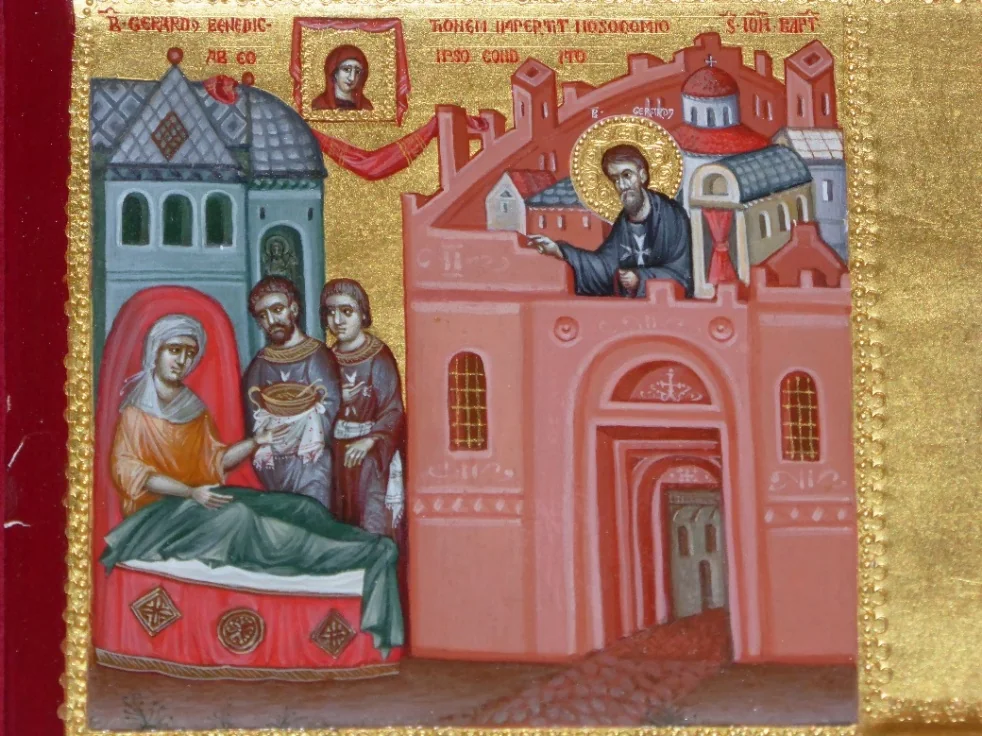
Picture477
Excerpt from the icon of Our Lady of Philermos, written by Makarius Tauc, in the Spiritual Centre of the Knights of Malta in Ehreshoven/Germany.
The inscription on the image excerpt reads:
“Beatus Gerardus benedictionem impertite noscomio Sancti Joannis Baptistae ab eo ipso conditio” –
"Blessed Gérard blesses the Hospital of Saint John the Baptist, which he founded."