6. The revival of hospitality in the Holy Land
The Order of St. John is present again today through
a. The Hospital of the Holy Family in Bethlehem261
 262
262
Hôpital de la Sainte Famille Bethlehem

https://www.malteser.de/spenden-helfen/krankenhaus-bethlehem/ueber-das-krankenhaus.html
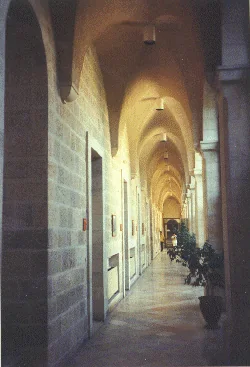 The hospital was opened in 1882 by the Sisters of Mercy (Rue du Bac) and operated until 1985, when they approached Count Pierredon of the Order of Malta to request that he take over or close the hospital. The Order of Malta assumed management, administration, and finances, but converted it into a maternity hospital. The first baby was born on February 26, 1990. Mr. Mohan told the author of this paper during a visit there in 1994 that it had taken the Order of Malta five years to complete the 28-bed hospital. It opened on February 26, 1990, and since then, over 6,000 babies have been born there. Mothers pay a fee of 550 shekels per delivery and stay for three days after giving birth. The cost per delivery is 1,500 shekels. The patients come mainly from Bethlehem, Bejara, and the Hebron area. In addition to inpatient care, the hospital offers six outpatient clinics per week, and patients pay 20-25 shekels per visit. Operating costs (1994) amounted to 1.2 million shekels, with a deficit of 600,000 shekels, which is covered equally by the French Association of the Order of Malta and various other national associations of the Order. For comparison, Medical Aid pays 3,000 shekels for childbirth in an Israeli hospital.
Plans include expanding the hospital by five single rooms, an intensive care unit and a second operating room.

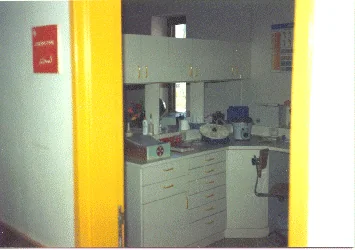
The laboratory
All images on this page are the author's own photographs.
 Image264
Wikipedia265writes:
"The hospital has been run by the Order of Malta since 1990. Located above the Church of the Nativity in Bethlehem, the clinic provides medical care for the local population. Above all, with approximately 3,500 births annually, it is the largest obstetrics and gynaecology clinic in the region and is open to pregnant women of all nationalities and faiths. A mobile unit also provides medical care for pregnant women in the desert villages of the West Bank. The hospital's capacity has been expanded to 63 beds, and a new floor with a delivery room and a larger neonatal intensive care unit has been inaugurated. A diabetes clinic for pregnant women, offering free care, has also been opened. Furthermore, a new paediatric and neonatal unit has been established with a donation from the Belgian government.
Since 2016, there has been a cooperation agreement with the Bambino Gesù Children's Hospital of the Holy See in Rome.

b. The St. John Eye Clinic in Jerusalem267
The hospitality of the Order of St. John was revived in Jerusalem in 1882, when the Most Venerable Order of St. John268established an eye hospital in Jerusalem.
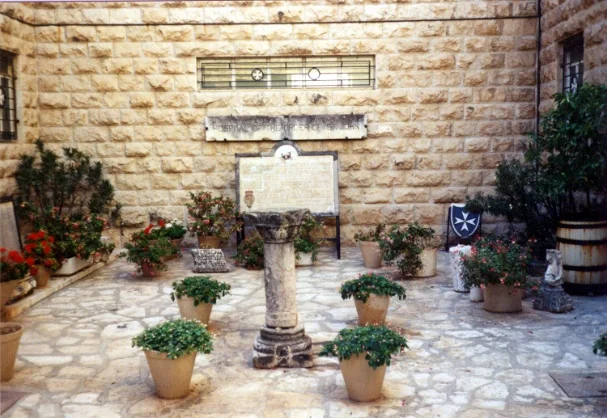
In Muristan, where the original hospital of the Order of St. John stood in the 12th century, stands this memorial stone:
 “Here in the Muristan was situated the first hospital of the Knights of St John of Jerusalem during the twelfth and thirteenth centuries in 1882 the Grand Priory in the British Realm of the Most Venerable Order of the Hospital of St. John of Jerusalem established an ophthalmic hospital in the Holy City in emulation of the humanitarian and charitable efforts of its mediaeval predecessors for the eleven years from 1949 to 1960 this work was centered in the adjacent properties known as Watson House and Strathearn House to commemorate these events the most venerable order owner of this site constructed this garden and inscribed this stone in 1972.
Pro Fide Pro Utilitate Hominum
In 1960 the work was moved to a new hospital in the Sheikh Jarrah Quarter of Jerusalem.”
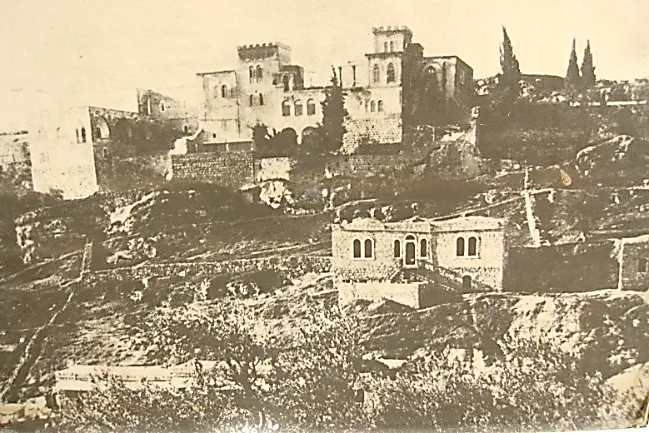 Image269
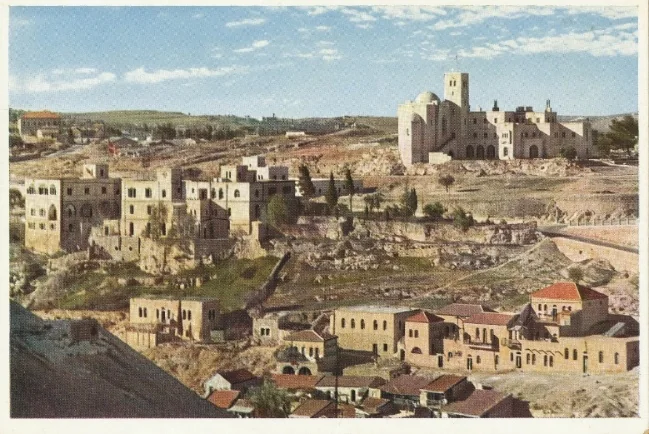 It was initially located on Bethlehem Road south of the Old City of Jerusalem but was destroyed in 1917.
The “St. John of Jerusalem
Eye Hospital Group” in 1930270


It was re-established in 1960 in a new building at Hebron Rd 17, Jerusalem, which now houses the "Mount Zion Boutique Hotel & Suites".

The St John of Jerusalem Eye Hospital Group's
Jerusalem Hospital is now located at Sheikh Jarrah in Jerusalem.272

Wikipedia274writes:
"The main Jerusalem hospital is an ISO and Joint Commission International accredited, general eye hospital. It has a 49-bed capacity and is staffed by both foreign and local specialist surgeons, doctors, paramedics, overseas medical volunteers and nurses. There is a large Outpatients Department and specialist retinal, corneal and pediatric services. The hospital also has a research unit.[4]
The hospital attracts a substantial number of volunteer doctors from around the world who not only help care for the patients but also help in the teaching and training of the local doctors.[5]"
Current information about the St. John Eye Clinic in Jerusalem275
The St. John Eye Hospital Group will remain active in 2026 and will be the only non-profit provider of specialized eye care in East Jerusalem, the West Bank, and Gaza. The hospital group has reaffirmed its mission to help regardless of ethnicity, religion, or ability to pay.
Current information (as of January 2026)
Operations: The main office in East Jerusalem is operational and serves as a central point of contact for patients from the entire region.
Patient numbers: In 2025, over 232,000 patients were treated and 4,550 major operations were performed, with almost half of the patients being children.
Expansion: In March 2025, a new, fully equipped hospital was opened in Nablus to improve access to medical care in the northern West Bank.
Situation in Gaza: The situation in Gaza remains difficult. The hospital there had to be evacuated for security reasons, but the teams are continuing their work at two temporary sites/field clinics in Deir al-Balah and Nuseirat, as well as via mobile clinics. Plans for the renovation of operating rooms at the Gaza hospital have been postponed indefinitely due to the ongoing conflict.
Education: The clinic is also a leading institution for education and research in the Palestinian territories, offering, among other things, a nine-month program in partnership with Al-Quds University.
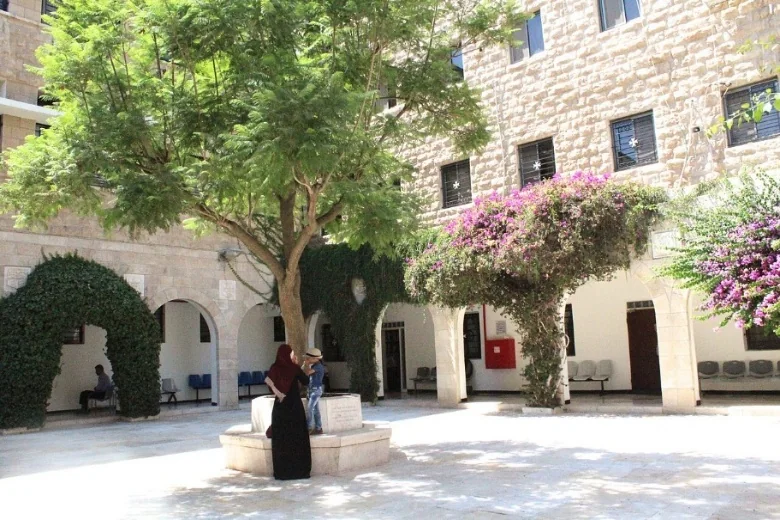
Photo: Saint John Eye Hospital Group
c. The Johanniter Order's Hospice in Jerusalem
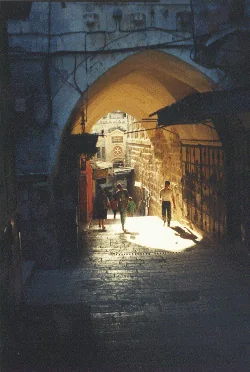
German Hospice of the Johanniter Order
on St. Francis Street in Jerusalem
– Via dolorosa


Story:
On December 11, 1866, the Protestant Johanniter Order acquired the Es Schurefa house on the Via Dolorosa. It had 18 beds and served as a rest stop and guesthouse for travellers to the Orient and missionaries. From 1866 to 1870, the Sunday service of the small German congregation was held there in the dining hall.
The Johanniter Order's newsletter of July 1936 states: "The hospice is used rather regularly by strangers; Knights Hospitaller have rarely requested accommodation there... Pilgrimage traffic to Palestine was interrupted during the First World War. The Kaiserswerth deaconess, Sister Theodore Barkhausen, represented the Order's interests in an exemplary manner. Only after the war was the Order able to re-establish contact with the hospice. Since then, it has been administered by a local committee... Work at the Johanniter Hospice in Jerusalem is currently light. This has several reasons. There are many tourists who want to be driven directly to their hotels with their luggage. This is much easier nowadays, as all hotels except the Austrian hospice and ours are located outside the Old City and are accessible by car. There are also a number of tourists who dare to walk through the Old City alone in the evening. We will hardly be able to attract these tourists to our hospice. – However, there are also travellers who find it interesting to stay directly in the Old City for a few days and enjoy the view of to enjoy the temple grounds on the Mount of Olives and the panoramic view over the rooftops of the old city with its unique charm, especially by moonlight. ..."
An old brochure [year?] advertises : “Since about the middle of the last [18th] century, when the [Protestant] Johanniter Order was re-established, it has maintained, true to its ancient principles, the Johanniter Order's Hospice in Jerusalem, very close to its original location. Given its central location in the Old City (only a 5-minute walk from the Church of the Holy Sepulchre and 8 minutes from the Temple Mount), its antique architectural style, yet its modern amenities (electric light, telephone, running water, and a bathroom), its Christian and friendly, family-like atmosphere (accommodation for 18 people), and the option of offering only accommodation or full board at moderate prices, this hospice can be warmly recommended to travellers to the Orient and missionaries as a place to stay and rest. The hospice manager organizes affordable domestic travel and, whenever possible, is willing to act as a personal and free guide for excursions in or outside Jerusalem. Details and prices are available upon request from the manager.”
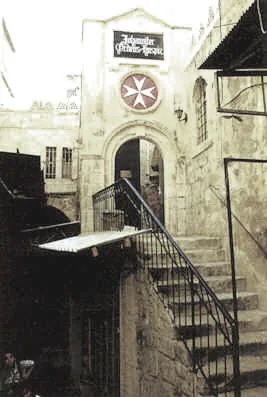
Sister Renate Sopp of the Jesus Brotherhood explains in an article entitled "St. John's Hospice in Jerusalem – In the Bustle of the Old City": "...The venerable building of the St. John's Hospice has been the home of the sisterhood of the Jesus Brotherhood in Jerusalem since 1985. ... The Brotherhood is affiliated with the Diaconal Service of the Evangelical Church. Its centre is in Gnadenthal, Germany. ... We are also delighted with the St. John's Hospice because we gladly and conscientiously continue the tradition of this house. It was founded in the middle of the last century to take in pilgrims and the homeless and to give them practical help and inner guidance. Our service today takes place on a much smaller scale but is in keeping with the past. One of the largest and most beautiful rooms in the hospice is the former dining hall. Evangelical services and Bible studies were held there in Jerusalem when the German congregation consisted of only a handful of people. We have transformed this room into a chapel where we celebrate our Liturgy of the Hours and where there is space for private prayer." There is space available – also for guests. It gives us courage and joy that prayers were offered here 100 years ago. The Hospitaller Hospice is located in the heart of Jerusalem's bustling Old City. During the Second World War, it lost its function as a hospice and became accommodation for Arab refugees of the Israeli War of Independence. Three families of these refugees still live in the rooms assigned to them back then. Others have since passed away, moved out, or been purchased by the Johanniter Order. We now live in the vacated rooms. "Live" is only partially accurate, as not all of them are habitable. Much renovation work is still needed. We are happy to be able to undertake this work ourselves as tenants of the Johanniter Order, with their support, and thus experience firsthand how old, dilapidated rooms are once again becoming beautiful and usable. Our Latroun brothers are helping us with this. Many volunteers are also lending a hand. We are all delighted by the rebirth of the Hospitaller Hospice in the heart of Jerusalem. A symbol of this is the new carved sign above our entrance, which – as in old ones – Times – now announced again: Johanniter Hospice.”
In an article entitled "New Paths – Open Doors in Jerusalem" in Kreuz & Quer No. 13 (1993), Roland Werner writes in a letter to the friends of the Christ Meeting and the Jesus Community: "A life centre of the Community of Jesus in Jerusalem at the Johanniter Hospice on the Via Dolorosa. ... In June 1992, ... the Brotherhood of Jesus asked our community to continue the work at the Johanniter Hospice in accordance with their principles. ... [The takeover was completed in March 1993. The goals of the house can be summarized as follows:] It is to become an open house for many people, supported by a community that plans and works in close connection with the Community of Jesus and the Christ Community in Marburg..."

Current information about the Johanniter Order Hospice in Jerusalem277
The Johanniter Hospice in Jerusalem (Johanniter Ordens-Hospiz) will continue to operate as an active Christian pilgrim hostel and meeting place for the year 2026 .
Current situation and operations 2026
Operation: The hospice is regularly open to pilgrims and visitors. It offers approximately 20 rooms with 14 to 18 guest beds in Jerusalem's Old City, directly at the 8th Station of the Via Dolorosa .
Community: Since 1993, the house has been enlivened by the Christus-Treff Marburg , which maintains an ecumenical community there as a tenant and seeks contact with Jews, Arabs and international guests.