D. The Influence of the Order
The Order of St. John, its rule, and the practices underlying it exerted a formative influence on monastic and church history from early times. This is most clearly demonstrated by the fact that its rule, as an exemplary rule, was adopted in whole or in part, or in the spirit of, later orders.
The Hospitaller Order of Teruel
The Teutonic Order of Saint Mary in Jerusalem
The Hospitaller Order of the Holy Spirit
The Order of Bridge Builders of Saint James
The Order of the Trinitarians
French hospitals
Order of the Knights of the Cross with the Red Star
In doing so, the Order of St. John set standards for Christian charity in large parts of the West for centuries.
The Hospitaller Order of the Holy Redeemer of Teruel

Pope Clement III.507
transferred on July 18, 1188508 The rule of the Order of St. John the Hospitaller Order of the Holy Redeemer of Teruel , which had been founded by King Alfonso II of Aragon for the release of prisoners. Later in 1188, the Hospitaller Order of the Holy Redeemer was united with the Order of Mountjoy (Montegaudio), and the hospital was given to the Templars in 1196.
The Teutonic Order of Saint Mary in Jerusalem

The Teutonic Order of Saint Mary of Jerusalem
(Teutonic Knights),
whose aim was the fight against the enemies of the Church and the charitable duties towards the poor, also adopted the rule of the Order of St. John in its constitution509in 1198 , concerning the care of the poor and sick.
 As early as 1143,
Pope Celestine II subjugated510 the German Hospital to the obedience and authority of the Order of St. John511.
“In 1143, Pope Celestine II issued a bull granting the Order of St. John jurisdiction over the Santa Maria Alemanna (Church of St. Mary of the Germans) in Jerusalem, a hospital that had housed German pilgrims and crusaders since 1128 who spoke neither the local language nor Latin. Although formally an institution of the Order of St. John, the Pope decreed that the prior and the brothers of the domus Theutonicorum (House of the Germans) should always be German themselves. Thus, in the 12th century, a tradition of a German-run religious institution developed in the Kingdom of Jerusalem. The latter gained its independence in 1190 and remained under the responsibility of the Order of St. John until 1229.512”
 Pope Innocent III,
in his bull “Sacrosancta Romana ecclesia” of February 19, 1199, expressed his satisfaction that the Teutonic Order, in its care for the poor and sick, was indeed following the rule of the Order of St. John513.
Image514
 515
515
Pope Celestine III
presents the Black Cross to the Teutonic Order.
 The predecessor of the
Teutonic Order
was " St. Mary's
of the German Knights "
A sign near the ruins explains:
"St. Mary's of the Teutonic Knights
In 1128, during the Second Crusade, a group of Teutonic Knights was formed to care for pilgrims in the Holy Land who were unfamiliar with the language of the other crusaders.
Besides a church, the Knights' Jerusalem centre at St. Mary's consisted of a hostel and a hospital. After many years, the Knights managed to separate from the dominant Hospitaller Order, and in 1190, during the Third Crusade, the Teutonic Order was founded. In the second half of the 13th century, part of the complex was destroyed by the Mamluks. Subsequently, residential buildings, storehouses, and stables were built on the site. Archaeological excavations began in 1968, followed by conservation and reconstruction work. This project was carried out on behalf of the Jerusalem Foundation by the Jerusalem Archaeological Expedition and the Company for Reconstruction of the Jewish Quarter of the Old City, with the help of a donation from AS Xel SE.
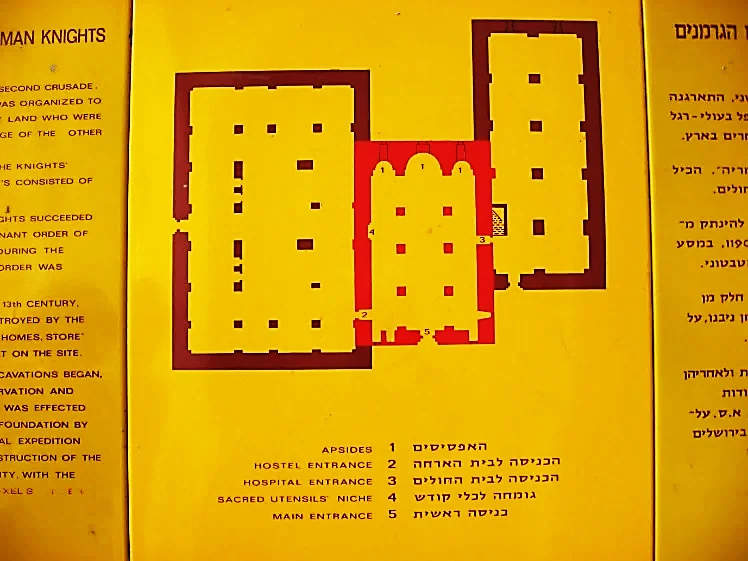 "The Church of St. Mary of the Teutonic Knights (also known as the Crusader Church of Santa Maria or the Church of St. Mary of the Germans) was a Crusader-era complex consisting of a church, hostel, and hospital. It was built in 1128 for German-speaking pilgrims. The Romanesque-style church was partially destroyed in the 13th century. In 1968, when the city began rebuilding the Jewish Quarter in the Old City, archaeologists unearthed the remains of the church. The site, located at the top of Ma'alot Rav Yehuda Halevi (the main staircase leading down to the Western Wall), was covered by collapsed buildings, some of which had served as makeshift dwellings and others as donkey stables. Archaeologist Meir Ben-Dov directed the excavation, conservation, and restoration of key elements of the site, which has been transformed into an archaeological garden with green spaces, seating, and information panels."516 Image517


Both images on this page are the author's own photographs.
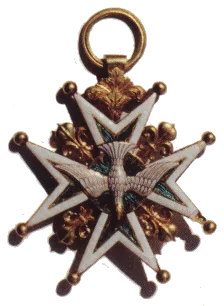
 The Hospitaller Order of the Holy Spirit
 Cruise ship passengers load their ships before departing for the Holy Land.
Image518
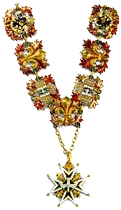
Collar
of the Order of the Holy Spirit, first half of the 19th century, France
Hospitaller Order of the Holy Spirit (Ordre Hospitalier du Saint-Esprit) , founded by Guido of Montpellier around 1170-1175 to care for the poor and sick, also modelled its charitable activities on the Order of St. John (519). Its rule ()520 In many respects it corresponds verbatim or in substance to the Rule of the Order of St. John.521
Google AI The Order of Bridge Builders of Saint James

The Order of the Bridge Builders of Saint James , whose task it was to build bridges to make it easier for travellers to cross rivers, and which also ran hospices, also based its charitable organisation on the Order of Saint John522.
 Image523
The French branch of the Order (de l'Hôpital d'Altopascio) received the Statutes of the Order of St. John from 524Pope Gregory IX on April 5, 1239 .
It says: " ...vobis regulam et institutionales hospitalis Sancti Johannis Jerosolimitani duximus concedendas, quas vobis et domui vestre volumus perpetuo observari." 525…. "...in habitu et aliis secundum regulam et institutions ipsius hospitalis [Sancti Johannis] incedatis . 526"
 (Translation: "...we have decided to grant you the rule and the institutions of the Hospital of Saint John of Jerusalem, which we want you and your household to observe forever." ... "that you dress and in other things according to the rule and the institutions of that very hospital [of Saint John]"
Image: Altopascio527 ild

The Order of the Trinitarians


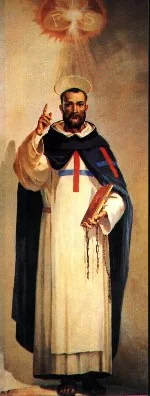

Saint John of Matha founded the Order of the Trinity531
(Order of the Most Holy Trinity for the Redemption of Captives) in 1197
to exchange prisoners.
 Pope Innocent III532
approved the order on December 17, 1198, with his letter “Operante divine dispositionis clementia.”
His rule also corresponds in some points verbatim to the rule of the Order of St. John or follows the same philosophy.
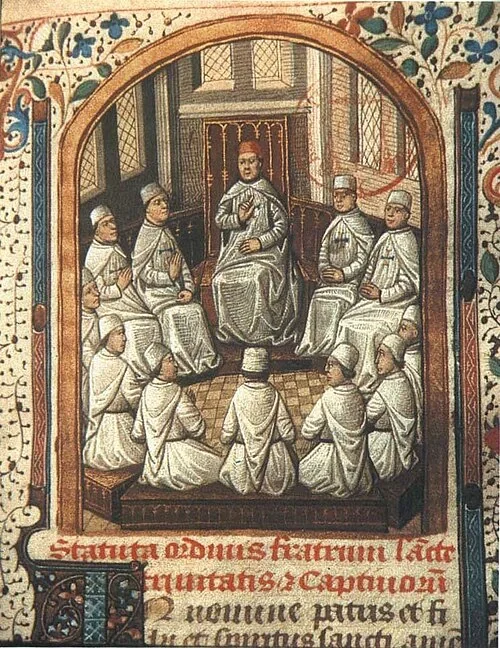 Image533
"The rule, which was alternately relaxed or reinstated, stipulated that each house should consist of seven brothers, one of whom should be the superior; the income of the house should be divided into three parts, one for the monks, one for the support of the poor, and one for the ransom of prisoners; finally, it forbade the monks from using a horse when traveling, either out of humility or because horses were forbidden to Christians in the Muslim countries to which the monks had to travel; hence their popular name, "Donkey Brothers" 534.
“The original rule of the Trinitarians (confirmed in 1198 by Innocent III) shows clear references to the older organisation of the Knights Hospitaller:
Referencing the sick: Both orders utilize the philosophy of the "sanctity of the poor." In the rules of the Knights Hospitaller, the sick were referred to as "our lords" (domini nostri). The Trinitarians adopted this hospitalic spirit in their daily practice of mercy.
Organization of the houses: The Trinitarian Rule stipulated that a community should ideally consist of seven brothers (four clerics, three lay brothers), led by a minister . This clear hierarchy and the distinction between the classes of brothers can be found in a similar form in the early statutes of the Knights Hospitaller.
Nursing as a duty: Although the Trinitarians were primarily a redemption order for slaves, their rule literally prescribed that hospitality and care for the poor and sick had to be provided in every one of their houses.535
Stamps of the Order of Malta dated March 2, 1998, commemorating the
800th anniversary of the founding of the Order of the Trinitarians:  536
536
| St. Felice de Valois, co-founder of the Order |
St. John of Matha receives the bull approving the Trinitarian Rule from Pope Innocent III. | St. John of Matha, founder of the Order the Trinitarians |
|---|
French hospitals
The same applies to French hospitals , e.g.
 in Paris (Hôtel Dieu)537,
Château-Thierry, Saint-Paul,
Mont Didier, Noyon,
Saint Julien, Saint-Jean in Cambrai,
Amiens,
Saint-Riquier,
Abbeville,
Beauvais and Montreuil-sur-More538.

The Order of the Knights of the Cross with the Red Star
Rytířský řád křižovníků s cervenou hvězdou
The commemorative publication marking 757 years of the Knights of the Cross with the Red Star reports:
"The mission and significance of the Order of the Knights of the Red Star were shaped both by the historical period of its founding and by the personality of St. Agnes Přemyslíd, a daughter of Přemysl Otakar I, who lived between 1211 and 1282. According to the Czech historian Josef Pekar, she is among the noblest figures in Czech history. Imbued with the reformatory religious ideals of St. Francis of Assisi (d. 1226), St. Agnes decided to renounce secular life and take the habit of a nun. She corresponded with St. Clare and with the centres of the new piety (devotio moderna) in Italy. She also followed the example of her aunt, St. Elizabeth of Thuringia, who founded the hospital in Marburg an der Lahn. This influenced not only St. Agnes's spiritual growth but also the spread of Franciscan ideals in the region." Bohemia.
In 1231, Saint Agnes appears to have co-founded two monasteries in Na Frantisku, Prague, which were then known as Bohemian Assisi. These were the Poor Clare convent, of which she became abbess in 1234, and the Franciscan monastery. The site also included a hospital, located near the Church of Saint Castulus, whose activities were more diverse than they are today. The term "hospital" derives from the Latin word "hospes" (meaning guest, traveller, stranger), which denoted a place where not only the sick, but also travellers, the poor, the homeless, and the unjustly persecuted were cared for. The hospital was managed by a lay brotherhood. The organisation and structure of its life and activities were based on rules already in place in other religious orders. The hospital brotherhoods of so-called knightly orders, such as the Order of Saint John , the Knights Templar, the Order of the Holy Spirit, and others, served as models .
At the request of Saint Agnes,

Pope Gregory IX, in , elevated 540
the Prague Hospital to the status of a separate order with the monastic rule of Saint Augustine.
 The Red Cross – symbol of Christian charity – was augmented in 1252 with a six-pointed red star. This symbol distinguished the Bohemian Order of the Knights of the Red Star from other hospitaller orders. To this day, it remains the only order of Czech origin and also the only male order founded by a woman. The mission of this order fulfilled the medieval man's desire for a union of chivalric and spiritual life. Among the most important characteristics of the order was its active charitable love for people in need of help and companionship.
The Order Cross541
The first independent settlement of the Teutonic Knights was the Church and Sanctuary of St. Peter in Poręčí, now part of Prague's New Town (Nově Město). This temple building is among the best-preserved Romanesque basilicas in Prague. In 1252, the Order's headquarters were moved to the crossroads near the Judita Bridge on the right bank of the Větava River. At the foot of the bridge, a new Hospital of the Holy Spirit and the Church of St. Francis were built. Both foundations recall the original cradle of the Order of the Teutonic Knights, as well as the Monastery of St. Agnes na Frantisku. The original church was later replaced by an early Baroque building from 1679 to 1688, constructed according to the designs of the renowned architect Jean B. Mathey and decorated with frescoes by V.V. Reiner and altarpieces by M.L. Willmann and J.K. Liska. The original Gothic church, however, never ceased to exist. Towards the end of the Middle Ages, the ground floor of the church sank almost five meters below the level of the adjacent  square due to the gradual rising of the old town's terrain and has remained in this state to this day. Later, it was converted into a burial and hospital chapel, which was decorated with artificial stalactites in 1683. The Baroque part of the monastery is located near the Church of St. Francis, on the foundations of the Judita Bridge, which was situated further north than the later Charles Bridge. The main Art Nouveau building was constructed between 1909 and 1912. In 1990, it once again became the headquarters of the Order of the Knights of the Crusades, which, after 40 years of suppression, is drawing on the spiritual legacy of its holy founder and renewing its activities for the benefit of the faithful.
Jan Nepomuk Jiriste, O. Cr.”
The Crusader symbol542
Images and text from: Galerie u Křižovníků.
The Treasure of the Order of the Knights of the Red Star. The catalogue of the permanent exhibition in the monastery building in Prague, Křižovníků Str. 1