3. Blessed Gérard
Founder of the Order
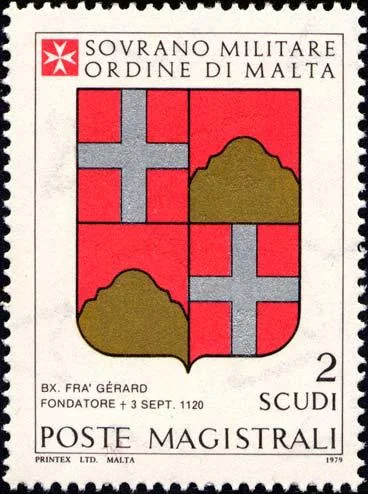
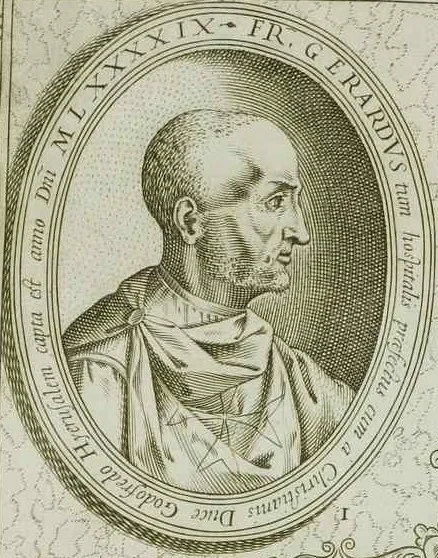
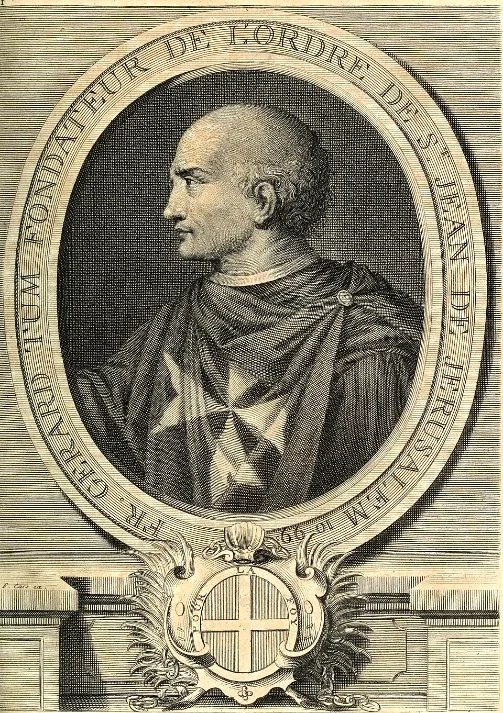
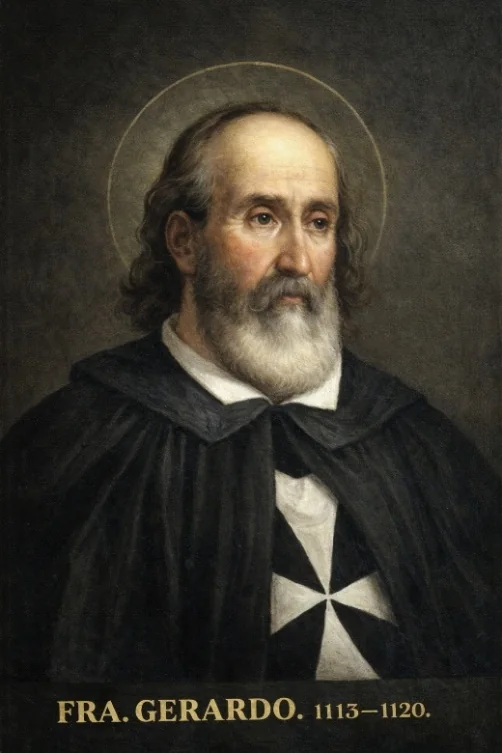


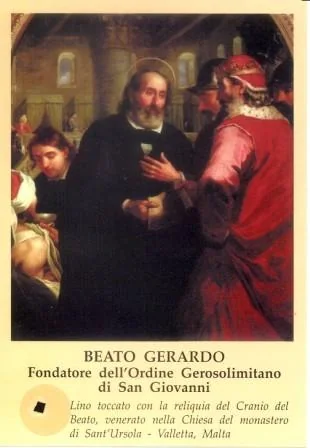
Gérard, the first rector of the Hospital of St. John of Jerusalem, was born in Amalfi according to some sources, and in Provence according to others. When Jerusalem was besieged by Godfrey, the barbarians imprisoned him in a dark jail, suspecting that, as a man of the utmost intelligence and great bravery, he might secretly smuggle the Christian army into the city. However, he was freed soon after the victor's entry. With profound piety, he served in the aforementioned hospital, and his reputation for charity and his noble order as a Hospitaller spread. Buglione and his captains honoured him with rich gifts, and thus the hospital's wealth and income grew, leading to the establishment of branches in various European provinces. Pope Paschal II, in a papal bull addressed to him, referred to Gérard as the founder and president of the Hospital of Jerusalem. He lived a life of piety and died at an advanced age in 1118 or 1120. He likely assumed leadership of the hospital as rector around the year 1099. He lived a devout life and maintained an impeccable character, which is why he is counted among the Blessed by the Holy Order of Jerusalem.

 Regarding the origin and history of Gérard, two main positions are opposed in historical scholarship:
Image100
Image101 :
Commemorative plaque in Martigue/Provence:
1. The Provençal Hypothesis102:
This tradition assumes an independent foundation and places Gérard's s 103 in Provence (southern France), more precisely on the island of Martigues near Marseille. Following this tradition, he 104is given the nickname "Tonque"105(in variations such as Tum, Tunc or Tenque).
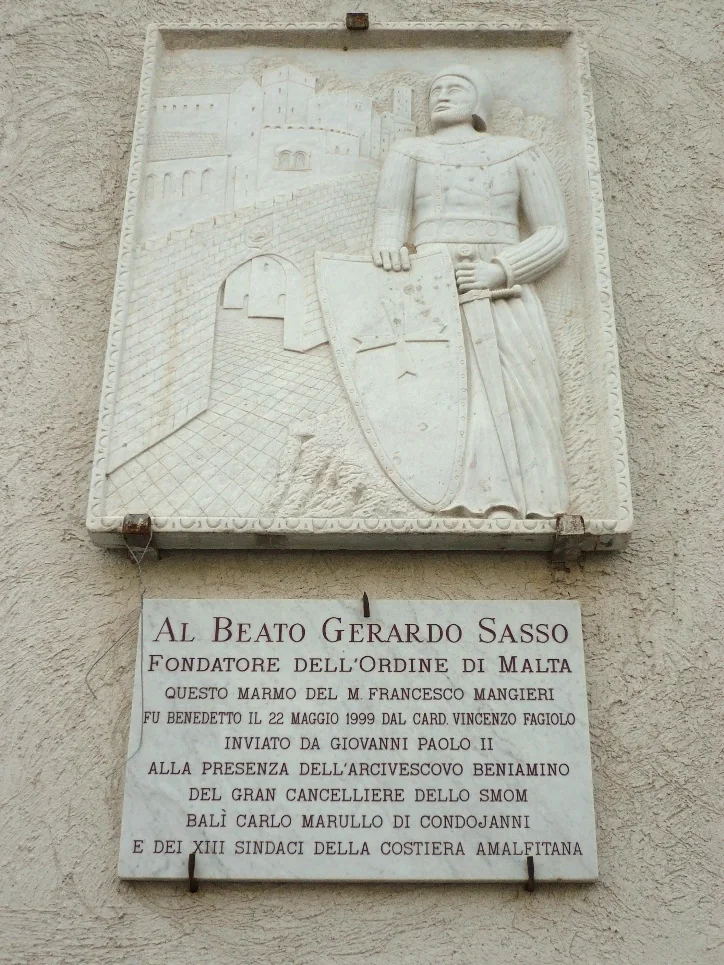 2. The Amalfi Hypothesis106: This represents the continuity of the hospital tradition and sees Gérard as a descendant of the "del Sasso" family.107 from Scala near Amalfi (southern Italy).108
It is not the aim of this study to definitively discuss the biographical details or the various versions of these hypotheses, although the probability that Gérard originated from Scala near Amalfi is very high. Regardless of which of these traditions is chosen, it remains clear that neither would proof of direct continuity increase the significance of the foundation, nor would the assumption of a spontaneous new foundation diminish it.
Image109
The Hospice of St. John remains, in any case, the historical cradle of the sovereign order known today as the Order of Malta.110
Regarding the institutional beginnings of the Order of St. John, differing research positions exist in historiography. One group of historians maintains that the original hospital was destroyed during the Seljuk attack between 1070 and 1078 and promptly rebuilt . 111In contrast, another view holds that the hospital withstood the Seljuk attacks, allowing its head to be personally present in Jerusalem during the decisive siege of 1099.
The figure of Blessed Gérard and the legend of the bread miracle
The historical identity of Blessed Gérard is inextricably linked to the events of the siege of Jerusalem in 1099. Contemporary chroniclers and later legends paint a picture of a man whose actions lie somewhere between historically documented steadfastness and miraculous divine intervention.

 William
of Tyre1186 112 (~1130-11861130–) was Chancellor of the Kingdom of Jerusalem. He died in 1190. Born around 1130 in Jerusalem, he studied in Europe from about 1145. After returning to his homeland in 1165, he was appointed Archdeacon of Tyre in 1167. In 1170, he was appointed tutor to the future King Baldwin IV, who appointed him Chancellor upon his accession to the throne. He wrote his widely acclaimed History of the Crusader States between 1169 and 1173 and became Archbishop of Tyre in 1175 .113
In his chronicle of the Crusades, "Historia rerum in partibus transmarinis gestarum" (History of Deeds Abroad), William of Tyre writes that Gérard was a man of "honourable conduct" who had long before humbly dedicated himself to serving the poor. He praises Gérard as a God-fearing man who led the hospital and, during the siege of Jerusalem in the First Crusade (1099), remained within the city walls and distinguished himself through exceptional charity. In summary, William of Tyre portrays Gérard as a humble servant of God whose organisational talent and profound charity laid the foundation for one of the most important orders of knighthood in the Middleages Ages 114.
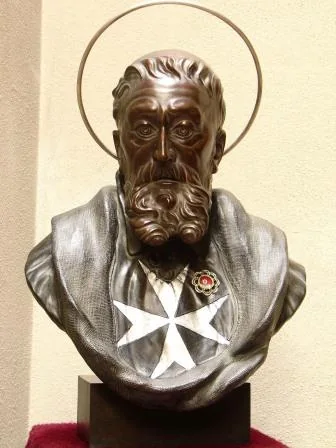
Blessed Gérard115
Crusaders
from William of Tyre's
"History of Deeds Beyond the Sea"116
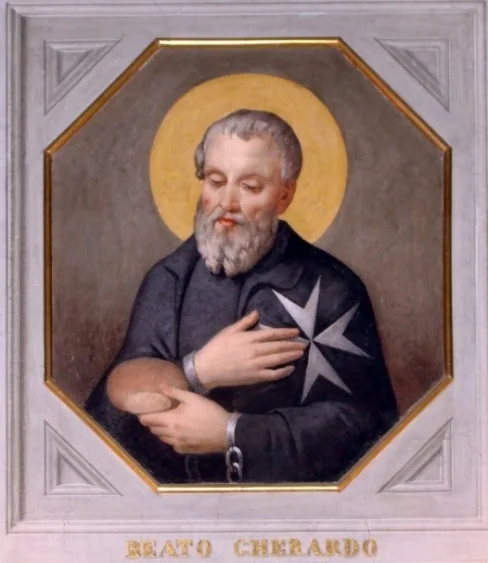
 During the siege of Jerusalem by the Christian army, Gérard fell under suspicion by the Muslim Fatimids of supporting the besiegers. William reports that Gérard was captured, tortured, and severely mistreated.
This historical hardship forms the backdrop for the so-called "Legend of the Bread Miracle." It is found in the *Miracles* , a collection of hospital legends that, from the late 12th century onward, were placed before the statutes of the Order of St. John as a spiritual introduction. While the first four legends construct biblical origins for the hospital, the story of the Bread Miracle, as the fifth legend, concludes the collection and transitions to the immediate history of the Order.
According to this account, Gérard administered the hospital under Saracen rule and served the poor with alms granted to him even by the rulers. When the Christian army lay before the walls suffering from severe famine, Gérard hid loaves of bread in his lap daily and threw them down from the city wall to the starving besiegers. Accused of treason by the Sultan's guards, Gérard was caught red-handed with the hidden loaves of bread and brought before the ruler. But when the accusers tried to present the evidence, they found, by the power of God, only stones in his garment. The Sultan, believing Gérard to be the victim of a malicious slander by his own servants, allowed the hospital administrator to leave in peace. Freed from suspicion, Gérard continued his work even more zealously, providing for the Christians until the city's capture on July 15, 1099.
This spiritual tradition has found a firm place in iconography:
A fresco () 117in the Chapel of the Grand Magistry in Rome depicts "Beato Gherardo" in chains, just as a representation in the Grandmaster's Palace in Valletta immortalizes the miracle of the loaves turning to stone. Modern research (cf. Oratores et Bellatores118) sees in these accounts the core of the historical truth: that Gérard supported the crusaders with both physical food and strategic information, and immediately after the victory took in the wounded at the Xenodochium .
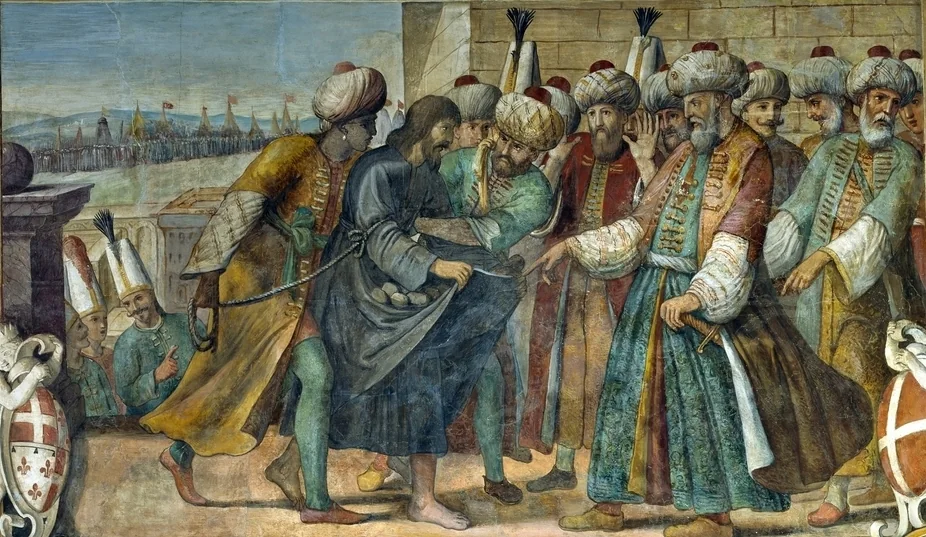
Fresco in the Grandmaster's Palace in Valletta119
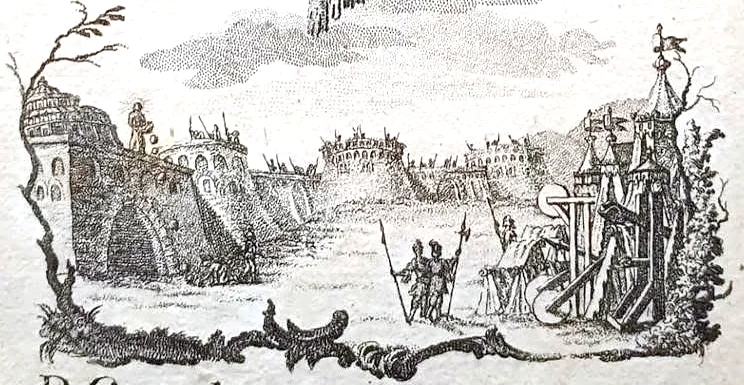 Blessed Gérard throws bread to the Crusaders from the city walls of Jerusalem. Detail of a copper engraving 120, probably from around 1740.
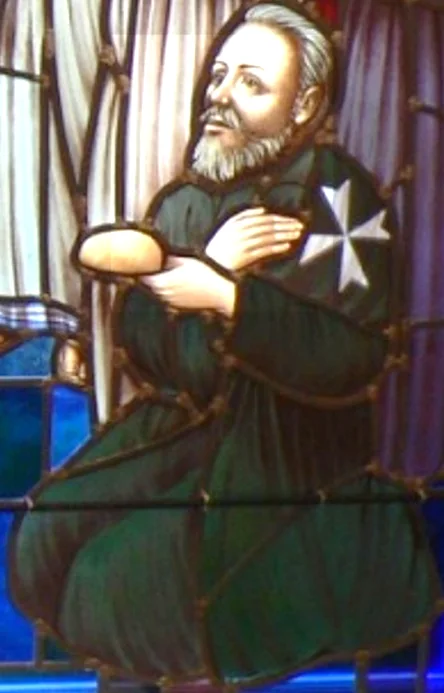

Icon of
Blessed Gérard121
Blessed Gérard122.
The reorganisation of 1099 as the founding act
The historical significance of Blessed Gérard is manifested in his role as a reformer and benefactor.
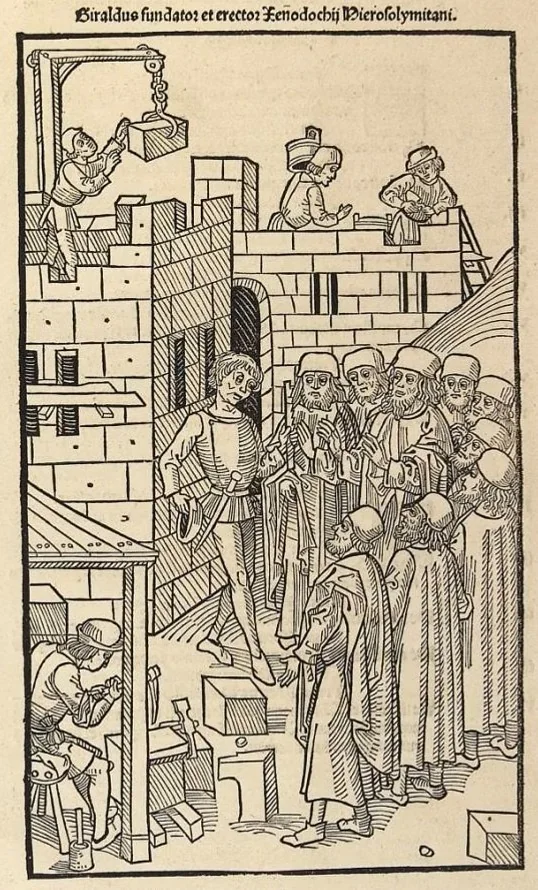 William Caoursin () 123aptly describes him as the "founder and builder of the Jerusalem Xenodochium." Immediately after the conquest of Jerusalem in 1099, Gérard subjected the existing hospice to a fundamental reorganisation. This measure was a logistical necessity in view of the massively increasing number of patients—resulting from wounded Crusaders and the throngs of pilgrims who followed them.
In historical research, the year 1099 is rightly considered the founding year of the community124, which developed into the Order of St. John125. For the sake of institutional continuity, it is secondary whether this act represented a formal separation from the mother monastery of St. Maria Latina and a modification of the Rule of St. Benedict, or whether the hospital brotherhood gradually adopted the structure of an independent order. In any case, it is historically legitimate to designate Gérard as the founder of the Order of St. John.
Under his leadership, the brothers began to live according to the evangelical counsels—poverty, chastity, and obedience. As an outward sign of their profession, they wore a black habit126) marked on the left side with a white cross127). Although the original statutes from Gerhard's time have been lost, it can be assumed, analogous to the later rule of his successor Raymond du Puy, that they represented a blend128 of Benedictine and Augustinian elements, supplemented by specific hospital provisions.
The assumption that the community under Gérard was merely a loose association of like-minded individuals must therefore be firmly rejected. Even though the Order of St. John, in the strict sense of canon law, only achieved its full independence between 1135 and 1153, the purposeful organisation under Blessed Gérard had already laid the firm foundation for this development in 1099.
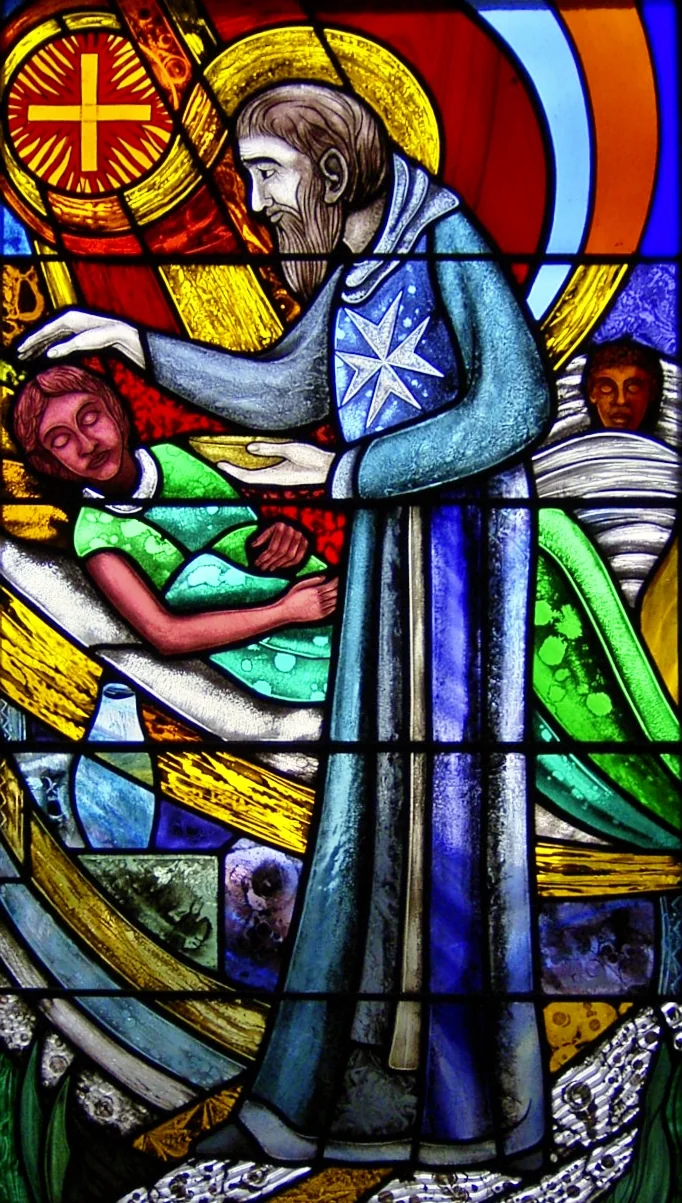 Blessed Gérard
in the Hospital of Jerusalem129
2B Excursus: Baldwin I (1100–1118):Consolidation and expansion of the Latin Kingdom
Baldwin I (originally Baldwin of Boulogne, c. 1058–1118), the younger brother of Godfrey of Bouillon, is considered the true architect of Latin rule in the Near East. After accompanying Godfrey on the First Crusade from 1096 onward, he separated from the main army after the siege of Nicaea. He advanced through Cilicia into Mesopotamia, where in 1098 he founded the first Crusader state, the County of Edessa.
After his brother's death in 1100, Baldwin was elected King of Jerusalem; his coronation took place on December 25, 1100. This election was significant in church politics, as it marked the victory of the military-secular faction over the theocratic ambitions of the Church. Under his rule, state authority over the clergy was considerably strengthened.
Seal of Baldwin, King of Jerusalem132 In 1110, King Baldwin I of Jerusalem
|
|---|
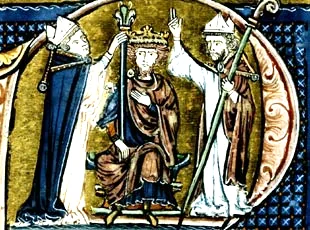
 Seal of the Kings of Jerusalem
 Baldwin's reign was characterized by an aggressive policy of expansion and the securing of borders. Through strategic concessions to the maritime republics of Genoa and Venice, he secured the necessary naval support to conquer the key port cities of Palestine. This was essential for supplies from the West and the economic stability of the Latin states. In addition to repelling Egyptian incursions, Baldwin acted as protector of the other Crusader states (Antioch, Edessa, and Tripoli). He died in 1118 during a campaign against Egypt, whereupon his cousin Baldwin II succeeded him.
3B Excursus: Baldwin II (1118–1131)Expansion and feudal hegemony Baldwin II (Balduin of Bourcq, † 1131), a cousin of his predecessor Baldwin I and also a participant in the First Crusade, consistently continued the expansion and consolidation policy of the Kingdom of Jerusalem. His reign was marked by an intense military conflict with the Seljuk forces in northern Syria. Under his rule, Jerusalem achieved a hegemonic position within the Latin states: The principality of Antioch became effectively dependent on the crown of Jerusalem, and the conquest of the important port city of Tyre further secured maritime control over the Levant. Baldwin II was succeeded by his son-in-law Fulk of Anjou, whose son Baldwin III (r. 1143–1162) was ultimately confronted with the beginning signs of the erosion of Latin power.
4B Excursus: Baldwin III (1143–1162)and the crisis of the Latin states Baldwin III, son and successor of Fulk of Anjou, assumed power in the Kingdom of Jerusalem in 1143, with his mother Melisende serving as regent until 1152. His reign was marked by a significant weakening of the Latin presence in the Near East. Key turning points included the loss of the County of Edessa to the Muslims in 1144 and the failure of the Second Crusade. Furthermore, in 1154, the Syrian ruler Nur ad-Din succeeded in annexing Damascus and large parts of northern Syria, which significantly increased the pressure on the Crusader states. After Baldwin's death in 1162, his brother Amalric I succeeded him to the throne. In the following generation, his nephew, Baldwin IV (known as "the Leper," reigned 1174–1185), attempted to defend the territory against Saladin's expansion. Due to his worsening leprosy, Baldwin IV arranged his succession as early as 1183 by crowning his young nephew, Baldwin V (died 1186).134 |
|---|
Expansion and logistical networking of the hospitality
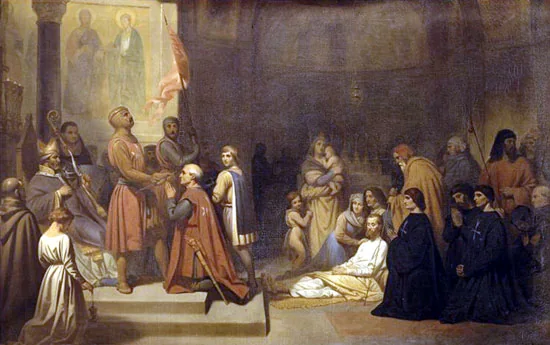 Already under the leadership of Blessed Gérard, the newly founded community experienced a massive increase in membership through pilgrims who joined the hospital as helpers or professed brothers. This consolidation of personnel was accompanied by significant donations135 including one from Godfrey of Bouillon.
Image136
In this context, a widespread, albeit idealistic, misinterpretation needs to be corrected: The legend that King Baldwin I presented Blessed Gérard with the sword of a Grandmaster does not stand up to historical scrutiny, as the chivalric component only fully developed later. Nevertheless, the generous endowments of Baldwin I (from 1108 onward) enabled Blessed Gérard to strategically expand his charitable network.
Even before formal papal confirmation in 1113, important branch hospitals were established in the European Mediterranean ports, including at the castle of Saint-Gilles, France, and in the Italian port cities.

Asti137,
Pisa, Bari, Otranto (Ydrontum), Taranto and Messina.
This wave of hospital foundations followed a clear logistical rationale: once passage to Jerusalem was secured again and the flow of pilgrims increased dramatically, these hospitals functioned as preventative care stations. By providing early treatment for sick pilgrims in Europe, the main hospital of the Order of St. John in Jerusalem was to be prevented from becoming overwhelmed. This maritime infrastructure thus formed the backbone of an organized, cross-border healthcare system.
 138
138
The papal constitution through “Pie postulatio voluntatis” (1113)
The birth of legal independence
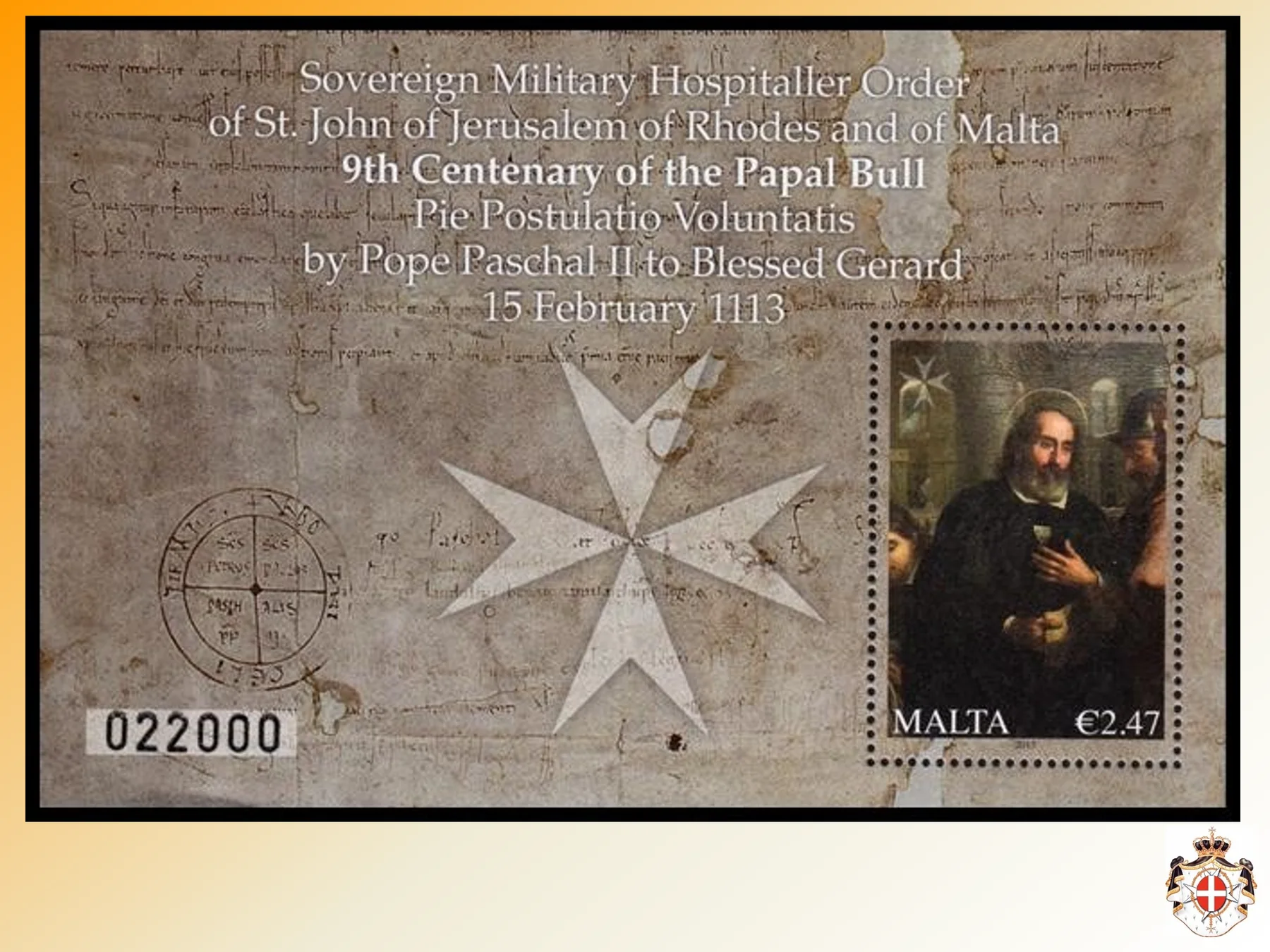
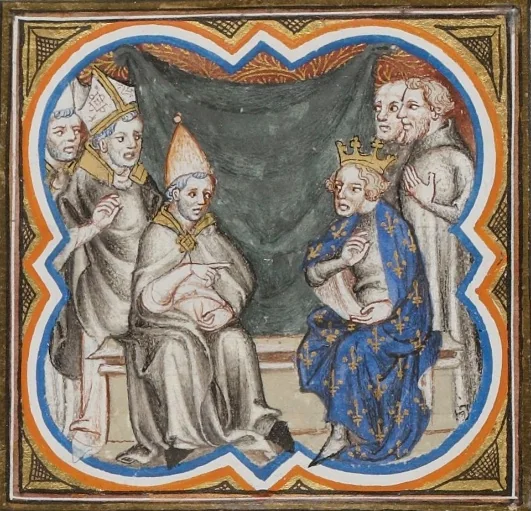 The decisive act of canonical consolidation was carried out by Pope Paschal II on February 15, 1113. With the solemn bull " Pie postulatio voluntatis," he confirmed the hospital community as an independent institution within the Church.
Through this groundbreaking decree, the Holy See assumed direct protectorate over the hospital in Jerusalem. The Pope not only confirmed the existing acquisitions and donations of the Order of St. John in Europe and Asia but also granted the community the privilege of exemption. This removed the hospital from episcopal jurisdiction and placed it directly under the Pope's authority. This bull formed the international legal foundation for the sovereignty of the Order of St. John and sealed the vision of Blessed Gérard: the transformation of a local brotherhood into a universal, papal-recognized order whose sphere of influence now extended beyond the borders of the Holy Land.
(Image )139
PAPAL BULL “Pie postulatio voluntatis”
of February 15, 1113140
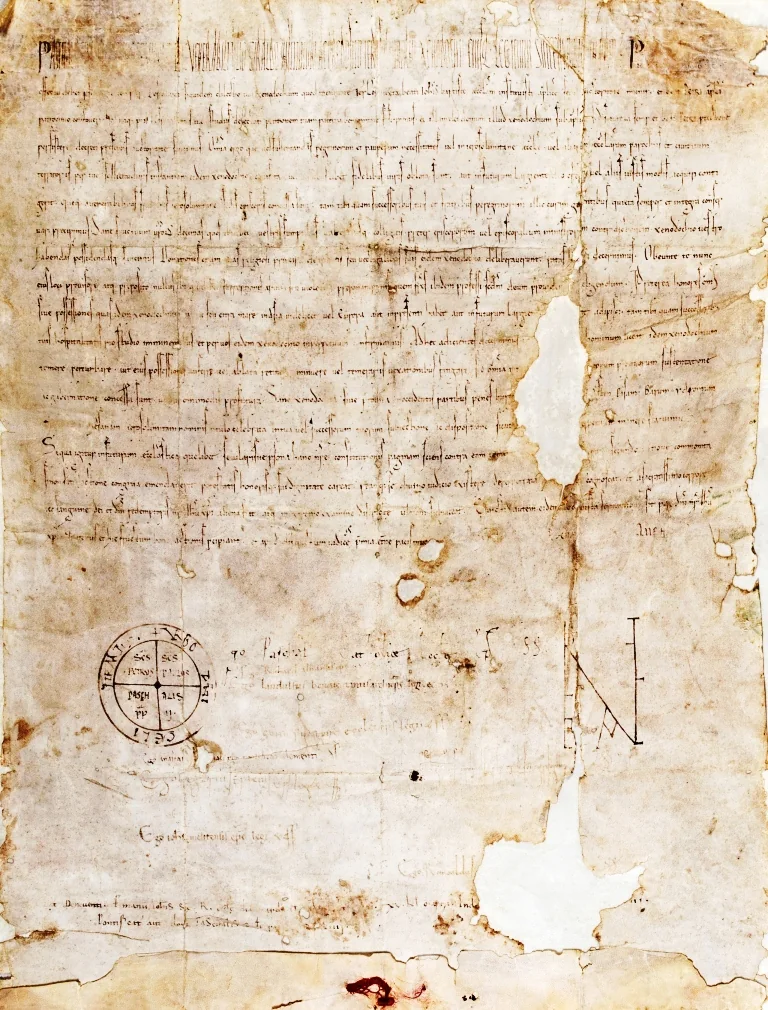
The manuscript above is the original,
but I found another manuscript (possibly AI-generated) at the following link:
https://schola-sainte-cecile.com/tag/pie-postulatio-voluntatis/

The text (in English translation141) reads as follows:
|
POPE PASCHAL II Paschal, bishop, and servant of such as are the servants of God, to his venerable son Gerard, founder and Master of the Hospital at Jerusalem, and to his lawful successors for evermore. All things whatsoever, therefore, which by your preserving care and solicitude have been collected for the benefit of the said Hospital, for the support and maintenance of pilgrims, or for relieving the necessities of the poor, whether in the churches of Jerusalem, or in those of parishes within the limits of other cities; and whatsoever goods may have been offered already by the faithful, or for the future may through God’s grace be so offered, or collected by other lawful means; and whatsoever goods have been, or shall be granted to thee, or to thy successors, or to the brethren who are occupied in the care and support of pilgrims, by the venerable brethren the bishops of the diocese of Jerusalem; we hereby decree shall be retained by you and undiminished. Moreover, as to the tithes of your revenues, which you collect everywhere at your own charge, and by your own toil, we do hereby fix and decree, that they shall be retained by your own Hospital, all opposition on the part of the bishops and their clergy notwithstanding. We also decree as valid all donations which have been made to your Hospital by pious princes, either of their tribute moneys or other donations. We ordain furthermore, that at your death no man shall be appointed in your place, as chief and master, by any underhand subtlety, or by violence; but him only who shall, by the inspiration of God, have been duly elected by the professed brethren of the Institution. Furthermore, all dignities or possessions which your Hospital at present holds either on this side of the water, in Asia, or in Europe, as also those which hereafter by God’s bounty it may obtain; we confirm them to you and to your successors, who shall devote themselves with pious zeal to the cares of hospitality, and through you to the said Hospital in perpetuity. We further decree that it shall be unlawful for any man whatsoever rashly to disturb your Hospital, or to carry off any of its property, or if carried off to retain possession of it, or to diminish anything from its revenues, or to harass it with audacious annoyances. But let all its property remain intact, for the sole use and enjoyment of those for whose maintenance and support it has been granted. As to the Hospitals or Poor Houses in the Western provinces, in the Borgo of St. Egidio, Asti, Pisa, Bari, Otranto, Taranto and Messina, which are distinguished by the title of Hospitals of Jerusalem, we decree that they shall for ever remain, as they are this day, under the subjection and disposal of yourself and your successors. If, therefore, at a future time, any person, whether ecclesiastical or secular, knowing this paragraph of our constitution, shall attempt to oppose its provisions, and if, after having received a second or third warning, he shall not make a suitable satisfaction and restitution, let him be deprived of all his dignities and honours, and let him know that he stands exposed to the judgment of God, for the iniquity he has perpetrated; and let him be deprived of the Sacraments of the Body and Blood of Christ, and of the benefits of the redemption of our Lord, and at the last judgment let him meet with the severest vengeance. But to all who deal justly and rightly with the same, on them be the peace of our Lord Jesus Christ, so that not only here below they may receive the rewards of good actions, but also before the Judge of all mankind, they may enjoy the blessing of peace eternal.
Given at Benevento, by the hand of John, Cardinal and librarian of the Roman Church, on the 15th day of February, in the 6th cycle of indiction of the incarnation of our Lord, in the year 1113, and in the 14th year of the Pontificate of Pope Paschal II. Picture143 |
|---|
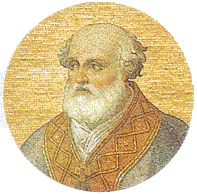
 I Paschal, bishop of the Catholic Church, have signed
124

The ecclesiastical significance of the bull " Pie postulatio voluntatis" can hardly be overestimated. In this document, the Xenodochium in Jerusalem, along with its constituent communities, is explicitly mentioned for the first time in a papal letter. Of particular importance is the mention of Gérard by name, who is solemnly confirmed in his roles as leader, head, provost, and head of the community.
Beyond merely recognizing the personnel structure, the Pope granted the community crucial institutional privileges:
Active suffrage: The community was granted the sovereign right to freely elect and install its superiors from among its own members after Gerhard's death. This ensured the internal autonomy of the Order of St. John against external influences.
Legal personality: For the first time, the Hospital Brotherhood was recognized as an independent, autonomous community and thus as a legal person.
Asset capacity: As a result of this legal personality, the Order of St. John received the authority to legally own and independently dispose of goods, real estate and income.
With this papal constitution, the process of emancipation was completed: what had once been a monastic branch had grown into a universal, independent institution of canon law.
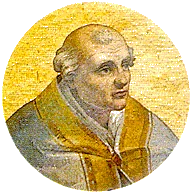 |
Pope Calixtus II (1119 - 13 November 1124) Image146 |
|---|
Calixtus, etc., to his venerable son Gérard, founder and provost of the Hospital of Jerusalem, and to his legitimate successors forever. For this purpose we recognize that we have been promoted, by the Lord’s disposition, to the service of the Apostolic See: that we ought to effectively come to the aid of his sons who implore help, and to protect the venerable places, as the Lord has granted. Wherefore, beloved son in Christ, Provost Gerard, incited by the pious efforts of your hospitality, we receive your petition with due kindness, and we fortify the Hospital established by you in the city of Jerusalem, near the church of St. John the Baptist, under the protection of the Apostolic See, after the example of our predecessor of holy memory, Pope Paschal. Furthermore, by the page of this present decree, we confirm the concession of our brother Pons, Bishop of Tripoli, which he—following his predecessor Herbert—bestowed upon your Hospital and established by a signed document. He indeed granted to the same Hospital, and to you and your legitimate successors, by the counsel and favor of Berengar, Bishop of Orange, then legate of the Apostolic See in those parts, all the tithes of the whole land which William Rostagni held, and after him Pons de Mezenes possessed, from the castle named Gaucefredus de Agolt to Calamo; as well as the parochial church, having a baptistery, a cemetery, the offerings of the living and the deceased, and all other things that belong to a parochial church, and all other churches that are within the borders of that aforementioned land, which belonged to Pons de Medenes, and whatever else should be of the right of the church of Tripoli, saving, however, the reverence and obedience of the bishop in those priests whom the prior of the aforementioned Hospital shall establish in the prenamed churches. Furthermore, he gave to the same Hospital the church of St. John the Baptist on Mount Pilgrim, with all that it ought to have, and with the tithes of the mills of William Beraldi, and also with the tithes of all possessions and things which the aforementioned house then holds in its entirety from the Bishopric of Tripoli. Therefore, this concession, just as it was made by the same bishop, was confirmed by our predecessor of holy memory, Pope Paschal. And all things that serve to sustain the needs of pilgrims and the poor, etc. (R) I, Calixtus, Bishop of the Catholic Church, have signed. (M). Given at Saint-Gilles, by the hand of Chrysogonus, cardinal-deacon of the Holy Roman Church and librarian, on the 19th of June, in the year 1120 of the Incarnation of the Lord, and in the 1st year of the pontificate of the Lord Calixtus II. |
|---|
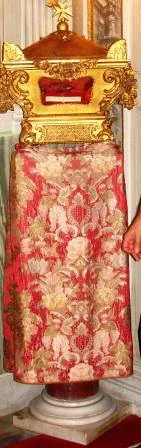
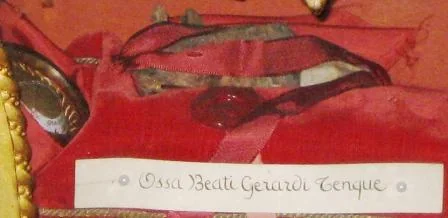
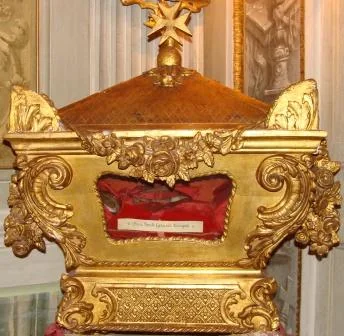
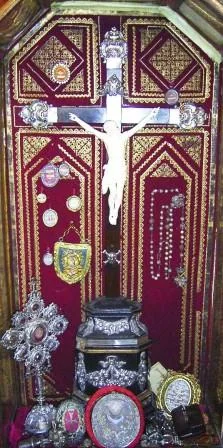
5B Excursus: Burial site and relics of Blessed GérardBlessed Gérard died on September 3, 1120. The French historian of religious orders, "The Hospitallers lost in him the father of the poor and of pilgrims [...]
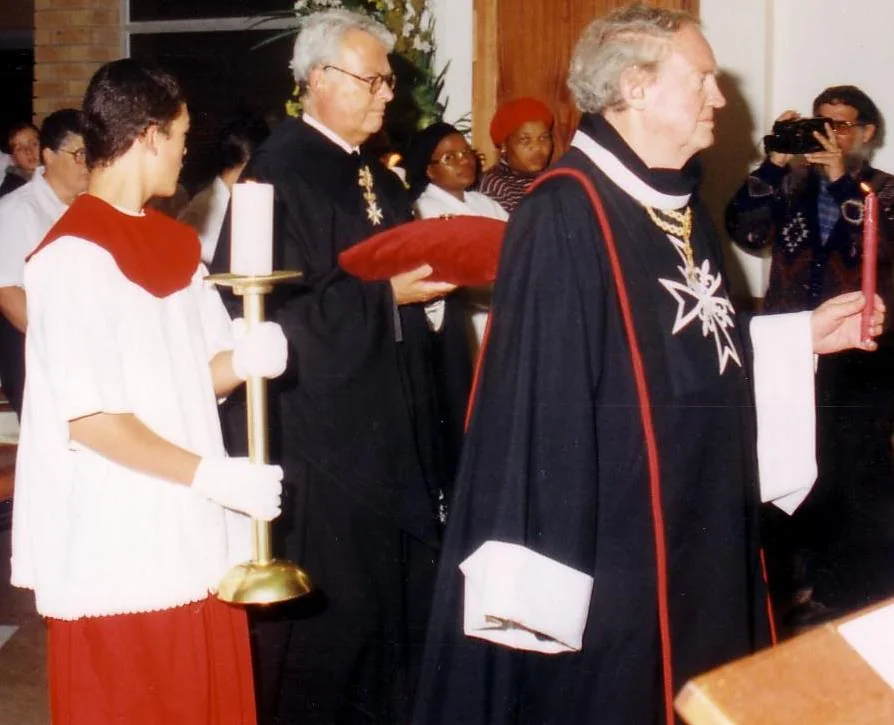
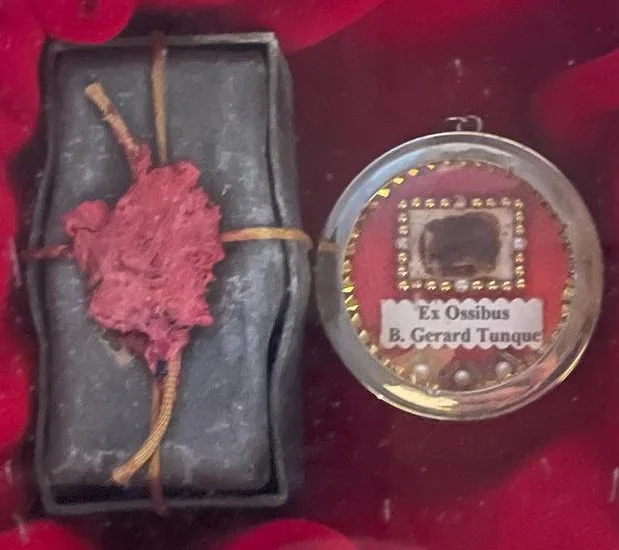
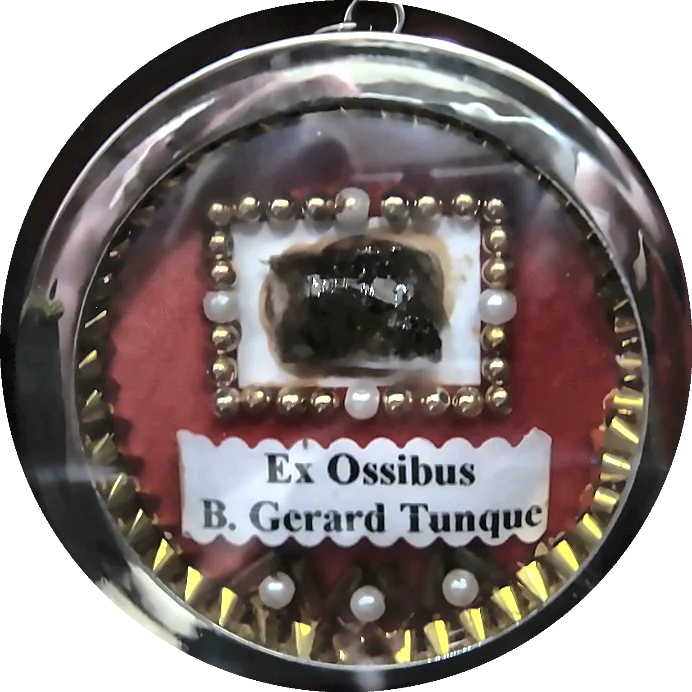
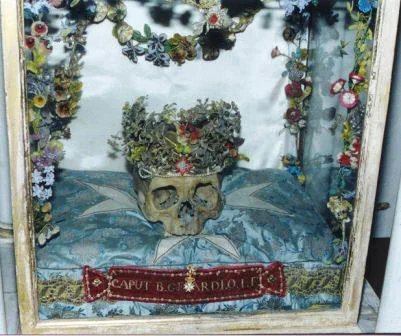
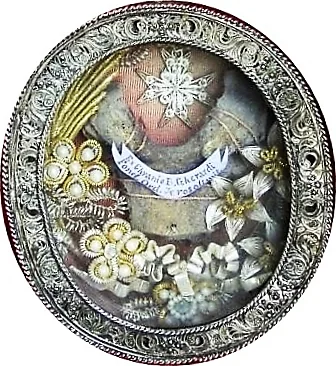
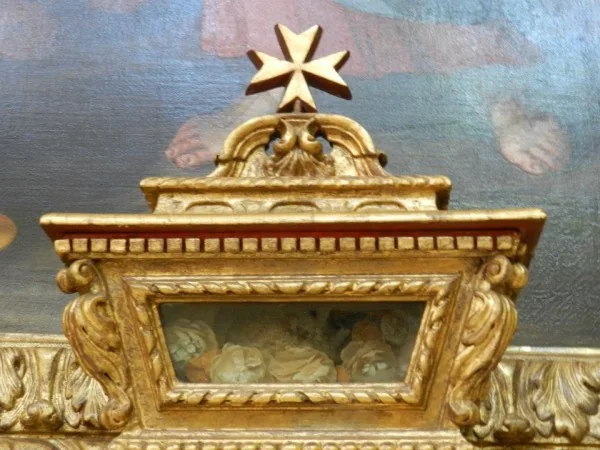
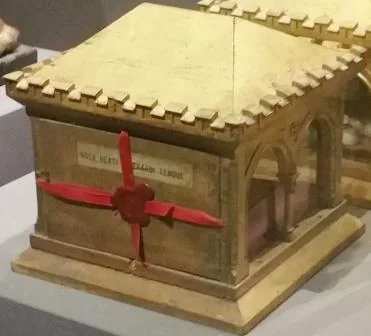
(Quoted and translated from HJA Sire: The original burial site in Jerusalem The grave of Blessed Gérard was located on the grounds of the hospital, most likely inside the church there. First transfer of the mortal remains to Manosque (France) Period: after 1187, but before 1283 The remains of Blessed Gérard appear to have been transferred to Europe after the fall of Jerusalem in 1187. The exact circumstances of how the relics arrived in Manosque have not yet been definitively clarified historically. Theodore Andrea Cook writes in “Old Provence”: "In 1080, a citizen from Martigues named Gérard Tenque founded the Hospital of St. John in Jerusalem [...]; Gilbert the Good, husband of Countess Gerberge of Provence, brought numerous relics from the Holy Land, which were later kept in the churches of Arles and the surrounding area." It is possible that Gilbert the Good brought the relics of Blessed Gérard to Manosque. In 1283, the body was interred in a precious silver reliquary adorned with precious stones in the Hospitaller chapel of Manosque, where it remained until the French Revolution. Msgr. François Ducaud-Bourget explains this in “The Spiritual Heritage of The Sovereign Military Order of Malta” (Vatican 1958): "Without a doubt, his relics were in Manosque from 1283 – from the time of the capture of Acre by the Mamluks and the reorganisation of the Hospitallers in Cyprus – until their destruction during the French Revolution." Transfer of the skull to Valletta (Malta) By order of Grandmaster Emmanuel Pinto, the head of Blessed Gérard was transferred to Valletta in Malta in 1749. Destruction of the relics during the French Revolution (1789–1799) Several sources confirm that the relics remaining in Manosque were destroyed during the turmoil of the revolution. Apparently, only an upper arm bone and a vertebra were salvaged. Securing the remaining relics in Martigues After the recovery, the humerus and vertebrae were kept in the church of Martigues. For a time, these remains were on display in the town hall there, following an official inventory. Current locations of the relics According to the author's current knowledge, the relics of Blessed Gérard are venerated in the following places:
Pictures: The author visited Martigues on March 12 and 13, 2015, The remaining humerus (or part of it) Upper arm relic of Blessed Gérard in the parish church of Martigues
All images on this page are the author's own photographs. Another reliquary in the same church (contents unknown – vertebrae?)
All images on this page are the author's own photographs. Vertebral relic of Blessed Gérard
All images on this page are the author's own photographs. Another reliquary in the same church
More pictures: LES MARTEGAUX ETAIENT A SAINT MAXIMIN Relics in the Church of Saint-Gérard in Vitrolles /France
All images on this page are the author's own photographs. |
|---|
 René Aubert de Vertôt,


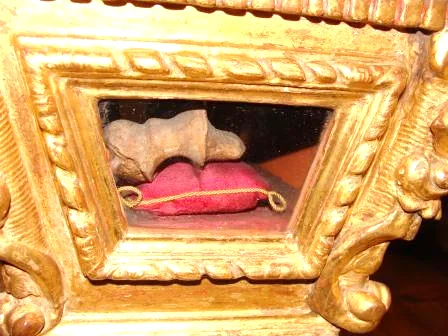
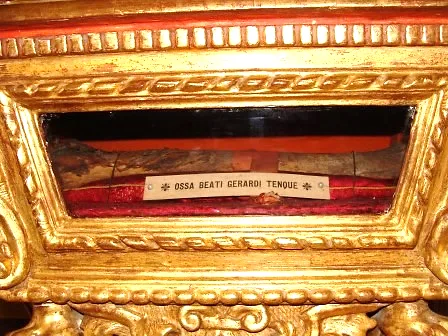

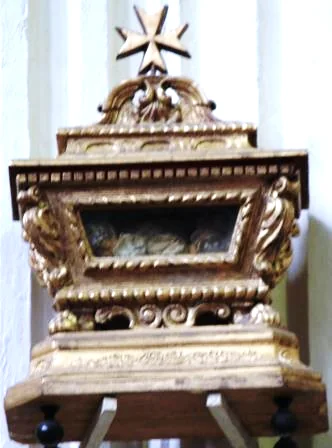



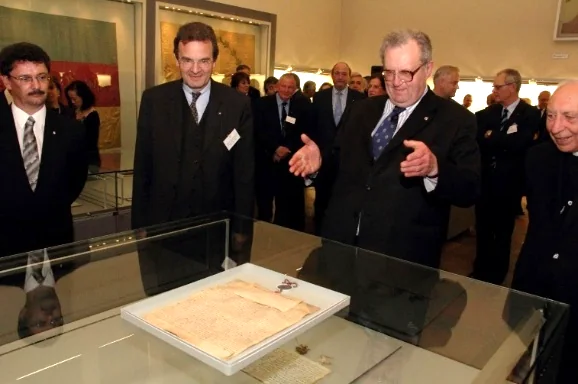
All images on this page are the author's own photographs. On September 3, 1996, the Grand Magistry presented
All images on this page The Grand Magistry has donated another part
All images on this page are the author's own photographs. The skull in St. Ursula's Convent in Valletta/Malta Current reliquary Former reliquary
A skull fragment of Blessed Gérard
All images on this page are the author's own photographs. Another skull fragment of Blessed Gérard
A relic of Blessed Gérard in the Another relic of Blessed Gérard is in Cologne.
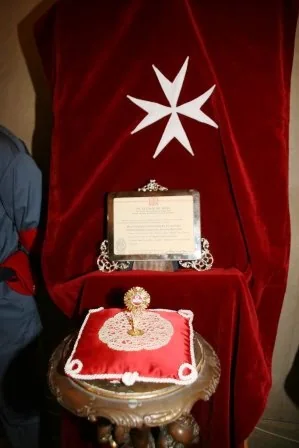
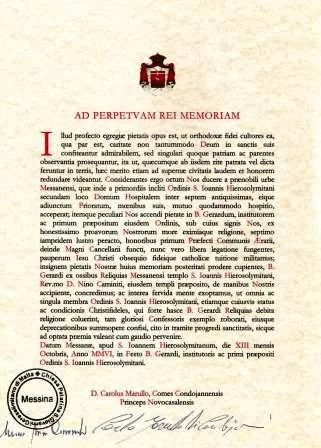
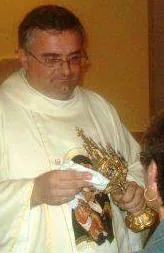
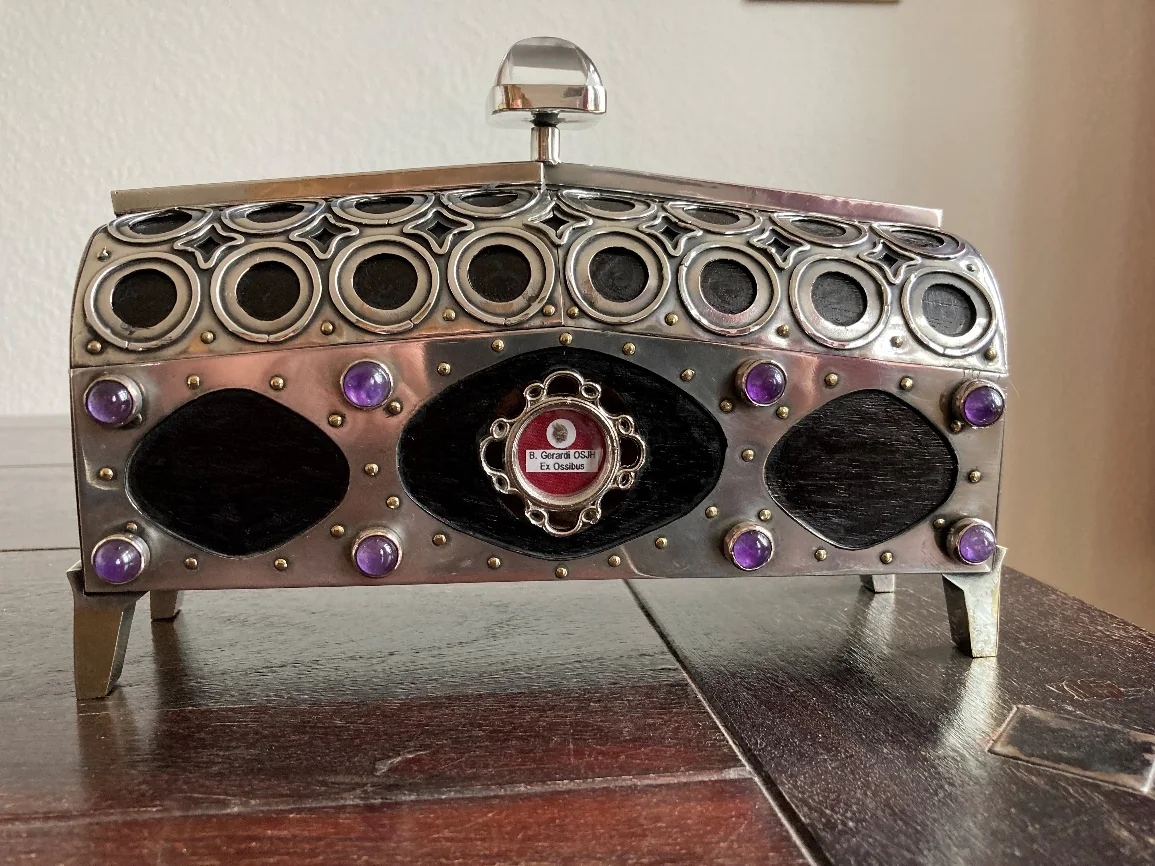
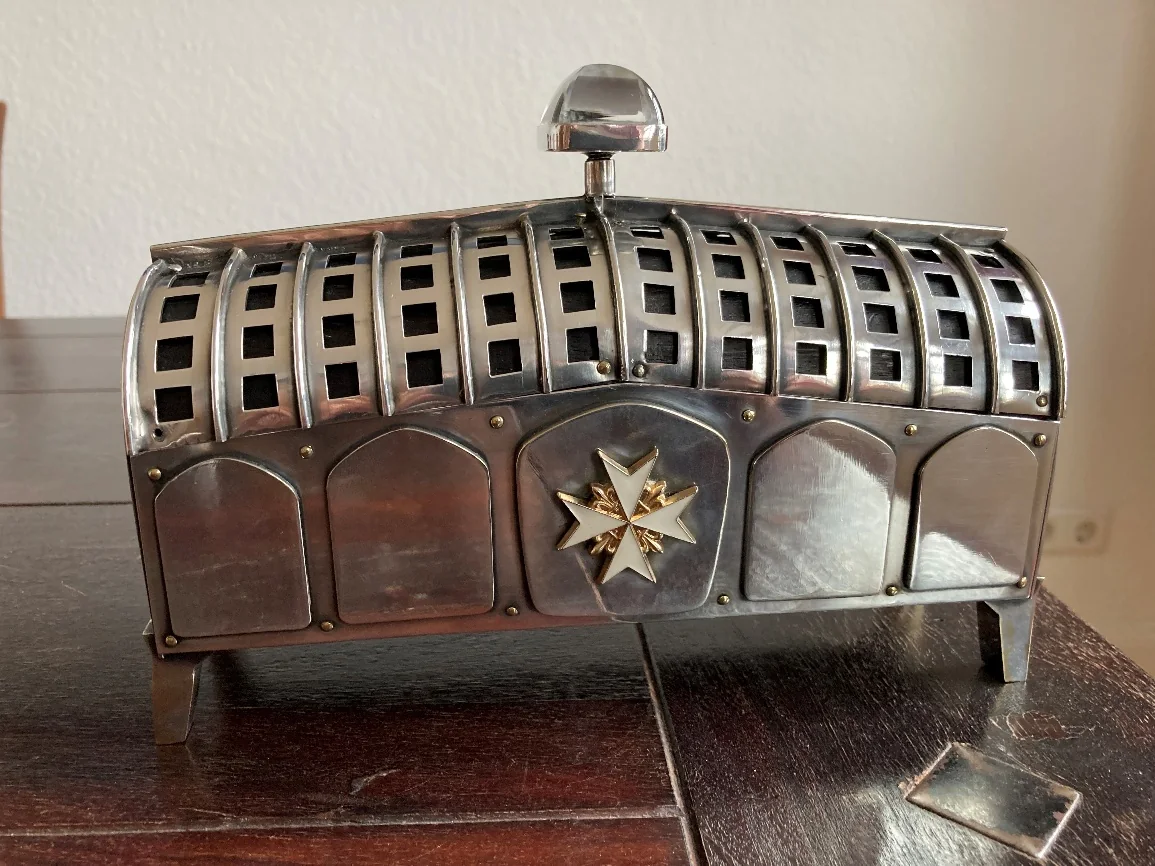
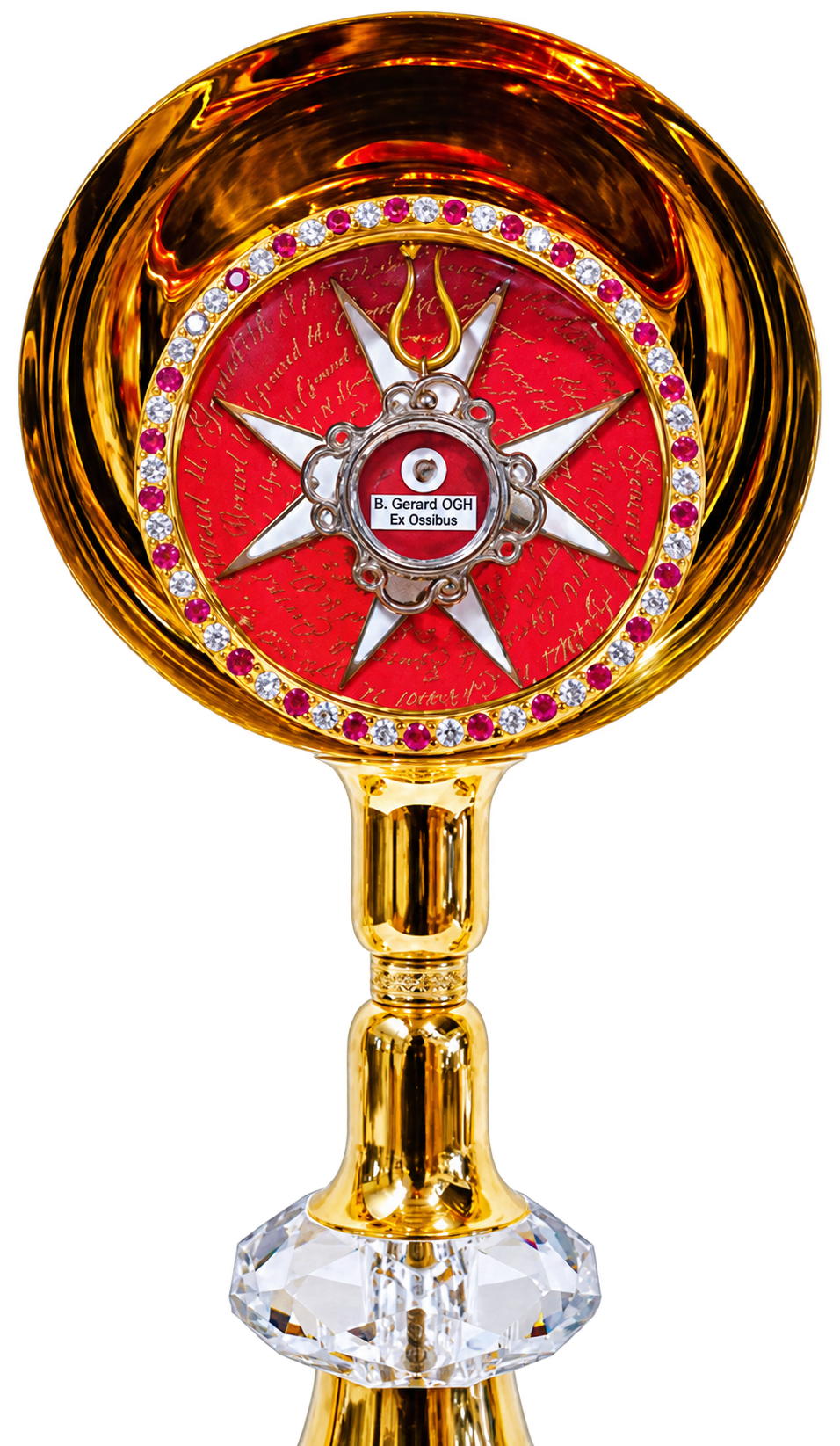
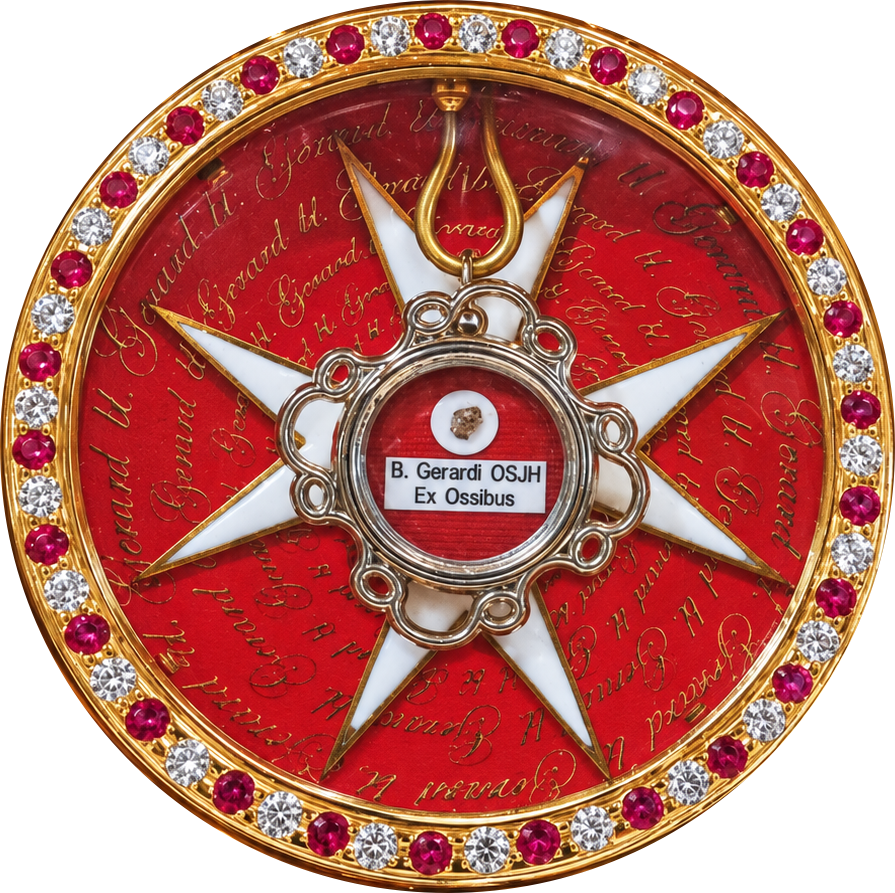
Since the inscription on the reliquary capsule is similar to that on the two Italian relics, A relic of Blessed Gérard in Slovenia Reliquary of Blessed Gérard, design and layout by Christoph Steidl Porenta, Zlatarna zlato runo 2024. In October 2023, Chancellor Roman Vučajnik brought this relic to the Slovenian Association as a gift from the Santa Ursula Monastery in Valletta.
Letter of authentication for the relic of Blessed Gérard from Santa Ursula Monastery in Valletta.
Images and text reproduced with permission from: |
|---|
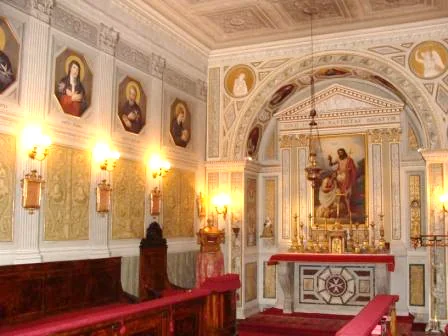 Part of the humerus from Martigues was handed over to the Grand Magistry