2. Background to the founding of the order and legendary origins
Although the year 1099 is generally accepted today as the founding year of the Order of St. John, written sources for its early period are scarce, which has given rise to numerous legends. The spectrum of these accounts ranges from the construction of a pre-Christian continuity to the assumption of a spontaneous new foundation in 1099.33
The anchoring in salvation history
The French historian William of St. Stephen 34 recounts a legend according to which the origins of the hospital date back to the time of King Antiochus and the Jewish high priest Melchior . Melchior, acting on divine inspiration, is said to have built a hospice with a treasure on the very spot that would later be sanctified by the crucifixion of Christ. The management of this institution later passed to Zechariah , the father of John the Baptist. Even a visit from Christ himself, as well as the leadership of Saint Stephen —as the first deacon of the Church, predestined for charitable service—are part of this narrative.
This legend-building can be traced back to the 12th and 13th centuries. In 1291, the prevailing belief in Rome was that the hospital in Jerusalem had been the site of key events in the New Testament . As early as 1260 35, a hospital master of the Order of St. John suggested that St. Stephen had been one of his predecessors36. However, William of St. Stephen was sceptical of this authenticity and suspected that any ancient institution would have been lost at the latest with the destruction of Jerusalem by Titus.
The Maccabean tradition and archaeological references
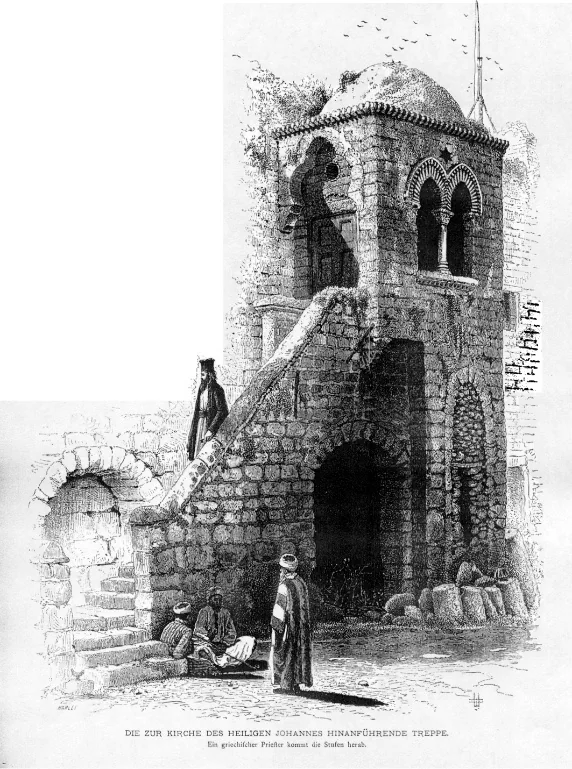
Other authors, such as Louis Beurrier , trace the founding back to John Hyrcanus I (r. 134–104 BC) of the Maccabean dynasty. The aim, they suggest, was to receive pilgrims at Solomon's Temple. This theory is supported by the mention of Hyrcanus in 2 Maccabees 3:11 and by the historically attested "Hyrcanus Monument," which is said to have stood on the site where the hospital's Church of St. John, dedicated to the patron saint of the Order of St. John, was later built.
William Caoursin 37further exaggerated this tradition in 1496: He claimed that
Judas Maccabeus himself had founded the hospital. He asserted that in this sacred space the Apostle Peter had received his primacy, that the first Council of Jerusalem had taken place there, and that Saint Stephen had chosen John the Baptist as the permanent patron saint of the house.
These legends illustrate the high ideal value that was attributed to the site of the hospital – it was understood as the centre of salvation history's continuity.
The late antique and early medieval forerunners
Besides the purely legendary origins, there are reports of early institutional foundations by the Christian Empire.
Thus, the historian A. v. Winterfeld 381859 held the view that Emperor Constantine and his mother Helena had already founded hospitals along the pilgrimage routes as well as in Jerusalem itself.
 Masson39elaborates on this Byzantine tradition and locates the “birthplace” of the later Order of St. John in the hospital that Emperor Justinian I (r. 527–565) had built in Jerusalem.
Pope Gregory the Great40 is historically documented, who at the end of the 6th century sent Abbot Probus to Jerusalem to establish41 a Xenodochium42.
According to Breycha-Vauthier de Baillamont, this complex comprised a hospital, a hospice, and a church dedicated to the Virgin Mary . 43To distinguish it from the Greek Orthodox tradition, it was named St. Maria Latina . This institution was completed in 603 but was probably destroyed as early as 614 during the Persian invasion.
 Towards the end of the 8th century, this charitable infrastructure was restored by
Charlemagne 44. With the diplomatic permission of Caliph Harun al-Rashid, he renewed the Gregorian foundation and placed it under the jurisdiction of the Benedictine monastery at the Church of St. Maria Latina 45. This connection to the Benedictine tradition laid the foundation for those hospital structures from which the Order of St. John would later emerge.
The Destruction of 1009
and the Amalfi Restoration
The monk Bernard46reported around 870 on the existence of the aforementioned hospital. However, this hospital, along with the Church of the Holy Sepulchre, was destroyed around 1009 by the Fatimid Caliph al-Hakim, despite the fact that his mother was a Christian.
After protracted negotiations with Caliph al-Zahir (r. 1021–1036), merchants from Amalfi, led by Mauro di Pantaleone , succeeded 47in obtaining permission to rebuild in 1023. The work, completed under Caliph al-Mustansir , led to the establishment of three separate institutions:
The reconstruction of the Benedictine Abbey of St. Maria Latina.
A hospice for female pilgrims, dedicated to Saint Mary Magdalene .

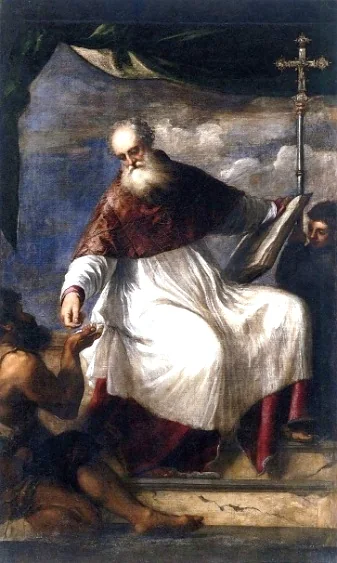 A hospice for male pilgrims,
whose chapel was originally dedicated
to John the Almsgiver48
but at the latest by 1113 received the patronage of St. John the Baptist49
The management of these hospices was the responsibility of rectors who were either Benedictines themselves, or at least closely associated with the Benedictine Order.
Historical sources mention a Magister Anzelinus50 and later a
superior Geraldus51 (Brother Gérard) as head of the John’s Hospice.
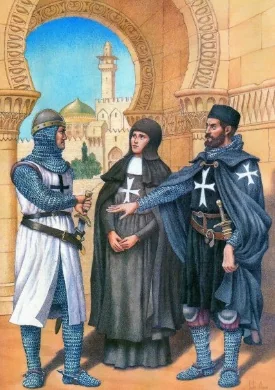
The hospice of St. Mary Magdalene is said to have been run by a noble Roman woman named Agnes52. The hospice was probably affiliated with the Benedictine convent of St. Mary Major53 .

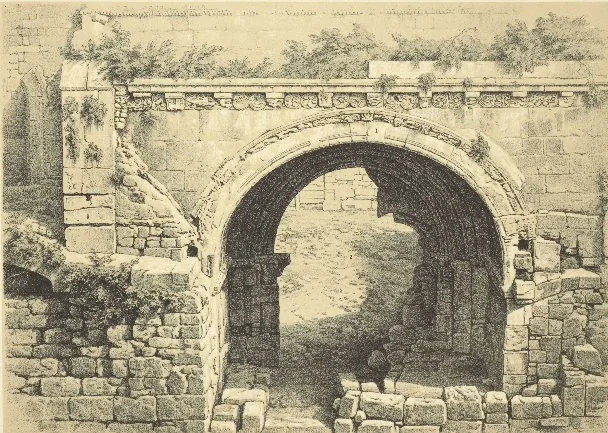
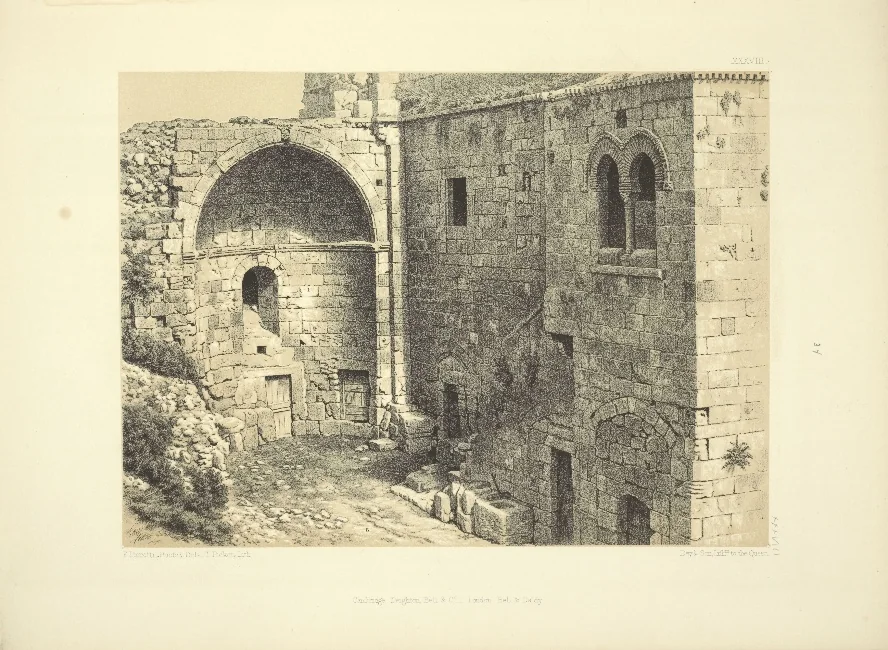
Archaeological findings55 confirm the existence of this early triple facility.
Methodological classification of continuity
It would be presumptuous, in the interest of a complete history of the religious orders, to assert a direct institutional continuity between the Gregorian, Carolingian, and Amalfi foundations. The upheavals of the 7th and 11th centuries make a continuous line unlikely. Nevertheless, these initiatives demonstrate the constant need of Western Christendom for a hospital infrastructure. This continuity is corroborated by archaeological findings in the Muristan district . Excavations, based on the plans of Conrad Schick and continued by the German Protestant Institute (DEI), identified the foundations of St. Maria Latina and the hospitals. This structural evidence supports the accounts of the specialized triple complex and bridges the gap to the most enduring form of this tradition: the
Order of St. John .

Site plan of the Hospital of St. John (in the green rectangle). Image56
|
|---|
 1B Excursus: Santa Maria Latina
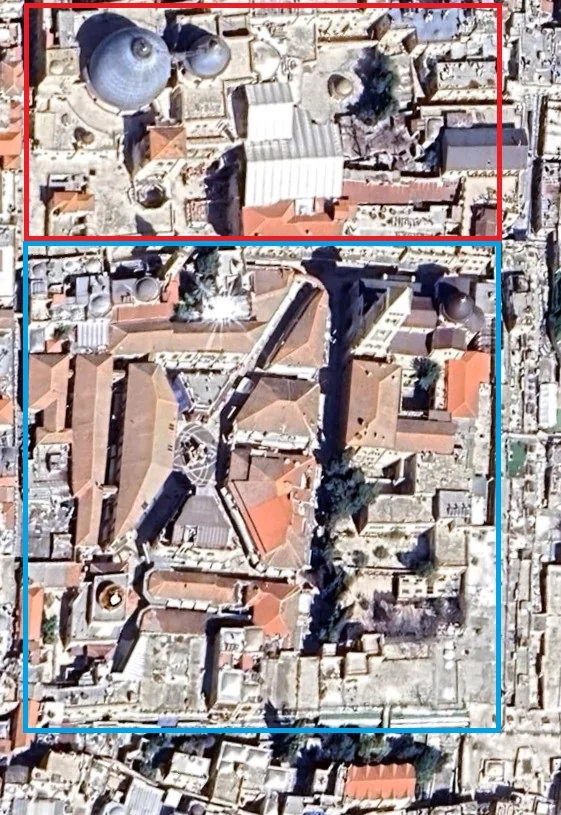

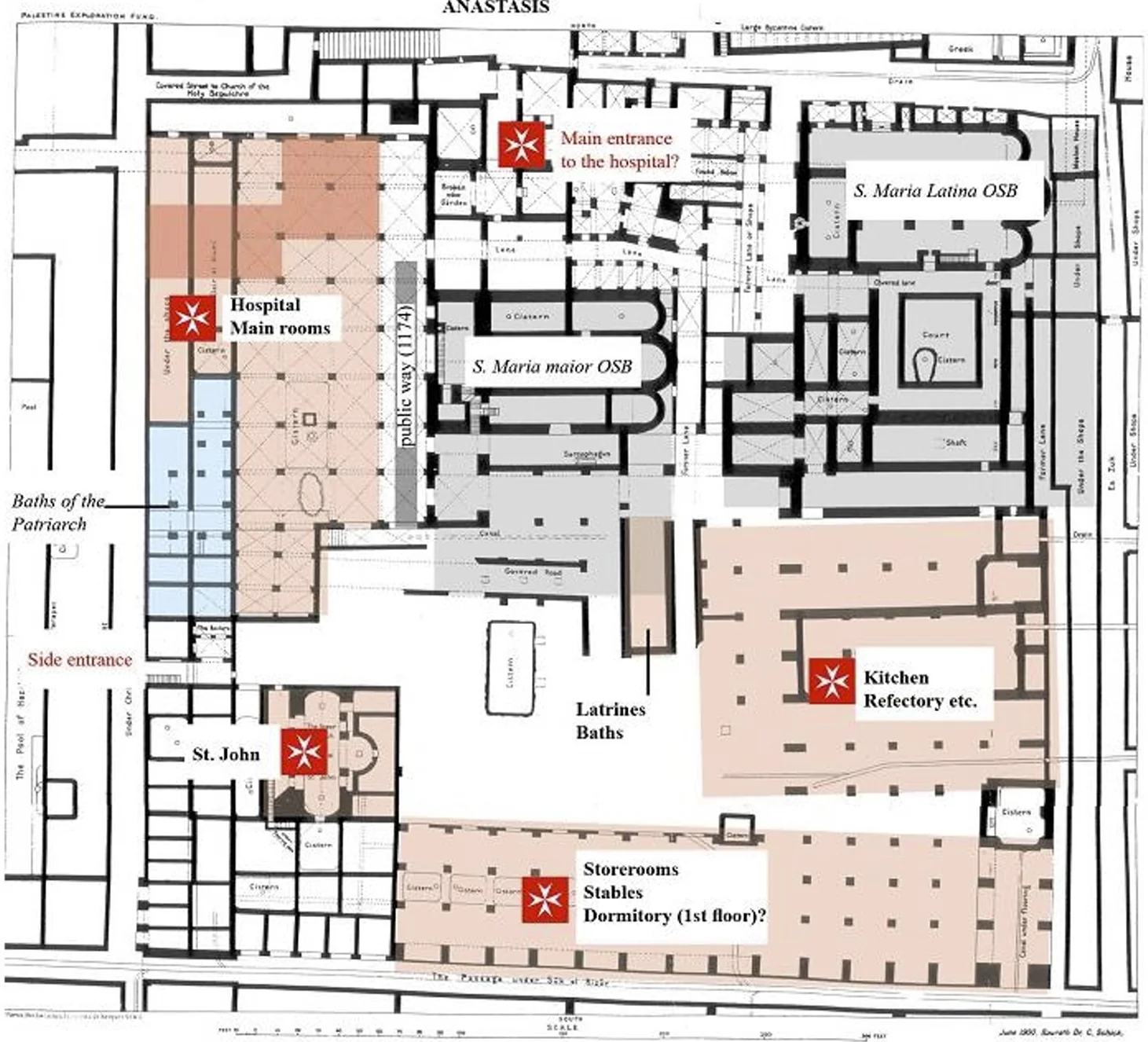

 The floor plan of St. Maria Latina61 |
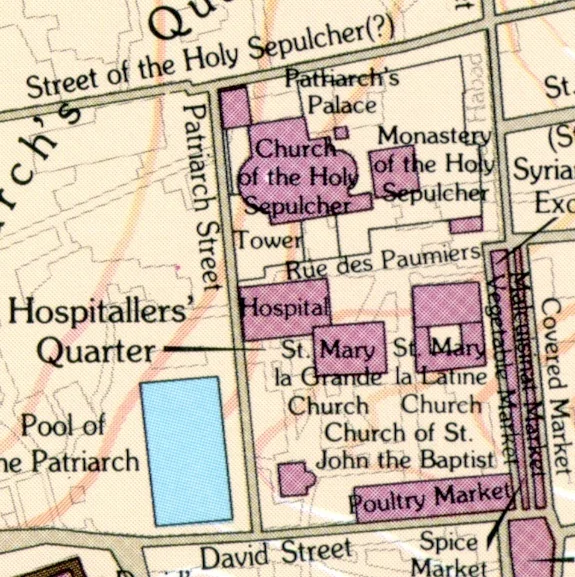 Map of the "Hospitaliter Quarter" of Jerusalem62 |
|---|
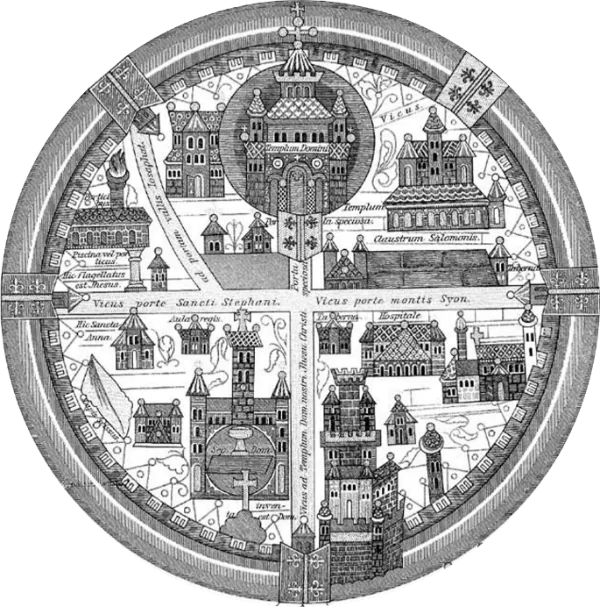
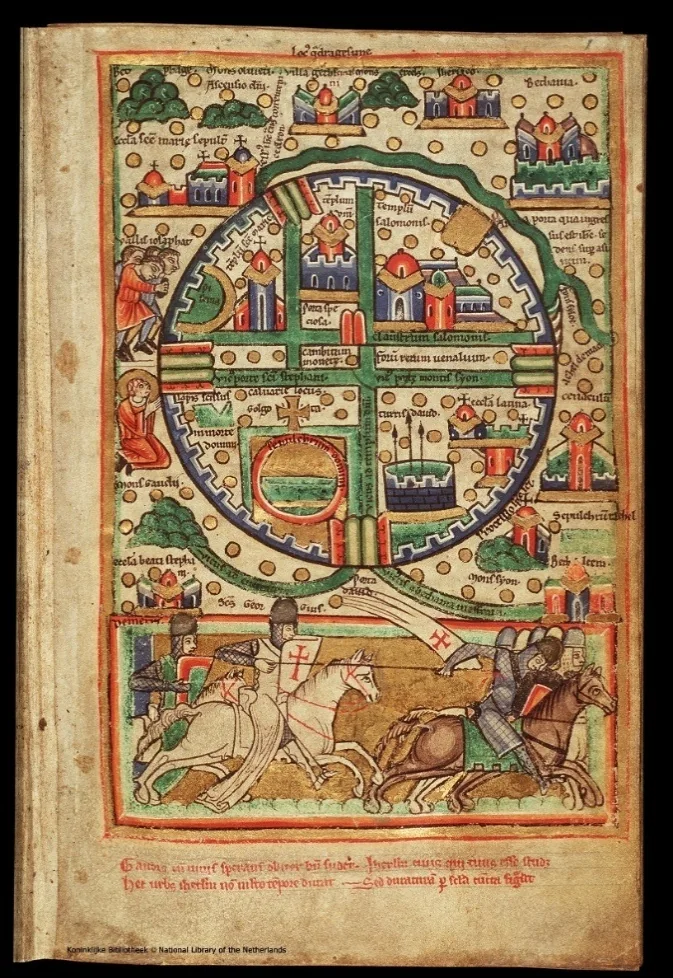
St. Maria Latina in contemporary “city maps”
Idealized city plan of Jerusalem based on an ancient model, showing the city wall and main street intersection. 12th century, Crusader period.63
|
|---|

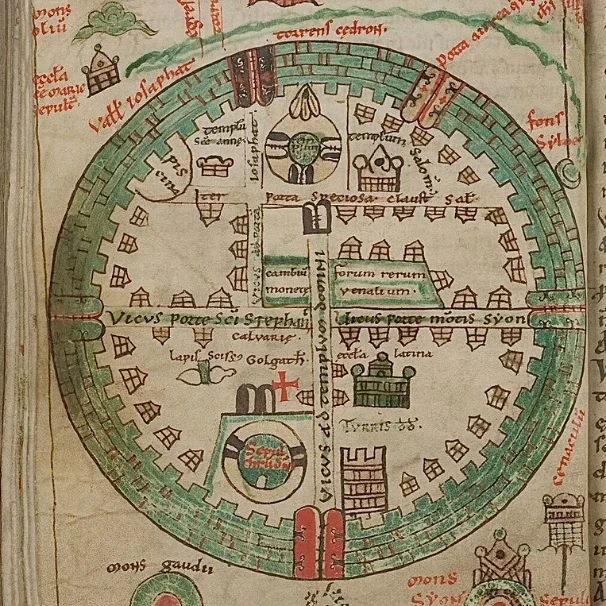
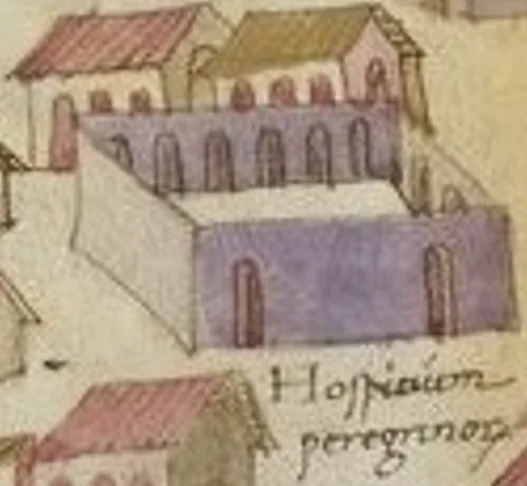
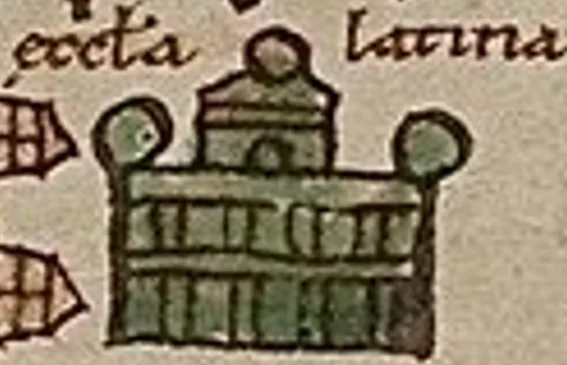 The “St. Omar Plan” of Jerusalem from the 13th century
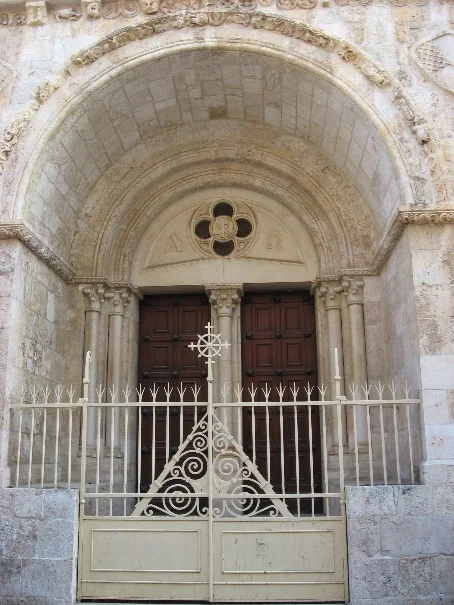
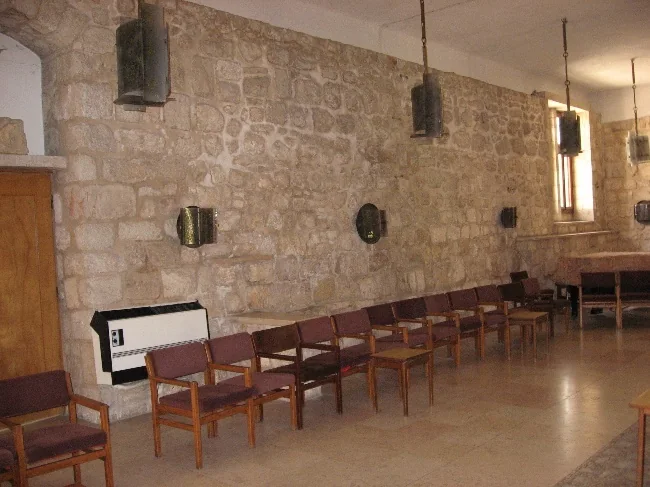
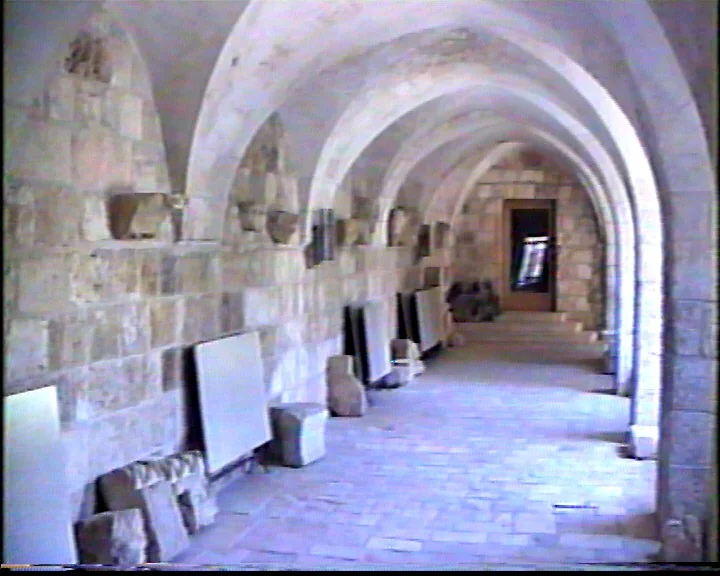
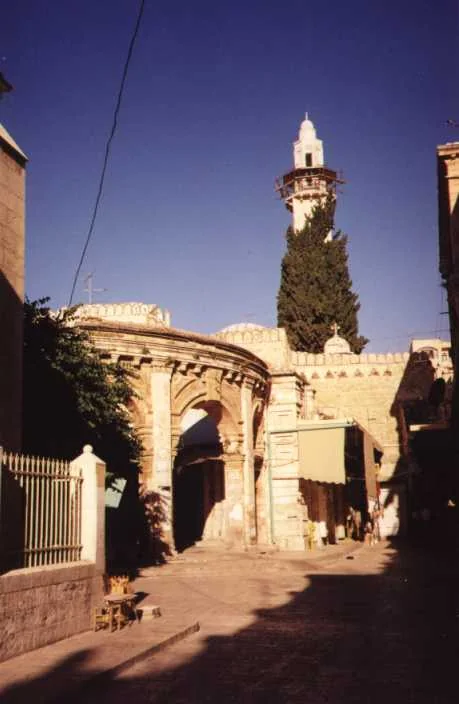
The Church of Santa Maria Latina64 (Today the Evangelical Church of the Redeemer)
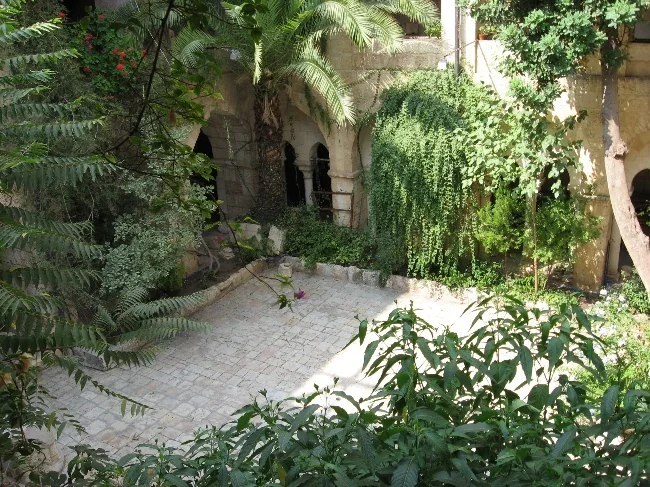
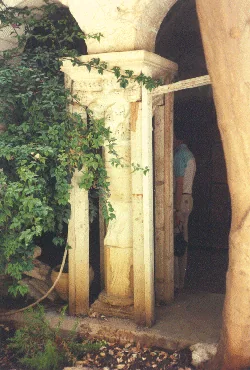
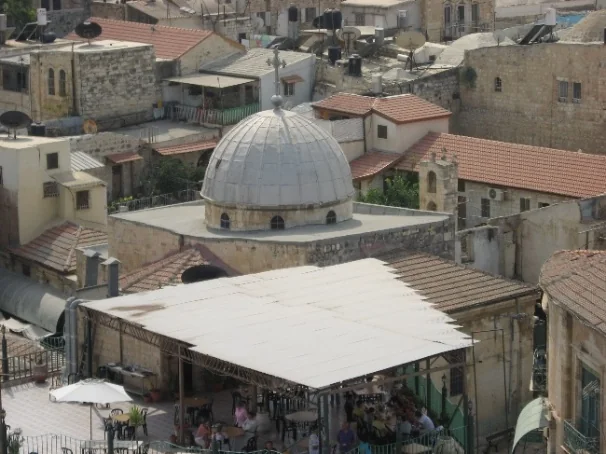
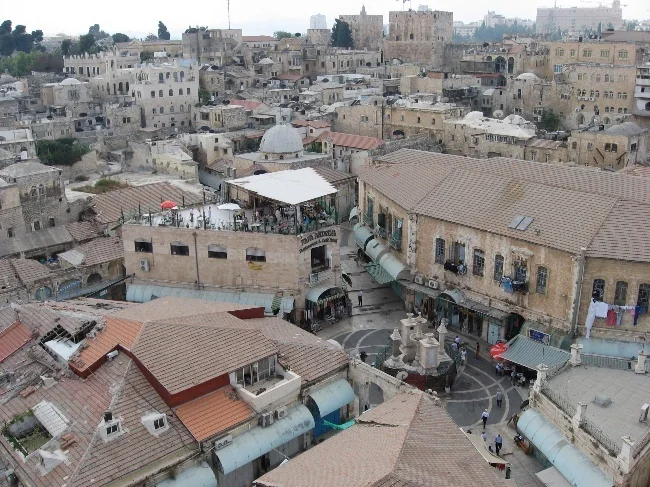
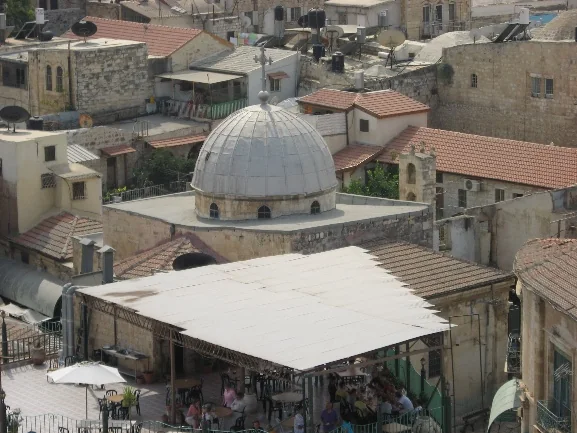
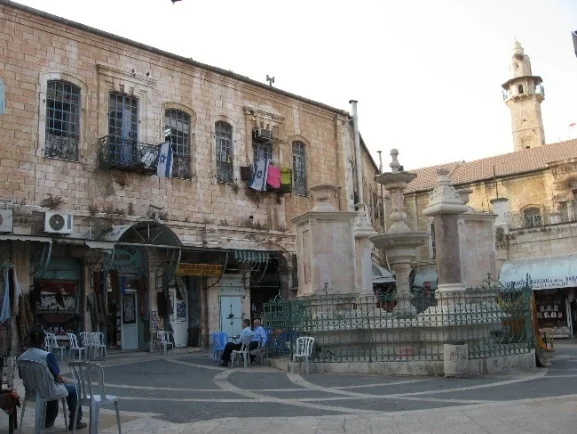
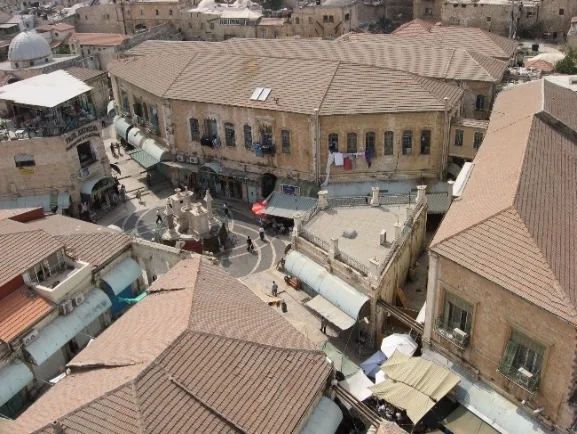
The Muristan The grounds of the former hospital are called "Muristan."
|
||||||||||||||||||||||||||||||||||||||||||||||||||||||||||||||||||||||||||||||||||||||||||||||||||||||||||||||||||||||||||||||||||||||||||||||||||||||||||||||||
|---|---|---|---|---|---|---|---|---|---|---|---|---|---|---|---|---|---|---|---|---|---|---|---|---|---|---|---|---|---|---|---|---|---|---|---|---|---|---|---|---|---|---|---|---|---|---|---|---|---|---|---|---|---|---|---|---|---|---|---|---|---|---|---|---|---|---|---|---|---|---|---|---|---|---|---|---|---|---|---|---|---|---|---|---|---|---|---|---|---|---|---|---|---|---|---|---|---|---|---|---|---|---|---|---|---|---|---|---|---|---|---|---|---|---|---|---|---|---|---|---|---|---|---|---|---|---|---|---|---|---|---|---|---|---|---|---|---|---|---|---|---|---|---|---|---|---|---|---|---|---|---|---|---|---|---|---|---|---|---|---|


















The emancipation of the hospital under Blessed Gérard

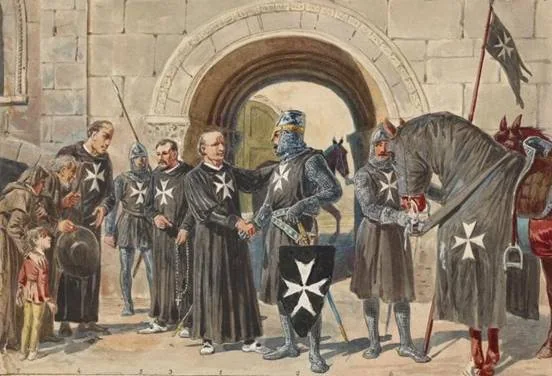
After the capture of Jerusalem on July 15, 1099—the culmination of the First Crusade— Godfrey of Bouillon and his companions found the hospital already fully operational. The comprehensive care provided there for the wounded crusaders impressed Godfrey so profoundly that he bestowed generous donations upon the brotherhood. 85 These endowments laid the financial foundation for its institutional independence. Subsequently, Gérard severed the connection with the mother abbey of St. Maria Latina in order to manage the hospital independently. Indeed, separate donations to the hospital adjacent to the monastery are documented as early as 1099.
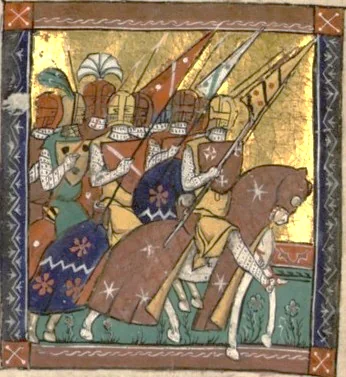 Godfrey of Bouillon , Duke of Lower Lorraine since 1076, was one of the principal leaders of the First Crusade. He commanded the troops that victoriously entered Jerusalem in 1099. Although offered the royal crown, he declined the title and instead chose to serve as "Advocate of the Holy Sepulchre" (Advocatus Sancti Sepulchri). However, he died after a reign of only one year.86
 Miniature from the book
"Chronicle of Geoffroy de Bouillon"87 (Cod.Reg.Lat.737)
 "The Siege of Jerusalem
during the First Crusade"
Stamp of the Order of Malta88
The French contingent of crusaders
elected Godfrey as their leader in 1096 1096 89.
The Hospital of Jerusalem on historical city maps
|
||||||||||||||||||||||||||||
|---|---|---|---|---|---|---|---|---|---|---|---|---|---|---|---|---|---|---|---|---|---|---|---|---|---|---|---|---|