C. The Novelty in the Spiritual Tradition
Based on the above descriptions and investigations, we can now recognize what innovations the Order of St. John introduced into the history of religious orders, the Church, and the world through its founding and its rule. We have thus reached the final stage of our presentation.
1. The Vow of Chastity
A significant new element in the spiritual tradition of the Order of St. John is the requirement of a vow of chastity () included in the Rule 478. No previous founder of a religious order had explicitly required this in their Rule. This does not mean that earlier orders did not require chastity, but
 479The Rule of the Order of St. John is the first monastic rule that
explicitly mentions the vow of chastity as a monastic vow.
Nicolas Moroso quotes the initiation rite for novices(?)480(ca. 1239):
“I vow and promise to Almighty God, the Blessed Virgin Mary, and St. John the Baptist that I will always obey the superior whom God and our Order give me, live without personal possessions, and preserve chastity , so help me God.”
The Augustinian Rule makes clear statements in chapter 4 regarding the preservation of chastity. It demands that one should be pleasing in one's moral conduct (AR 4,19), behave in a manner befitting one's holy state (AR 4,21), and not desire women, nor wish to be desired by them, nor look at them impurely (AR 4,22).
The Rule of St. Benedict does indeed call “loving chastity” (RB 4.64) an instrument of good works, and the abbot must also be chaste (RB 64.9).
As early as 816, the Aachen Rule for Clergy listed chastity among the duties of clergy.481
Canon 4 of the Lateran Synod of 1059 likely served as the basis for the canonization of the Rule () 482. It requires of secular priests:
“Those clergy who, obedient to our predecessor, have preserved chastity, should eat and sleep together in the churches to which they are consecrated, share the incomes, and lead an apostolic life .”
Chastity first appears in the profession formula of the Canons Regular of St. Genoveva in Paris in 1148 during its reformation at the suggestion of St. Bernard of Clairvaux (483). Abbot Odo of St. Genoveva called these vows " chastity, community life and obedience ".
Raymond formulates it in the Rule of the Order of St. John:
“the things they have promised God… chastity and obedience… and that they live without possessions.484”
Through a further development of the Rule of St. Augustine, the vow of chastity found its way into the Rule of the Order of St. John. The priests of the Brotherhood of the Hospital of Jerusalem, the predecessor of the Order, had a decisive influence on the formation of the Rule.
2. The “Poor of Christ485” / “pauperes Christi”
A second new element of the Order of St. John is the designation of the sick as “Poor of Christ” or “Holy Poor” (460 486) 487.
This designation was not previously common in the Western Church but later became part of its vocabulary (461) 488.
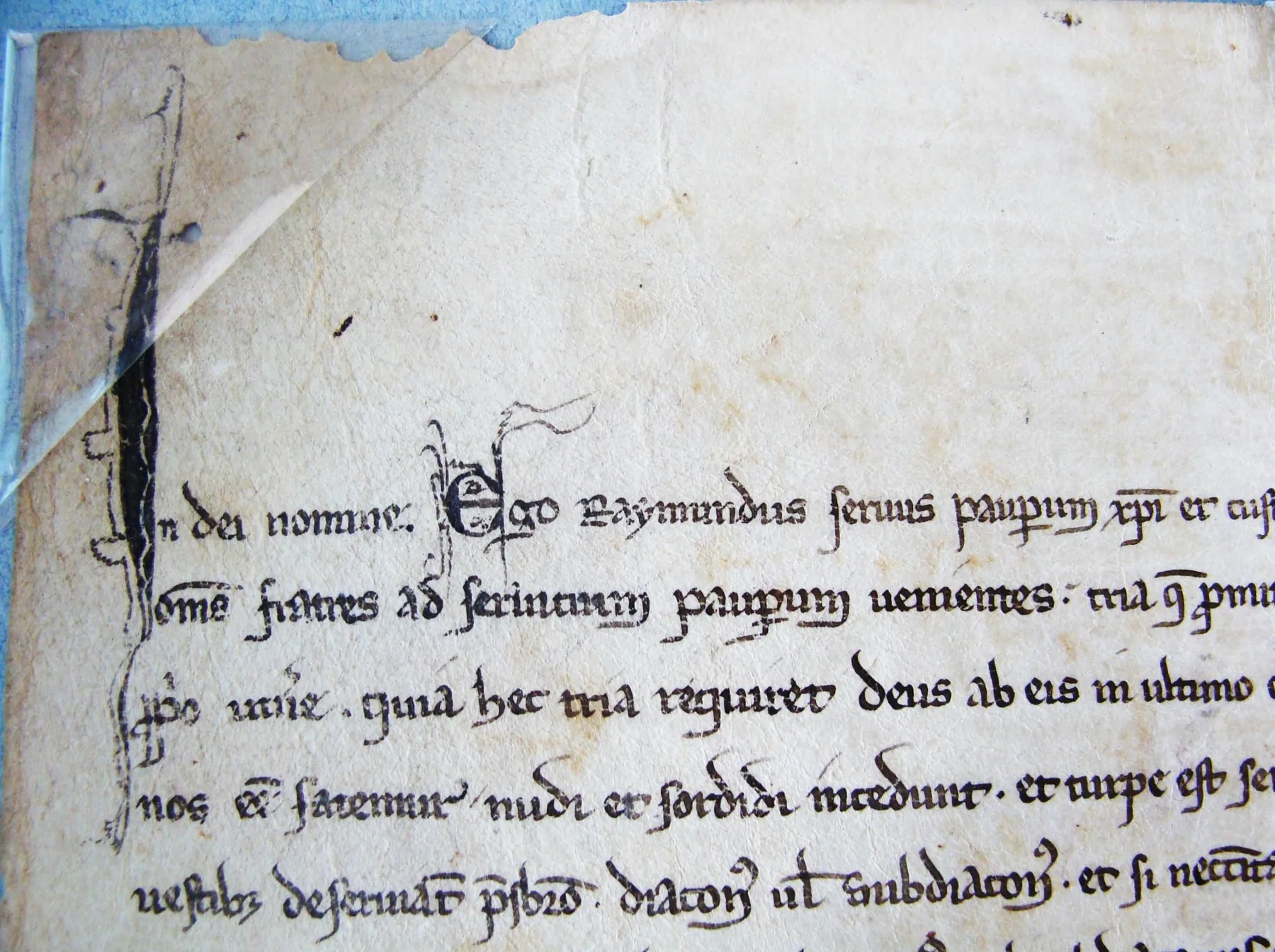
In the Rule of the Order of St. John, the sick are first called "Poor Christ" (pauperes Christi) in the Western Church.
Later, this expression entered common usage:
Thus, various popes used the term " Poor Christ " in several bulls:
Even secular rulers used this term:
King Baldwin I of Jerusalem in the year 1110492
Emperor Frederick Barbarossa in the year 1158493or
King Baldwin III of Jerusalem in the year 1160494.
In the deeds of gift of William Ferrariis495and Raoul le Fun496(1165–1172) the sick are referred to as “Holy Poor”.
These concepts are closely and profoundly connected with the spirituality of the Order of St. John, which – as explained above – admits the sick person as a full member into the “community of saints” of the hospital.
Chapter 6 is also part of the propers of the Rule of the Order of St. John.
Sending alms to "the poor of the hospital" in Jerusalem has always been the shared responsibility of the religious orders' branches for the motherhouse, the hospital in Jerusalem, known as "responsions".
This leads us to the third, most characteristic new element in the spiritual heritage of the Order of St. John: Hospitality in its particular form and its particular authenticity in the Order of St. John.
 Picture497
Interior view of a hospital
of the Order of St. John.
Copper engraving by Rasmäsler, 1828,
after Rarnberg.
3. Hospitality
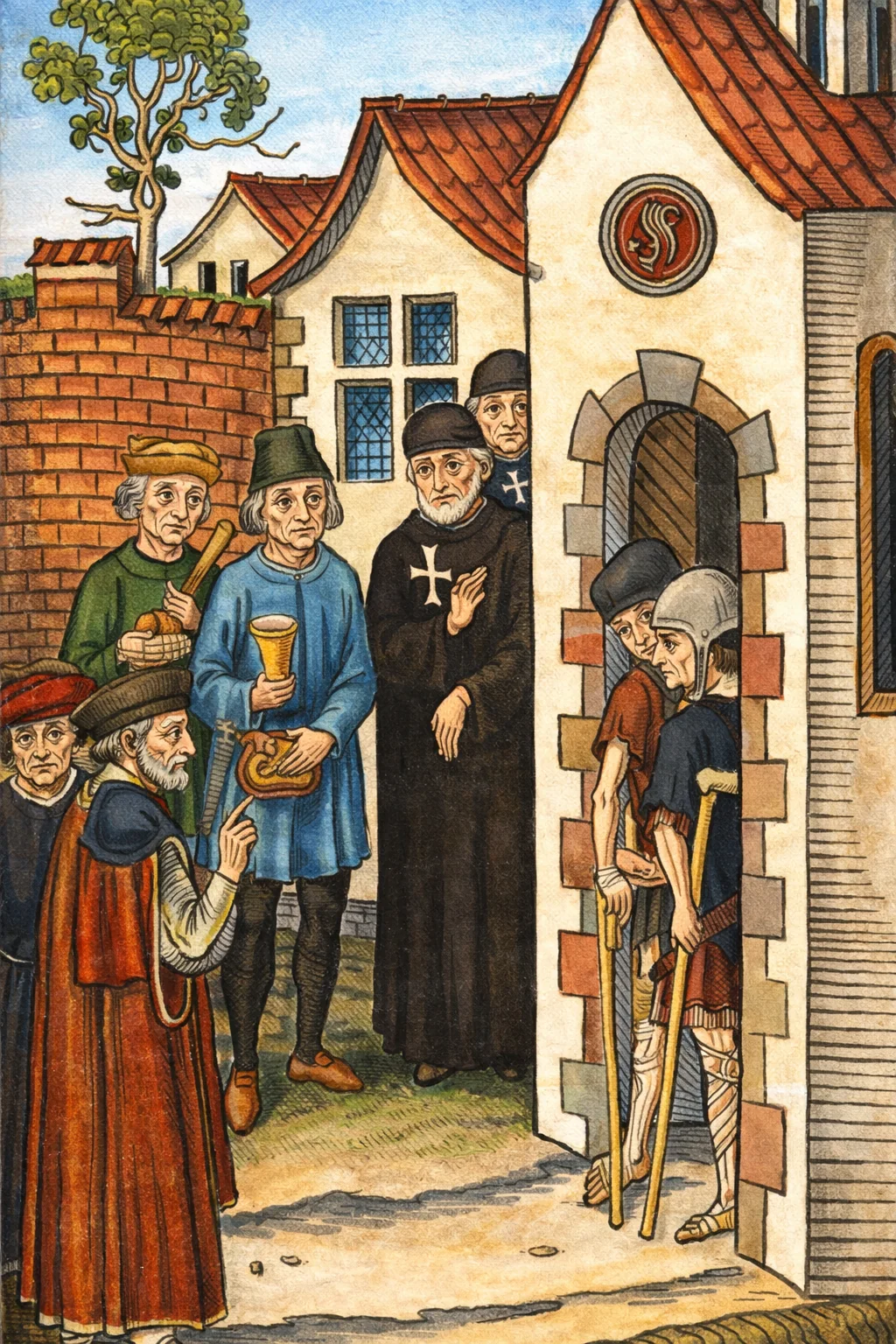
The Order of St. John was the first order to make hospitality its main task .
It is the oldest and for centuries was the only regular aid institution in the West .
Precursors were
the Roman valetudinaria for the care of sick slaves in order to maintain their labour power and
the xenodochia , which were established in large numbers over time by the bishops for the care of the sick and elderly, based on a recommendation of the Council of Nicaea in 325,
But the Order of St. John is the first religious order whose central task and focus was the care of the poor and sick, and which carried out this service on a large scale.
The rule of the Order of St. John does not yet include a vow of hospitality.
It was only in the customary law of the Order around 1239 that the admission ceremony for new members was described in chapter 121.
Here it says:
"You promise and vow to God and Our Lady,
as well as to our gracious Lord, St. John the Baptist,
To live and die in obedience means to be obedient to every sovereign God will give you.
You also promise to live chastely until death.
You also promise to live without owning property .
But we make yet another promise
that no one else makes: for you promise
to be servants and slaves to our sick masters .”
If we now consider this as a fourth religious vow or an additional promise, it is certainly a profound innovation, for such a promise appears for the first time in the history of religious orders alongside the vows to live according to the evangelical counsels, as we find in our day in the Hospitaller Order of St. John of God (Brothers of Mercy)499.
As I have described in detail above, the hospitality of the Order of St. John is, in its innermost essence, spirituality. Service to the
"poor of Christ" is spiritual service. This is evidenced by Chapter 3 of the Rule, which belongs to its independent body of material. There, visiting the sick, including administering Holy Communion to the sick, is taken for granted, and only liturgical regulations have been established for it.
I am convinced that the conception of charity as the worship of God, which then as now constitutes the essential aim of religious orders, was the driving force that has preserved the Order through the severe storms of its history, unlike other religious orders of chivalry 500. The Order of St. John was the first order to make hospitality its principal task. It was sometimes proudly described as the oldest and for centuries the only regular charitable organisation in the West .501It rightly deserves the honour of being the oldest hospitaller order in the world.
“The order founded by Gérard anticipated for many centuries all subsequent organisations dedicated to the care of the poor and sick.”502
 Also noteworthy and novel in this context is to whom the service was directed. While the Augustinian and especially the Benedictine Rule () 503primarily aim at attaining salvation through service to God and neighbour (504), the main goal of the Rule of the Order of St. John is the selfless striving for the salvation of one's neighbour, that is, the poor and the sick. The latter is certainly not the result of a comprehensive dogmatic-exegetical reflection on fundamental principles but rather owes itself to an early Christian impulse. The desire for one's own salvation certainly plays a major role for a brother of the Order of St. John, but the Order's activity is directed far more clearly outwardly, that is, toward the sick, in an altruistic way.
Blessed Gérard
in the Hospital of Jerusalem505
 4. The Origin of the Rule of the Order of St. John
One final novel aspect is the different origin of the Rule of the Order of St. John compared to older monastic rules. In the Rule of St. Augustine and the Rule of St. Benedict, the founder of the order provides practically and theoretically grounded precepts for a God-pleasing monastic life. The Rule of the Order of St. John, on the other hand, is a theoretical and theological reflection on the practice of the order, written down because this practice has proven correct and has thus been standardized. That is to say, the rule is not merely theory to be put into practice, but a philosophy of lived experience, whose norms will also govern future practice.
 What is also unusual in this context is that the order's rule itself and all its appended statutes are always authorized by the entire General Chapter and not just by the founder or his successors, the Hospitallers. These are early signs of a democratic structure in the legislation of a religious order. Thus, the veneration of Blessed Gérard or his successor Raymond du Puys as the order's founder receded into the background compared to the great veneration of St. John, the chosen patron saint. This fact, too, is unknown in any other ancient order.
Picture506